1. How did the tiny MINERVA-II rovers move across Ryugu's rocky surface?
2. Which country's space agency sent the Hayabusa2 spacecraft to Ryugu?
🤯 Mind-Blowing Fact • Grade 2
Each tiny hop by the MINERVA-II rovers floated up to fifty feet across Ryugu and stayed airborne for fifteen whole minutes before drifting back down!
✨ Word Sparks (Grade 2 Glossary)
Tap 🔊 to hear
subsurface
Material hidden underneath the top ground layer
impactor
Heavy object fired to carve a crater
pristine
Clean, fresh, and completely unchanged over time
🪝
How did a Japanese spacecraft dig a fresh crater on Ryugu to scoop up underground rocks?
1
Twin to Bennu, Twice as Wide
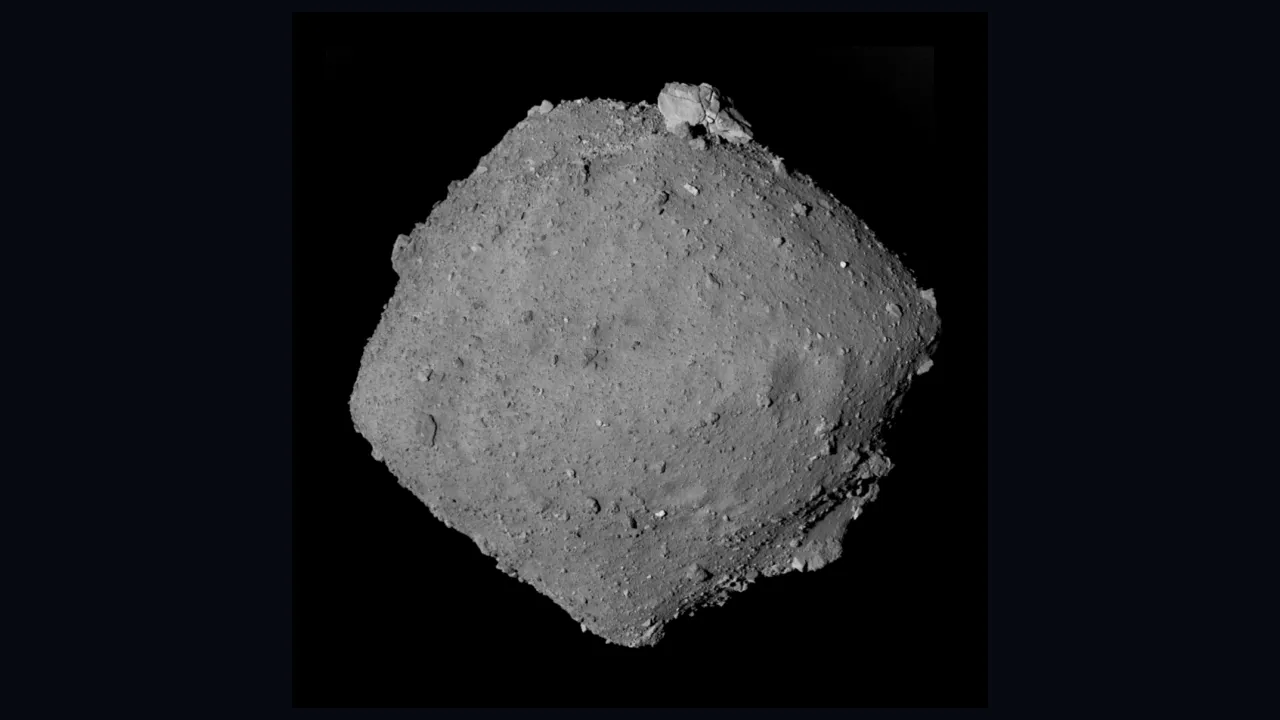
Found in 1999 just four months before Bennu, 162173 Ryugu looks like Bennu's bigger sibling! Measuring almost 3,000 feet wide with a sharp ridge around its middle, this dark rubble pile takes sixteen months to circle the Sun.
2
Hopping Robots and a Space Cannonball
When Japan's Hayabusa2 arrived in 2018, it dropped three hopping robots that snapped history's first action photos from an asteroid's surface! Next, Hayabusa2 hid safely behind Ryugu while firing a baseball-sized copper ball to blast a fresh 45-foot crater.
3
Two Scoops of Ancient Dust
Gathering both surface gravel and fresh underground pebbles from that new crater, Hayabusa2 delivered 5.4 grams of black treasure to Australia in December 2020!
1. Why did Hayabusa2 blast an artificial crater onto Ryugu before its second touchdown?
2. Where did Ryugu's name come from?
🤯 Mind-Blowing Fact • Grade 3
Ryugu's boulders are surprisingly fluffy and lightweight—filled with so many microscopic airless pores that they would crumble like freeze-dried coffee if squeezed hard!
✨ Word Sparks (Grade 3 Glossary)
Tap 🔊 to hear
porous
Full of tiny holes and empty spaces
uracil
One of four chemical letters inside RNA
JAXA
Japan's national aerospace exploration space agency
🪝
Why did Ryugu's returned space pebbles contain vitamins and building blocks of genetic code?
1
Darker Than Charcoal
Picture hovering twelve miles above an asteroid covered in jagged boulders darker than charcoal! When 's Hayabusa2 reached 162173 Ryugu in June 2018, cameras showed its 2,950-foot diamond body reflects less than 2 percent of incoming sunlight.
2
MINERVA-II and MASCOT Landings
Because Ryugu's surface gravity is eighty thousand times weaker than Earth's, wheels would simply spin and launch a rover into space. Instead, Japanese MINERVA-II hoppers and the European MASCOT lander used internal spinning arms to hop gently across boulders, measuring fragile, rocks.
3
Surface vs. Underground Samples
In February 2019, Hayabusa2 fired a tiny tantalum pellet at touch-down to kick surface gravel into its collector horn. In April, its Small Carry-on Impactor blasted out buried material for a July second grab, parachuting 5.4 grams to Woomera, Australia in December 2020.
4
Uracil and Vitamin B3 in Space
Inside Ryugu's sealed grains, scientists discovered water-bearing clays, amino acids, vitamin B3 (niacin), and —one of the four chemical letters of RNA!
1. What surprising life-related molecules did scientists find inside Ryugu's returned samples?
2. How did Hayabusa2 loosen gravel during its brief touch-and-go landings?
🤯 Mind-Blowing Fact • Grade 4
Tiny microscopic bubbles inside a crystal returned from Ryugu still held liquid carbonated water trapped 4.5 billion years ago—older than Earth itself!
✨ Word Sparks (Grade 4 Glossary)
Tap 🔊 to hear
CI chondrite
Rarest, most chemically unaltered type of meteorite
space weathering
Surface changes caused by solar wind and micrometeoroids
carbonated
Water holding dissolved carbon dioxide gas
🪝
How could an asteroid cruising right past warm Earth actually have been born out beyond Neptune?
1
Matching the Rarest Meteorites on Earth
Out of more than seventy thousand meteorites in museum collections worldwide, fewer than ten belong to an ultra-rare, chemically primitive group called —rocks whose element ratios match the Sun itself! When laboratories opened Hayabusa2's 5.4-gram capsule from 162173 Ryugu in 2021, X-ray and electron microscopes revealed a stunning match: unweathered Ryugu grains are pristine CI-chondrite cousins, darker and more intact than any specimen altered by Earth's damp air.
2
Isotopes from the Outer Solar System
Even though Ryugu orbits between Earth and Mars today, iron and chromium isotopes inside its clay minerals tell an epic travel story. Those isotopic fingerprints match icy comets and outer giant-planet worlds rather than inner rocky planets—proving Ryugu's icy parent formed beyond Jupiter and Saturn over 4.5 billion years ago!
3
Liquid Carbon Dioxide Trapped in Crystal
Microscopic bubbles trapped inside Ryugu iron-sulfide crystals even still hold tiny droplets of ancient liquid water! Because carbon dioxide ice only stays frozen solid far past the solar nebula's deep outer frost line, those tiny liquid bubbles confirm Ryugu's parent world coalesced in the chilly outskirts near Uranus and Neptune.
4
Space Weathering Caught in the Act
Comparing Hayabusa2's weathered top-layer chamber against its pristine artificial-crater chamber showed how solar wind and micrometeoroids strip surface oxygen and bake hydrated clays—solving a decades-old mismatch between telescope spectra and museum meteorites.
1. What clue inside Ryugu's crystals proved its parent body originally formed in the cold outer Solar System?
2. Why did collecting BOTH surface pebbles and artificial-crater subsurface pebbles help astronomers so much?
🤯 Mind-Blowing Fact • Grade 5
After dropping off its Ryugu sample capsule at Earth in December 2020, Hayabusa2 still had half its xenon ion fuel left—so it is cruising right now on an extended mission to visit a tiny, fast-spinning 100-foot asteroid in 2031!
✨ Word Sparks (Grade 5 Glossary)
Tap 🔊 to hear
phyllosilicate
Sheet-layered clay mineral containing bound water
fluid inclusion
Microscopic droplet of ancient liquid inside crystal
photosphere
Visible glowing outer surface of the Sun
🪝
How did JAXA's dual-chamber sample return from 162173 Ryugu rewrite the history of Solar System mixing?
1
Engineering Triumph at a Spinning-Top Rubble Pile
Building upon Japan's pioneering Hayabusa1 return of silicate dust from asteroid Itokawa, JAXA launched Hayabusa2 in December 2014 toward Cg-type Apollo asteroid 162173 Ryugu. Arriving in June 2018, instruments mapped an oblate 900-meter spinning top—its sharp equatorial Ryujin Dorsum ridge sculpted by ancient YORP-driven fast rotation—with a bulk density of 1,190 kilograms per cubic meter and over 50 percent microporosity. Deploying the hopping MINERVA-II1 rovers and Franco-German MASCOT lander proved Ryugu's boulder-choked surface utterly lacked fine dust ponds.
2
Explosive Crater Excavation and Dual Sampling
To sample both space-weathered regolith and pristine interior rock, Hayabusa2 executed two autonomous touchdowns. After collecting Chamber A grains using a five-gram tantalum projectile in February 2019, the mothership deployed a standalone deployable camera (DCAM3) and tucked safely behind Ryugu while its Small Carry-on Impactor detonated a shaped charge, firing a two-kilogram copper liner at two kilometers per second! Excavating the 14.5-meter artificial crater 'Omusubi-Kororin' exposed subsurface material harvested into Chamber C that July before the sealed capsule landed at Woomera on December 6, 2020—while Hayabusa2 zoomed onward toward tiny rapid-rotator 1998 KY26.
3
Unaltered Ivuna-Type (CI) Cosmochemistry
Laboratory analyses of the 5.424-gram cache revealed volatile-rich (serpentine and saponite clays), carbonates, magnetite framboids, and zero high-temperature chondrules—matching solar photospheric abundances closer than any rock ever studied, free of terrestrial sulfate oxidation.
4
Nucleobases, Presolar Grains, and Trans-Saturnian Birth
Chronological dating via manganese-chromium isotopes indicates aluminum-26 decay melted water ice inside Ryugu's parent planetesimal roughly five million years after Solar System birth, gently stewing rocks at 37 degrees Celsius. Nucleosynthetic iron-54 anomalies, trapped CO2-bearing inside pyrrhotite crystals, uracil, niacin, and fragile presolar stardust grains converge on a startling origin: Ryugu's ancestor condensed near Uranus and Neptune before giant-planet migration scattered fragments into the Polana or Eulalia Main-Belt families.
5
Two Cousins, Two Stories: Ryugu and Bennu
Paired side-by-side with NASA's Bennu cache, Ryugu demonstrates how distinct outer-nebula reservoirs delivered prebiotic organics and water across the terrestrial planet zone.