1. Easy memory trick: what does the 'C' in cones help you see in bright light?
2. Why do colorful toys look mostly gray in a very dark bedroom?
🤯 Mind-Blowing Fact • Grade 2
Astronomers use a cool stargazing trick: looking slightly beside a faint star aims its light onto your sensitive rods so the star pops into view!
✨ Word Sparks (Grade 2 Glossary)
Tap 🔊 to hear
cylinder
Straight tube shape like a tiny rod
sensitive
Able to notice even tiny faint clues
stargazing
Watching stars shine in the night sky
🪝
How did two tiny eye cells get named after geometric shapes from math class?
1
Shapes Under a Microscope
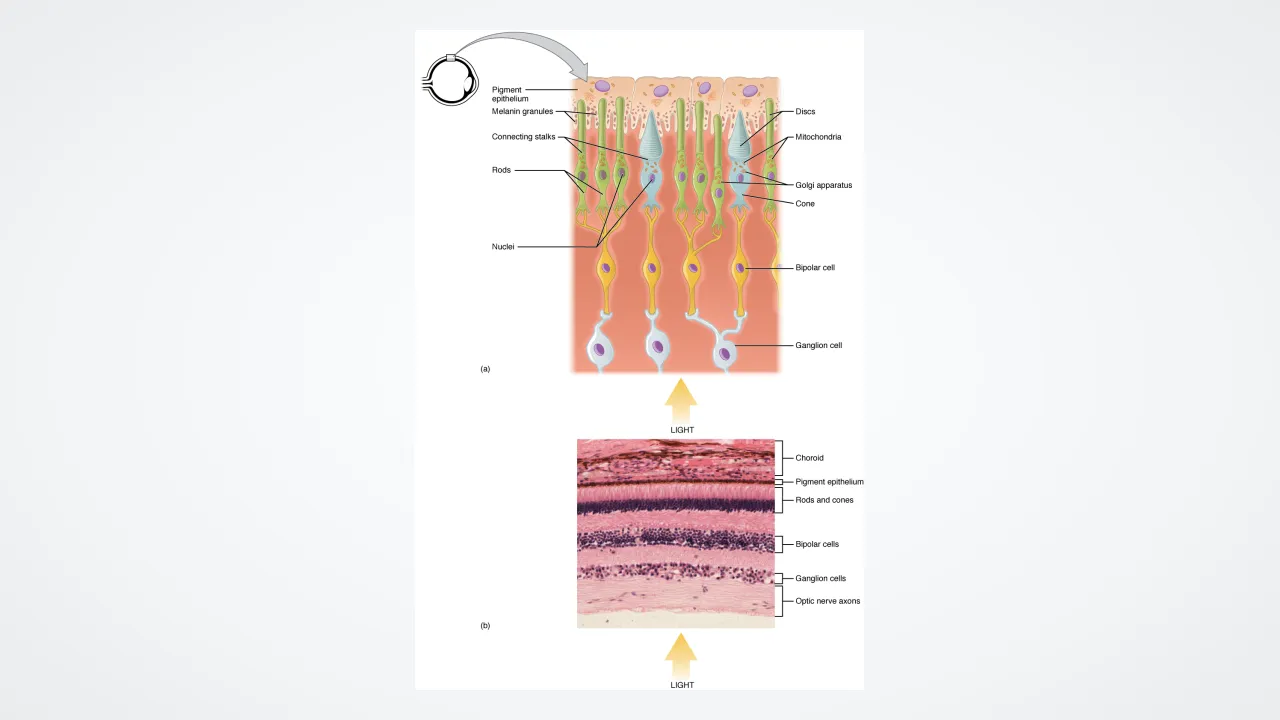
Peek at the back of an eye through a powerful microscope and you will spot millions of tiny cells shaped just like straight and pointy ice-cream cones! That is how rods and cones earned their fun names.
2
Three Cones Mix Every Color
Six million cones crowd mostly into the bullseye center of your retina. Three kinds of cones respond to red, green, and blue light—mixing together in your brain to paint millions of bright daytime colors!
3
One Hundred Twenty Million Night Guards
Spread around the outer edges sit 120 million super- rods. They spot twinkling stars and side-of-the-eye motion whenever evening grows dark.
1. Which three light colors do your cone cells team up to mix?
2. Why does looking slightly to the side of a super-faint star help you spot it at night?
🤯 Mind-Blowing Fact • Grade 3
While humans mix colors with three cone types, many birds, turtles, and butterflies carry FOUR cone types—letting them see glowing ultraviolet patterns on flowers invisible to us!
✨ Word Sparks (Grade 3 Glossary)
Tap 🔊 to hear
rhodopsin
Light-sensitive pigment powering rod night vision
adaptation
Adjusting smoothly to brand-new surrounding conditions
ultraviolet
Short-wave light beyond violet humans cannot see
🪝
Why does it take twenty minutes in a dark campsite before hidden stars suddenly fill the sky?
1
Day Shift Versus Night Shift
Step out of a bright cabin into a dark forest campsite, and at first you can barely see your own sneakers! Wait fifteen to twenty minutes, though, and silver tree trunks and thousands of stars appear. You just experienced the handoff between your daytime cones and nighttime rods!
2
Rhodopsin: The Night-Vision Molecule
Each of your 120 million rods holds stacks of tiny discs filled with a purplish pigment called . Bright sunshine bleaches rhodopsin pale so rods rest all day. Once darkness falls, your eyes steadily rebuild fresh rhodopsin—boosting night sensitivity thousands of times in a process called dark !
3
Trichromatic Color Mixing
During daytime, six million cones run the show inside your central fovea. Short-wave (blue), medium-wave (green), and long-wave (red) cones compare incoming light so your brain distinguishes ripe strawberries from green leaves.
4
Why Some People See Colors Differently
If someone inherits red and green cones tuned very close together—common in about one in twelve boys—certain shades look similar, a harmless trait called color vision deficiency!
1. Why do your eyes need 15 to 20 minutes to reach full night vision at a dark campsite?
2. How many types of color-sensing cones do most humans have, compared with four in many birds?
🤯 Mind-Blowing Fact • Grade 4
Experiments proved that a fully dark-adapted human rod cell can fire a measurable electrical response after catching just ONE single photon—the smallest unit of light in the universe!
✨ Word Sparks (Grade 4 Glossary)
Tap 🔊 to hear
peripheral
Outer side vision away from exact center
opsin
Protein pocket holding light-catching retinal molecules
chromosome
Packaged DNA strand carrying inherited traits
🪝
Why do submarine crews and backyard astronomers use dim RED flashlights to read maps in the dark?
1
Why Red Flashlights Save Night Vision
Climb aboard a submarine at night or visit a hilltop telescope party, and every map flashlight glows deep ruby red! That clever trick comes straight from comparing rods and cones. Your daytime L-cones detect long red wavelengths easily so you can read star charts clearly—yet your rod cells' rhodopsin pigment barely notices deep red light at all! Because red rays don't bleach rhodopsin, you can look right back up at faint galaxies without waiting twenty minutes to dark-adapt again.
2
Pooling Signals Versus One-to-One Detail
Wiring differences explain why cones read tiny letters while rods rule twilight. Inside your central fovea, each individual cone gets its own private telephone line to a relay neuron, preserving razor-sharp detail. Out in the retina, up to a hundred rods pool their whispers onto one shared ganglion cell—sacrificing crispness so faint glimmers add up into a detectable signal!
3
Daily Housekeeping Stacks
Every photoreceptor stacks roughly a thousand membrane discs packed with proteins. Each morning at dawn, worn tip discs pinch off and get recycled by neighboring pigment cells while fresh discs grow from the base!
4
X-Chromosome Color Genetics
Because the genes for red and green cone sit side by side on the X , boys (XY) experience red-green color differences much more often than girls (XX).
1. Why do astronomers use dim red flashlights to read star maps at night?
2. Why are rod cells much better at spotting faint starlight than reading tiny letters?
🤯 Mind-Blowing Fact • Grade 5
Look closely at a real rainbow and you will NEVER find magenta—magenta is an 'extra-spectral' color constructed purely by your brain when blue S-cones and red L-cones fire together while green M-cones stay quiet!
✨ Word Sparks (Grade 5 Glossary)
Tap 🔊 to hear
scotopic
Dim-light vision powered solely by rod cells
photopic
Bright-light color vision powered by cones
dichromat
Animal seeing color with two cone types
🪝
How do three cone absorption peaks at 420, 534, and 564 nanometers trick your brain into seeing colors like magenta that don't even exist in a rainbow?
1
Max Schultze and Duplicity Theory
In 1866, German microscopic anatomist Max Schultze compared the retinas of nocturnal owls and bats against diurnal lizards and songbirds, founding the 'duplicity theory' of vision: vertebrate sight pairs two complementary receptor systems! (night) vision relies on ~120 million cylindrical rods peaking in sensitivity around blue-green 498-nanometer light, whereas (daylight) vision deploys ~6 million tapered cones packed up to 200,000 per square millimeter inside the rod-free foveola.
2
Young-Helmholtz Trichromacy and Spectral Peaks
Early physicists Thomas Young and Hermann von Helmholtz predicted that three receptor classes could synthesize the entire visible spectrum long before molecular biologists sequenced the opsin genes! Human S-cones peak near 420 nanometers (violet-blue), M-cones near 534 nanometers (emerald-green), and L-cones near 564 nanometers (yellow-green/red). Because an individual cone is 'color-blind' on its own—counting photons without labeling wavelength—your brain deduces hue by comparing ratios across all three cone classes, even inventing non-spectral 'magenta' when S- and L-cones fire without M-cones!
3
The Purkinje Shift at Twilight
Watch a rose garden at dusk and witness the Purkinje effect discovered by Czech physiologist Jan Evangelista Purkyně in 1825: as sunlight fades into twilight (mesopic vision) and rods take over from L-cones, red petals suddenly darken toward black while blue delphiniums and green leaves appear luminously bright!
4
Amplification Cascades Inside Outer Segments
How can one photon trigger a rod? Within its stacked outer-segment discs, a single activated rhodopsin molecule triggers hundreds of transducin G-proteins, activating phosphodiesterase enzymes that hydrolyze thousands of cyclic GMP molecules—slamming sodium channels shut in a million-fold biochemical amplifier!
5
Evolution of Primate Color Vision
Most non-primate mammals—including dogs and deer—are with only two cone types; our ancestor primates duplicated an opsin gene on the X chromosome tens of millions of years ago, gifting us vivid red-green vision ideal for spotting ripe fruit against forest canopies!