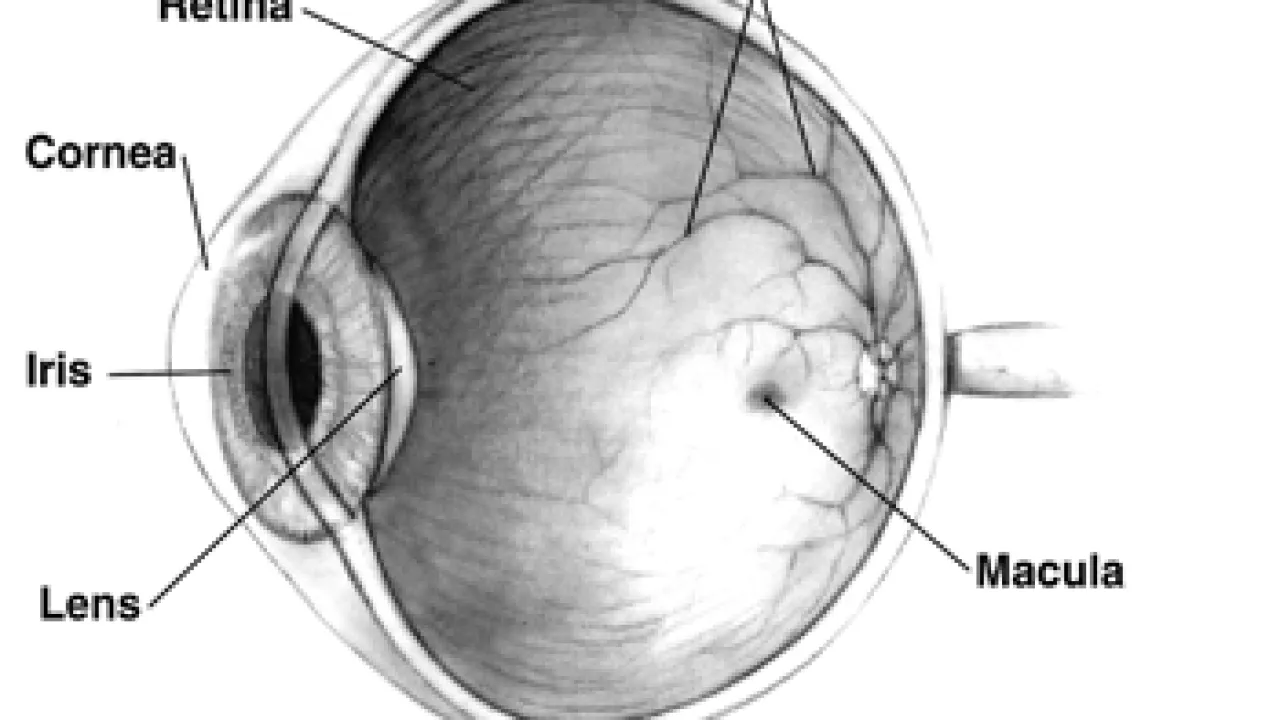
1. How do pictures first land on the retina at the back of your eye?
2. Where inside your eye is the retina located?
🤯 Mind-Blowing Fact • Grade 2
When an eye doctor shines a gentle light through your pupil, your retina is the ONLY living brain tissue visible from outside the body!
✨ Word Sparks (Grade 2 Glossary)
Tap 🔊 to hear
sensor
A part catching light or touch clues
detail
Tiny crisp shapes and fine lines
bullseye
The exact middle spot of a target
🪝
How does a tissue-paper layer at the back of your eye turn sunlight into electrical thoughts?
1
Wallpaper That Can See
Picture standing inside a hollow round ball lined with glowing magic wallpaper! Across the back wall of each eyeball sits your retina—thinner than a dime, yet busier than a digital camera .
2
Flipping Light Into Sparks
After your front cornea and inner lens bend incoming light rays, a tiny upside-down picture lands cleanly on the retina. More than one hundred twenty million light-catching cells instantly turn those light rays into tiny electrical signals!
3
The Bullseye Spot
Right in the center sits a tiny zone that lets you read small book letters and thread needles with super-sharp .
1. What does the retina turn focused light rays into so your brain can understand them?
2. What helps you read tiny letters on a page so clearly?
🤯 Mind-Blowing Fact • Grade 3
Gram for gram, your hard-working retina uses even MORE oxygen and energy per minute than the rest of your thinking brain!
✨ Word Sparks (Grade 3 Glossary)
Tap 🔊 to hear
photoreceptor
A specialized cell catching rays of light
fovea
Tiny central retinal pit for sharpest sight
photon
A single tiny packet of light energy
🪝
Why does a ten-layer tissue thinner than an index card count as an outpost of your actual brain?
1
A Piece of Brain Inside Your Eye
Touch the side of your forehead and think about this cool fact: before you were born, two little buds grew straight out of your developing brain to form the retinas of your eyes! Because of that origin, your retina doesn't just snap pictures—it starts sorting edges, colors, and motion before sending reports back home.
2
Ten Microscopic Layers
Even though your entire retina is barely a quarter-millimeter thick, a microscope reveals ten neat cellular layers stacked like a club sandwich! —famous rod and cone cells—catch of light and pass messages forward through mini-computing neurons.
3
Macula and Fovea: Sharpest Vision
Near the center of the retina lies an oval region called the macula, with a tiny pit at its heart called the . Whenever you read comic books or spot a hawk high in the sky, your eye muscles aim light straight into that ultra-sharp fovea!
4
Why Inverted Images Feel Normal
Convex eye lenses cross light rays so images hit the retina upside down and backward, yet your visual cortex seamlessly interprets up as up!
1. Why do neuroscientists classify the retina as part of your central nervous system?
2. Which tiny pit at the center of your retina's macula gives you razor-sharp reading vision?
🤯 Mind-Blowing Fact • Grade 4
Octopuses and squids evolved camera-like eyes independently with photoreceptors facing forward—meaning octopuses have zero blind spot, while humans get superior blood nourishment right behind our sensors!
✨ Word Sparks (Grade 4 Glossary)
Tap 🔊 to hear
epithelium
Protective sheet of cells lining a surface
choroid
Blood-vessel-rich layer nourishing the outer retina
compression
Packing huge information neatly into smaller signals
🪝
Why did vertebrate eyes wire their light sensors at the VERY BACK of the retina behind clear layers of nerves?
1
The Surprising 'Inverted' Retina Puzzle
Design a smartphone camera and you would put light sensors right in front and tuck circuit wires behind them. Surprisingly, human and vertebrate retinas are built the opposite way! Incoming light glides through transparent layers of ganglion and bipolar relay neurons first before striking the rod and cone photoreceptors parked against the back wall. Why? Because photoreceptors burn colossal amounts of energy and constantly shed worn-out light discs—so parking them snug against the nutrient-rich retinal pigment and blood supply keeps them fed and recycled nonstop!
2
Clearing the Way at the Fovea
What about ultra-sharp central reading where even transparent nerve layers might scatter a tiny bit of light? Evolution solved that brilliantly at the fovea centralis—a 1.5-millimeter pit where overlying relay neurons and blood vessels sweep politely aside like parted stage curtains, letting light strike tightly packed cones with zero obstacles!
3
Smart Data Compression On-Site
Roughly 126 million rods and cones catch raw light, yet only about 1.2 million optic nerve fibers leave each eye—a hundred-to-one funnel! Horizontal, bipolar, and amacrine cells inside the retina compress that flood into smart summaries of contrast, color edges, and motion.
4
Why Carrots Really Help Eyes
Dark pigment cells behind the retina recycle vitamin A—plentiful in orange carrots and leafy greens—to rebuild fresh light-catching molecules every single second!
1. What major advantage comes from parking human photoreceptors against the back wall of the retina?
2. How does the fovea centralis give you extra-crisp central focus?
🤯 Mind-Blowing Fact • Grade 5
It takes less than two hundred femtoseconds—two ten-trillionths of a second—for a light-hit retinal molecule inside your eye to snap straight and kick off the chemistry of sight!
✨ Word Sparks (Grade 5 Glossary)
Tap 🔊 to hear
phototransduction
Converting absorbed light photons into electrical signals
ophthalmoscope
Lighted medical tool inspecting the living retina
contrast
Clear difference between neighboring light and dark
🪝
How did strapping upside-down prism goggles onto volunteers prove that your retina and brain construct visual reality together?
1
Phototransduction: Turning Photons Into Code
Named from the Latin 'rete' ('net') by ancient Alexandrian anatomist Herophilus because its delicate vessels resembled a fisherman's net, the human retina operates as a ten-layered neural supercomputer just 250 micrometers thick. When a single photon strikes vitamin-A-derived retinal nestled inside an opsin protein, the molecule snaps from bent 11-cis-retinal to straight all-trans-retinal in mere femtoseconds! Counterintuitively, photoreceptors release steady glutamate in darkness and hyperpolarize—quiet down—when illuminated, tipping off downstream ON- and OFF-bipolar neurons.
2
Center-Surround Edge Detection
Rather than transmitting raw pixel brightness like a basic webcam, retinal circuits compute ! Nobel Prize-winning studies by Haldan Keffer Hartline, Ragnar Granit, and Stephen Kuffler revealed 'center-surround' receptive fields: horizontal and amacrine interneurons compare each spot against its neighbors, firing vigorously at crisp light-dark borders, color contrasts, and sudden motion while ignoring uniform glare.
3
Parallel Channels to the Brain
Over twenty distinct types of retinal ganglion cells sort visual scenes into parallel streams before axons exit at the optic disc. Midget (parvocellular) pathways carry high-resolution color detail from the foveola, parasol (magnocellular) pathways track rapid movement, and melanopsin-containing ganglion cells measure sky brightness to set your circadian clock.
4
George Stratton's Upside-Down Goggles
In the 1890s, psychologist George Stratton wore special inverting prism lenses for eight straight days that flipped images upright onto his retina—making the world initially appear upside down! Within five days, his adaptive brain rewired his perception until he could walk and pour tea normally.
5
Retinal Scans and Bionic Implants
Because retinal arterioles and venules are directly visible through an —invented by Hermann von Helmholtz in 1851—physicians check cardiovascular and neurological health painlessly, while modern engineers test microelectronic retinal prostheses and optogenetic therapies to restore sight.