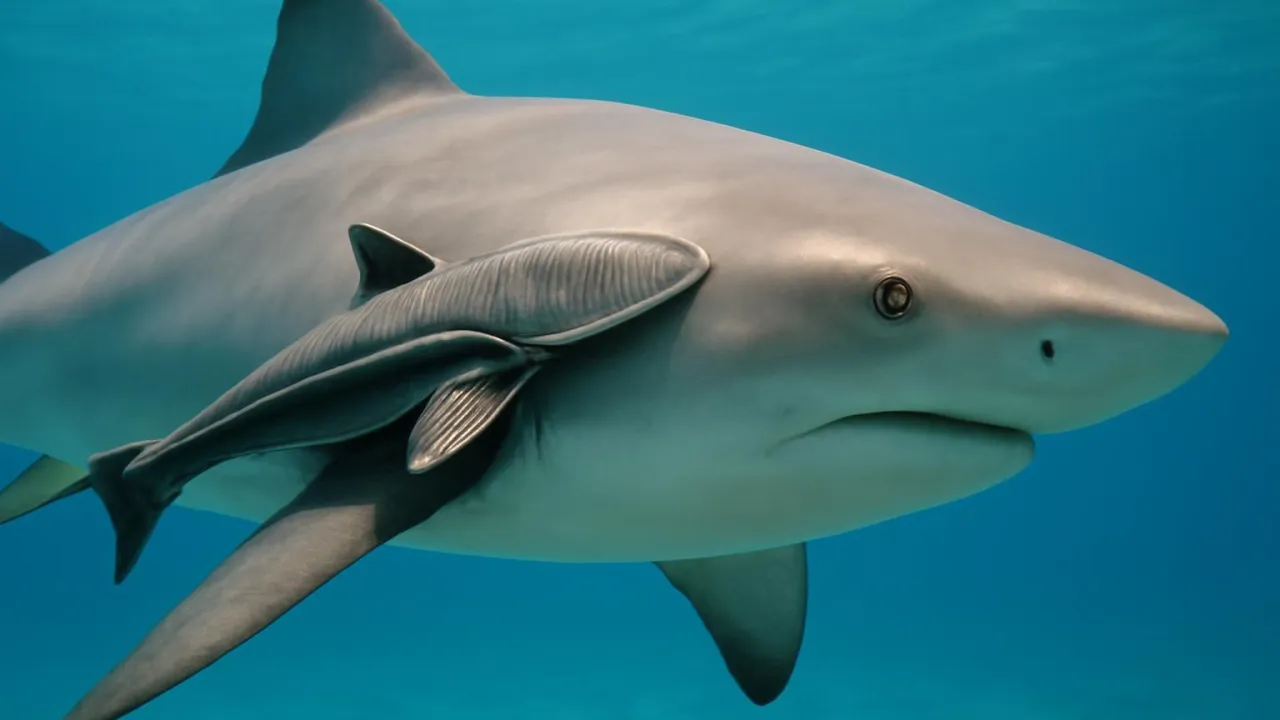
Remoras can swim up to 20 miles per hour while holding on tight!
✨ Word Sparks (Grade 2 Glossary)
Tap 🔊 to hear
suction
A strong pull that holds things tight
parasite
A tiny bug that lives on animals
host
An animal that another lives on or with
🪝
Have you ever seen a fish that rides on other fish?
1
How Remoras Stick
Remoras have a flat, sticky disk on their heads that helps them hold tight to bigger fish. This disk acts like a strong cup. It lets the remora stay attached even when the big fish swims fast. This way, the remora can travel without using much energy.
2
Where Remoras Live
Remoras live in warm oceans all around the world. They like to stay close to big fish like sharks, turtles, and whales. These big animals swim long distances, so remoras get to explore many places. The ocean is their home, and they find food by riding along.
3
What Remoras Eat
Remoras eat small leftover food scraps from their . They also clean tiny off the big fish’s skin. This helps keep the big fish healthy. The remora gets food, and the big fish gets cleaned. It is a helpful friendship for both.
Remoras can travel hundreds of miles by hitching rides on ocean giants!
✨ Word Sparks (Grade 3 Glossary)
Tap 🔊 to hear
symbiotic
A helpful relationship between two animals
camouflage
Colors or shapes that help hide animals
parasite
A small animal that lives on others
🪝
How does a remora use its suction disk to survive in the ocean?
1
The Suction Disk Adaptation
Remoras have a unique suction disk on top of their heads that acts like a natural suction cup. This disk allows them to attach firmly to larger marine animals such as sharks, turtles, and whales. By holding on tightly, remoras can travel long distances without using much energy. This adaptation helps them avoid predators and find food easily.
2
Remora’s Role in the Ecosystem
Remoras feed on leftover scraps and found on their hosts. This behavior helps keep the host animals clean and healthy by removing harmful parasites. This relationship benefits both the remora and the larger animal. The remora gains food and protection, while the host gets cleaned.
3
Camouflage and Protection
Remoras often have dark, streamlined bodies that help them blend into the ocean water. Their shape reduces water resistance, allowing them to swim quickly when needed. When attached to a host, they are protected from many predators. Their and suction disk work together to keep them safe.
4
Life Cycle and Growth
Remoras start life as free-swimming larvae in the ocean. As they grow, they develop the suction disk needed for attachment. Juvenile remoras search for suitable hosts to hitch rides on. This attachment is crucial for their survival and growth into adults.
1. What does the remora’s suction disk help it do?
2. How does the remora help its host?
🤯 Mind-Blowing Fact • Grade 4
Remoras can remain attached to fast-swimming sharks at speeds over 20 miles per hour!
✨ Word Sparks (Grade 4 Glossary)
Tap 🔊 to hear
mutualistic
Both animals help each other
vacuum
A space with no air that pulls tight
parasite
A small animal that can harm others
🪝
Why do remoras form symbiotic relationships with large marine animals across oceans?
1
Adaptation Through Suction Disk
Remoras have evolved a specialized suction disk on their heads that allows them to attach securely to large marine animals such as sharks, turtles, and whales. This adaptation reduces their energy expenditure by enabling them to hitch rides instead of swimming long distances. The disk’s structure creates a seal that keeps the remora attached even in strong ocean currents.
2
Ecological Role and Mutual Benefits
Remoras engage in a symbiotic relationship where both the remora and the host benefit. The remora feeds on leftover food scraps and removes from the host’s skin, which improves the host’s health. This cleaning behavior helps maintain the balance of the marine ecosystem by reducing parasite loads on large animals.
3
Geographic Distribution and Habitat
Remoras are found in warm ocean waters worldwide, including the Atlantic, Pacific, and Indian Oceans. They prefer tropical and subtropical regions where large marine animals are abundant. Their ability to attach to various hosts allows them to travel vast distances and adapt to different marine environments.
4
Cause and Effect of Host Attachment
By attaching to large hosts, remoras gain protection from predators and access to food resources without expending much energy. This cause-and-effect relationship benefits remoras by increasing their survival chances. However, remoras do not harm their hosts, which is why the hosts tolerate their presence.
1. What benefit do remoras get by attaching to hosts?
2. Where do remoras mostly live?
🤯 Mind-Blowing Fact • Grade 5
Remoras evolved a suction disk from dorsal fin rays, a unique adaptation among fishes.
✨ Word Sparks (Grade 5 Glossary)
Tap 🔊 to hear
lamellae
Thin plates inside the suction disk
ectoparasite
Parasites living on the outside of animals
coevolution
When two species evolve together over time
🪝
How do remoras’ unique adaptations enable their survival and ecological role in marine environments worldwide?
1
Taxonomy and Scientific Classification
Remoras belong to the family Echeneidae and the genus Remora, with the scientific name Remora remora. They are ray-finned fishes classified under the order Perciformes. Their evolutionary adaptations, particularly the suction disk, distinguish them from other fish species. This disk evolved from modified dorsal fin rays and is a key taxonomic characteristic.
2
Physiological Mechanics of the Suction Disk
The remora’s suction disk functions through a series of that create a vacuum seal on the host’s body surface. This mechanism allows the remora to maintain attachment even at high swimming speeds exceeding 20 miles per hour. The disk’s flexibility and muscular control enable quick attachment and release, facilitating efficient hitchhiking on various marine animals.
3
Ecological Role and Symbiotic Relationships
Remoras play an important ecological role by engaging in mutualistic relationships with large marine animals such as sharks, turtles, and whales. By feeding on and leftover food, remoras contribute to the health of their hosts and the overall marine ecosystem. This symbiosis exemplifies and ecosystem balance in ocean habitats.
4
Conservation and Human Impact
Although remoras are not currently endangered, their populations can be affected by overfishing and habitat degradation. Pollution and climate change also threaten marine ecosystems where remoras live. Protecting ocean habitats and large marine animals indirectly supports remora survival and biodiversity.
5
Quantitative Comparisons and Behavior
Remoras can grow up to three feet long and weigh around 10 pounds, which is small compared to their hosts like sharks that can exceed 15 feet. They can maintain attachment at speeds over 20 miles per hour and travel hundreds of miles by hitching rides. Their ability to conserve energy while traveling long distances is a remarkable evolutionary advantage.