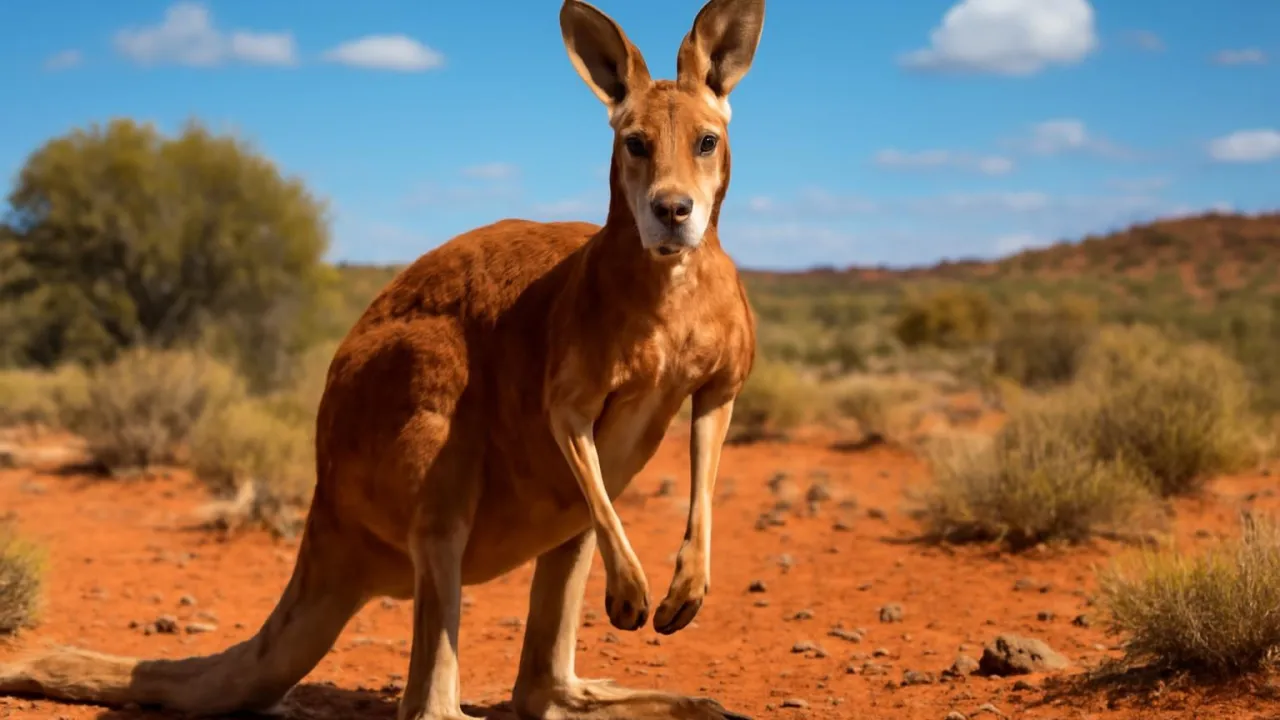
Red kangaroos are the largest marsupials and can leap faster than a car on a city street!
✨ Word Sparks (Grade 2 Glossary)
Tap 🔊 to hear
marsupial
Animal with a pouch for babies
predator
An animal that hunts other animals
shelter
A safe place to rest or hide
🪝
Have you ever wondered how far a red kangaroo can jump?
1
Amazing Jumpers
Red kangaroos use their strong legs to jump very far and very fast. They can leap over 30 feet in one jump. Their long tails help them keep balance while hopping. This helps them move quickly across the dry land.
2
Where They Live
These kangaroos live in the hot deserts and open plains of Australia. They find under bushes or trees during the hottest parts of the day. At night, they come out to eat fresh grasses and shrubs. They drink water when it rains or from small waterholes.
3
Their Red Fur
Red kangaroos have soft red fur that helps them stay warm when it is cold. Their fur also protects them from the hot sun. The fur color helps them blend in with the dry red soil and sand. This keeps them safe from .
1. Why do red kangaroos use their tails when they hop?
2. Where do red kangaroos live?
🤯 Mind-Blowing Fact • Grade 3
Red kangaroos can reach speeds up to 35 miles per hour when hopping!
✨ Word Sparks (Grade 3 Glossary)
Tap 🔊 to hear
camouflage
Colors that help animals hide
herbivore
An animal that eats only plants
pouch
A pocket on a mother’s belly for babies
🪝
Did you know the red kangaroo is the largest hopping animal on Earth?
1
Powerful Legs and Tail
Red kangaroos have powerful hind legs that allow them to leap great distances. Their long tails act as a counterbalance and help with stability during fast hops. This adaptation helps them escape predators quickly. Their strong legs also help them cover large areas while searching for food.
2
Living in Harsh Deserts
These marsupials live in the arid deserts and grasslands of Australia. They seek shade during the hottest parts of the day to avoid overheating. Their fur color provides by blending with the red soil and dry grasses. This helps protect them from predators like dingoes and eagles.
3
Eating Plants and Surviving
Red kangaroos are that feed mostly on grasses and shrubs. They get most of their water from the plants they eat, which helps them survive in dry habitats. Their digestive system is adapted to extract nutrients efficiently from tough desert plants. This allows them to thrive where water is scarce.
4
Marsupial Babies in the Pouch
Female red kangaroos carry their babies, called joeys, in a on their belly. The joey stays in the pouch for several months to grow and develop safely. This pouch protects the young from harsh weather and predators. It also allows the mother to move quickly while caring for her baby.
Red kangaroos can leap over 30 feet in a single bound and reach speeds faster than many cars on city streets.
✨ Word Sparks (Grade 4 Glossary)
Tap 🔊 to hear
ecosystem
A community of plants and animals living together
predator
An animal that hunts other animals for food
adaptation
A body part or behavior that helps survival
🪝
How does the red kangaroo’s unique body help it survive Australia’s harsh environment?
1
Adaptations for Speed and Balance
Red kangaroos have evolved powerful hind legs that enable them to leap great distances at speeds up to 35 miles per hour, which helps them escape . Their long, muscular tails provide crucial balance and support when hopping or standing upright, allowing them to maintain stability on uneven desert terrain. This combination of speed and balance is essential for survival in open habitats with few places to hide.
2
Role in the Ecosystem
As herbivores, red kangaroos play an important role in controlling grass and shrub growth, which helps maintain the balance of their . They serve as prey for native like dingoes and wedge-tailed eagles, contributing to the food web. Additionally, their grazing habits help disperse seeds, promoting plant growth and biodiversity in arid regions.
3
Geographic Range and Habitat
Red kangaroos are found across most of Australia’s arid and semi-arid interior, including deserts and open plains. They avoid dense forests and coastal areas where food is less available. Their ability to survive with little water allows them to thrive in these dry, hot environments where few other large mammals can live.
4
Human Impact and Conservation
While red kangaroos are not currently endangered, habitat loss and hunting have affected some populations. They are sometimes managed through regulated hunting to balance populations and protect farmland. Conservation efforts focus on preserving their natural habitats and ensuring sustainable coexistence with human activities.
1. Why are red kangaroos important in their ecosystem?
2. What helps red kangaroos survive in dry places?
🤯 Mind-Blowing Fact • Grade 5
Red kangaroos can hop faster than 35 miles per hour and leap more than 30 feet in one bound!
✨ Word Sparks (Grade 5 Glossary)
Tap 🔊 to hear
marsupial
Mammal with a pouch for carrying babies
locomotion
The way animals move from place to place
metabolism
How the body uses food and water
🪝
What makes the red kangaroo a remarkable example of marsupial adaptation in Australia’s deserts?
1
Scientific Classification and Evolution
The red kangaroo, scientifically named Osphranter rufus, belongs to the family Macropodidae, which means 'big foot.' This species evolved unique adaptations for life in arid Australian environments over millions of years. like the red kangaroo carry their young in pouches, a trait that distinguishes them from placental mammals. Their evolutionary success is linked to their specialized and reproductive strategies.
2
Physiological Mechanics of Movement
Red kangaroos use their large, muscular hind legs to generate powerful leaps that can cover distances exceeding 30 feet in a single bound. Their elastic tendons store energy during landing, which reduces muscular effort and increases efficiency at high speeds up to 35 miles per hour. The tail acts as a fifth limb, providing balance and support during slow movements and acting as a prop when standing.
3
Conservation Status and Human Interaction
Although red kangaroos are classified as Least Concern by conservation authorities, they face threats from habitat fragmentation and hunting. Population control measures include regulated harvesting to prevent overgrazing and protect agricultural lands. Conservation programs aim to maintain stable populations while educating the public about the species’ ecological importance.
4
Ecological Role and Adaptations
As dominant herbivores in Australia’s arid zones, red kangaroos influence plant community dynamics through selective grazing. Their ability to survive with minimal water intake is aided by efficient kidneys and metabolic adaptations that reduce water loss. Their distinctive reddish fur provides camouflage against the desert soil, helping avoid predation from dingoes and birds of prey.
5
Quantitative Comparisons and Records
Adult male red kangaroos can weigh up to 200 pounds (90 kilograms) and stand nearly 6 feet (1.8 meters) tall. Their hopping speed of 35 miles per hour (56 kilometers per hour) rivals that of some small cars in urban traffic. They can leap distances over 30 feet (9 meters), which is far greater than any other . These impressive physical feats demonstrate their specialized adaptations for survival.