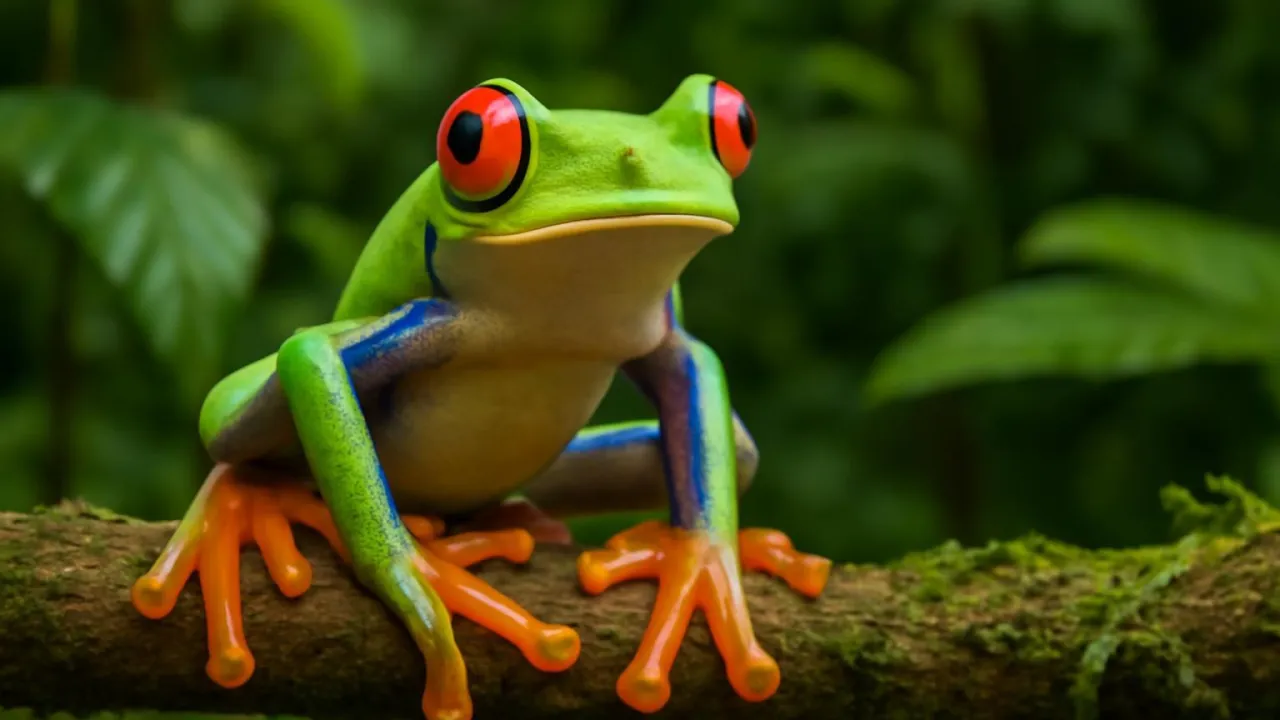
When scared, the frog opens its big red eyes wide to startle predators!
✨ Word Sparks (Grade 2 Glossary)
Tap 🔊 to hear
camouflage
Colors that help animals hide
predator
An animal that hunts other animals
rainforest
A wet forest with many animals
🪝
Did you know this frog’s eyes can surprise its enemies?
1
Bright and Colorful
The red-eyed tree frog has bright red eyes and green skin. Its orange toes help it climb trees easily. These colors help it hide in the leaves.
2
Rainforest Home
This frog lives in the warm, wet of Central America. It spends most of its time high up in the trees. At night, it searches for insects to eat.
3
Eating Bugs
The frog uses its sticky tongue to catch insects like flies and crickets. It is very quick and can jump far to catch food. Eating bugs helps it stay healthy and strong.
This frog’s red eyes flash open suddenly to scare away hungry predators!
✨ Word Sparks (Grade 3 Glossary)
Tap 🔊 to hear
nocturnal
Active at night, sleeps in the day
deimatic
A way to scare animals by surprise
adaptation
A trait that helps animals survive
🪝
How does the red-eyed tree frog’s bright eyes help it survive?
1
Colorful Camouflage
The frog’s bright green skin helps it blend with rainforest leaves. Its orange toes and blue sides add colorful camouflage. When resting, it tucks its bright parts away to avoid predators. This helps it stay safe during the day.
2
Nighttime Hunter
This frog is , meaning it is active at night. It hunts insects like crickets and flies using a sticky tongue. Its large red eyes help it see well in the dark. This helps it catch enough food to survive.
3
Startling Defense
If a predator approaches, the frog suddenly opens its red eyes wide. This startles the predator and gives the frog time to jump away. This defense is called behavior. It helps the frog escape danger quickly.
4
Rainforest Habitat
The red-eyed tree frog lives in Central American rainforests. It spends most of its life in trees, where it lays eggs on leaves above water. The rainforest provides nutrients and moisture needed for its survival. This ecosystem is vital for the frog’s life cycle.
The frog’s sudden red eye flash is a clever defense that helps it survive many predator attacks.
✨ Word Sparks (Grade 4 Glossary)
Tap 🔊 to hear
deimatic
A surprise action to scare animals
ecosystem
All living things and their home
deforestation
Cutting down many trees in forests
🪝
Why does the red-eyed tree frog’s bright eyes help it survive in the rainforest?
1
Camouflage and Color
The red-eyed tree frog’s green skin blends perfectly with rainforest leaves, hiding it from predators during the day. Its bright orange toes and blue sides are hidden when resting, but these colors help it blend into the colorful rainforest environment. This camouflage protects it from predators and helps it survive in a dense .
2
Startling Defense Mechanism
When threatened, the frog suddenly opens its large red eyes to startle predators, giving it a chance to escape. This behavior confuses predators and reduces attacks. The frog then uses its strong legs to leap far away, avoiding danger quickly. This defense is vital in the competitive rainforest food web.
3
Role in the Rainforest Ecosystem
The red-eyed tree frog plays an important role in the rainforest by controlling insect populations, eating crickets and flies. It also serves as prey for larger animals like snakes and birds, fitting into the food web. Its presence helps maintain balance in this rich . Human activities like threaten its habitat and survival.
4
Geographic Range and Habitat
This frog is native to Central American rainforests, from southern Mexico to northern Colombia. It prefers humid, warm environments with plenty of trees and water. The rainforest’s moisture supports its skin and breeding needs. Conservation efforts focus on protecting these habitats to ensure the frog’s future.
The red-eyed tree frog can leap six feet to escape predators, more than twice its body length!
✨ Word Sparks (Grade 5 Glossary)
Tap 🔊 to hear
arboreal
Lives mostly in trees
aposematic
Bright colors that warn predators
deimatic
Surprising action to scare animals
🪝
How do the red-eyed tree frog’s unique features help it survive in Central America’s rainforests?
1
Taxonomy and Scientific Classification
The red-eyed tree frog, scientifically named Agalychnis callidryas, belongs to the family Phyllomedusidae. It is an amphibian known for its vibrant coloration and lifestyle. This species is closely related to other leaf frogs native to Central and South America. Its classification helps scientists study its evolutionary adaptations and ecological role.
2
Physiological Adaptations and Mechanics
This frog’s large red eyes contain specialized pigments that help it see in low light during its nocturnal activities. Its suction-cup-like orange toe pads allow strong adhesion to smooth leaves and branches. The frog’s skin secretes mucus to keep it moist, crucial for respiration through the skin. Its powerful hind legs enable impressive jumps up to 6 feet (1.8 meters) to evade predators.
3
Behavior and Defense Strategies
When threatened, the frog exhibits behavior by suddenly revealing its bright red eyes to startle predators. This momentary surprise allows it to leap away quickly and hide. The frog’s bright colors also serve as signals, warning predators of possible toxicity. These combined defenses increase its chances of survival in a predator-rich environment.
4
Ecological Role and Conservation Status
The red-eyed tree frog plays a vital role in controlling insect populations within its rainforest ecosystem. It serves as prey for snakes, birds, and larger amphibians, maintaining balanced food webs. Habitat destruction from deforestation poses a significant threat to its populations. Conservation efforts include habitat protection and environmental education to preserve this species.
5
Quantitative Comparisons and Habitat Details
Adult red-eyed tree frogs measure about 2 to 3 inches (5 to 7.5 centimeters) in length and weigh approximately 0.5 ounces (14 grams). They inhabit humid rainforests with temperatures ranging from 70 to 85 degrees Fahrenheit (21 to 29 degrees Celsius). Their jumping ability can reach distances up to 6 feet (1.8 meters), which is over twice their body length. These quantitative traits highlight their impressive adaptations.