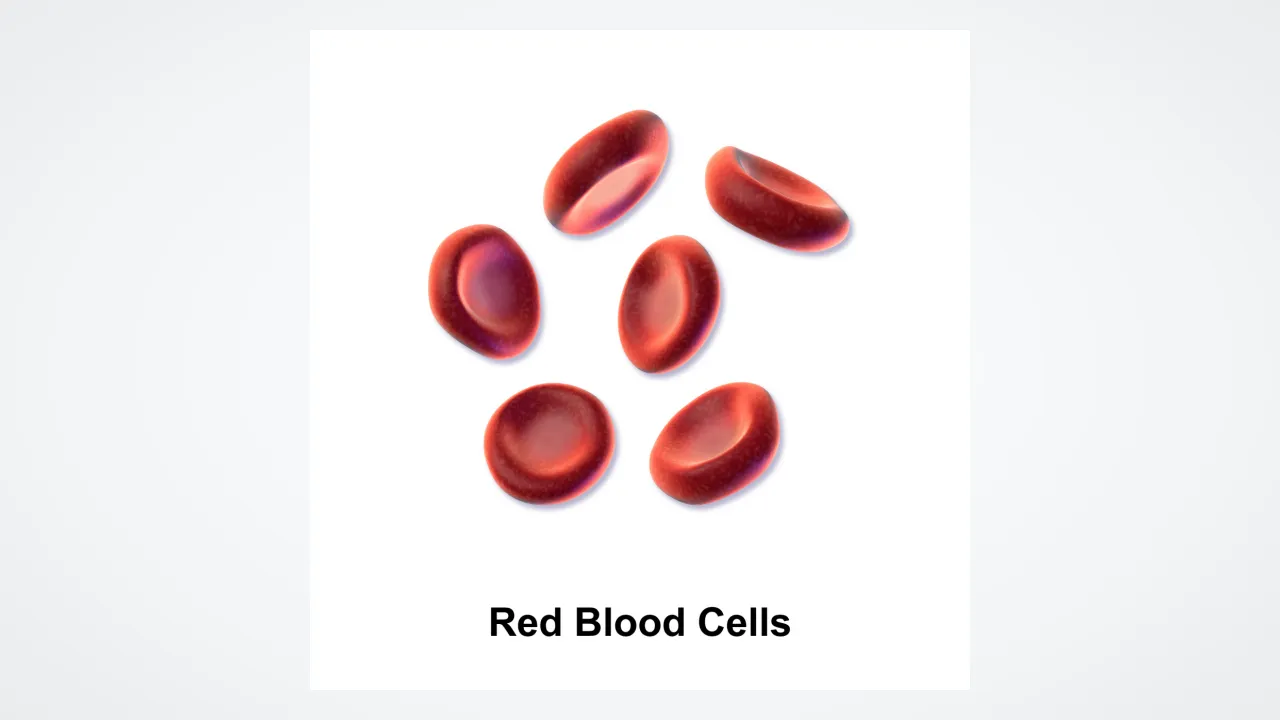
1. What fun food shape does a red blood cell look like?
2. What special cargo do red blood cells pick up inside your lungs?
🤯 Mind-Blowing Fact • Grade 2
More than two-thirds of ALL the trillions of cells in your entire human body are red blood cells!
✨ Word Sparks (Grade 2 Glossary)
Tap 🔊 to hear
bone marrow
soft spongy center of bones making blood
hemoglobin
iron-packed red protein that carries oxygen
iron
helpful mineral from foods like spinach and beans
🪝
Did you know new red blood cells are born deep inside the middle of your bones?
1
Born Inside Bone Marrow
Tap gently on your hip or breastbone! Hidden inside the spongy center of many bones is a busy workshop called red . Every single second, your marrow builds more than two million brand-new red blood cells!
2
Iron Magnets for Oxygen
Each red blood cell is stuffed full of a special -rich protein called . Like a friendly magnet, iron grabs oxygen in your lungs—giving blood its rich red color, just like iron makes rusty bikes reddish!
3
Four Months on the Road
One red blood cell races around your body for about four months before retiring so fresh young cells can take its place.
2. What mineral inside hemoglobin gives red blood cells their red color and grabs oxygen?
🤯 Mind-Blowing Fact • Grade 3
One single red blood cell completes a full lap from your heart, through your body, and back again in only twenty to sixty seconds!
✨ Word Sparks (Grade 3 Glossary)
Tap 🔊 to hear
erythrocyte
scientific medical name for a red blood cell
biconcave
curved inward on both top and bottom
spleen
organ near stomach that recycles worn blood
🪝
Why do red blood cells throw away their own control center before entering your bloodstream?
1
Making Extra Cargo Room
Almost every cell in your body keeps a round control center called a nucleus—except mature red blood cells! Scientists call them , and right before leaving bone marrow, each young cell ejects its nucleus to make room for 270 million hemoglobin molecules!
2
Why Dimpled Discs Work Best
Why are red blood cells shaped like discs—plump around the rim and pinched thin in the center—instead of round marbles? That pinched shape creates thirty percent more surface area so oxygen molecules can zip in and out instantly!
3
Never Eating What They Carry
Mature red blood cells also toss out their mitochondria power plants! That means they never burn up a single molecule of the precious oxygen they are delivering to your brain and muscles.
4
Smart Recycling After 120 Days
Without a nucleus to make repairs, wear out after about 120 days. Cleanup cells in your and liver carefully save and recycle every atom of iron for new blood cells!
1. Why does a mature red blood cell get rid of its nucleus and mitochondria?
2. What happens to the precious iron inside a red blood cell after 120 days?
🤯 Mind-Blowing Fact • Grade 4
Why does a bruise slowly change colors from purplish-red to green to yellow as it heals? Cleanup cells are breaking down leftover hemoglobin pigments step by step—first into greenish biliverdin and then into yellow bilirubin!
✨ Word Sparks (Grade 4 Glossary)
Tap 🔊 to hear
heme
iron-holding ring inside hemoglobin that binds oxygen
erythropoietin
kidney hormone ordering marrow to make red cells
carbonic anhydrase
fast enzyme helping blood transport carbon dioxide
🪝
Why do athletes training high in the Rocky Mountains build billions of extra red blood cells?
1
One Billion Oxygen Seats Per Cell
Do the quick math inside a single 7.5-micrometer red blood cell: it holds roughly 270 million hemoglobin proteins, and each hemoglobin features four iron-centered pockets that grab one oxygen molecule apiece. That means one microscopic erythrocyte ferries over one billion oxygen molecules on every trip from your lungs!
2
Springy Spectrin Skeletons
During its 120-day career, a red blood cell travels roughly three hundred miles and squeezes through capillaries narrower than itself hundreds of thousands of times! A springy meshwork of proteins—led by spectrin and actin—lines the inner cell membrane so the disc can fold like a soft taco and snap right back without popping.
3
Ferrying Carbon Dioxide Home Too
Dropping off oxygen is only half the shift. Inside tissues, a lightning-fast enzyme inside red blood cells——converts cell waste carbon dioxide and water into harmless bicarbonate ions dissolved in blood plasma, then flips them back into carbon dioxide gas at the lungs so you can exhale!
4
High-Altitude Kidney Signals
Hike up to thin mountain air, and special oxygen sensors inside your kidneys notice immediately! They release a hormone called (EPO) that tells red bone marrow to ramp up red blood cell production so every breath captures more oxygen.
1. Which organ senses thin mountain air and releases EPO hormone to boost red blood cell production?
2. How many oxygen molecules can a single hemoglobin protein hold at once?
🤯 Mind-Blowing Fact • Grade 5
Every single second of your life, your bone marrow launches 2.4 million brand-new red blood cells while your spleen retires 2.4 million worn-out ones—keeping twenty-five trillion cells in pinpoint balance!
✨ Word Sparks (Grade 5 Glossary)
Tap 🔊 to hear
Bohr effect
acid and carbon dioxide prompting oxygen release
erythropoiesis
bone marrow process of building red blood cells
antigen
surface marker defining A, B, AB, O blood
🪝
How does a protein machine inside red blood cells know to grab oxygen tightly in your lungs yet let go generously in hot muscles?
1
Cooperative Allostery of Hemoglobin
Numbering roughly twenty-five trillion in an adult—nearly eighty percent of all human cells—anucleate erythrocytes rely on anaerobic glycolysis so they consume zero oxygen while transporting ninety-eight percent of arterial O2. In 1962, chemist Max Perutz won the Nobel Prize for X-ray crystallography showing how tetrameric hemoglobin (two alpha and two beta globin chains) breathes mechanically: when the first O2 binds one ferrous (Fe2+) heme inside oxygen-rich alveoli, the protein clicks from its tense state to a relaxed state, making it hundreds of times easier for the next three O2 molecules to jump aboard!
2
The Bohr Effect: Smart Unloading on Demand
Equally brilliant is how erythrocytes know precisely where to unload cargo. Discovered in 1904 by Danish physiologist Christian Bohr (father of physicist Niels Bohr), the uses metabolic waste as an automatic release trigger! Hard-working muscles generate heat, carbon dioxide, and lactic acid protons (lowering local pH), which nudge hemoglobin back toward its tense shape—releasing extra oxygen right into the hungriest tissues while carbonic anhydrase converts CO2 into plasma bicarbonate.
3
ABO Antigens on the Membrane
Studded across every erythrocyte's lipid bilayer are millions of glycoprotein sugar trees that define human blood types—discovered by Karl Landsteiner in 1901 (Type A, B, AB, and O, plus Rh factor), turning blood transfusions into safe, lifesaving medicine.
4
Erythropoiesis to Macrophage Recycling
Driven by renal erythropoietin, hematopoietic stem cells in axial bone marrow mint 2.4 million reticulocytes per second, which mature into erythrocytes before splenic macrophages retire them at 120 days—shipping salvaged iron via transferrin back to marrow and converting heme rings into bile pigments.
5
Microscopes and Evolutionary Trade-Offs
First glimpsed in 1658 by Dutch naturalist Jan Swammerdam and measured accurately in 1674 by Antonie van Leeuwenhoek, erythrocytes even reveal genetics in action: Linus Pauling showed in 1949 that a single amino-acid swap causes sickle-cell hemoglobin—the very first 'molecular condition' ever identified, preserved in tropical regions because carrying one copy shields against malaria.