👷 CAREERS
💼 Quantum Mechanics, Atomic Physics & Quantum Computing
VA Economics, Civics & Career Readiness SOL K.8, 1.8, 2.8, 3.9
Quantum Physicist
Exploring the Wild Rules of Atoms and Light
Grade 2 • Developing • 96 words
🧭 Career FieldPhysics Research Labs, Quantum Computing Companies & Universities
🛠️ Key Tools & SkillsPrecision lasers, vacuum chambers, ultra-cold refrigerators, mirrors, and math equations
🏢 WorkplaceVibration-free laser optics tables, cleanrooms, and national laboratories
⚡ Everyday Impact SparkHarnesses the surprising behavior of single atoms and light particles to build tomorrow's computers and sensors
🤯 Mind-Blowing Fact • Grade 1
About one million atoms lined up side by side would barely be as thick as one single sheet of notebook paper!
✨ Word Sparks (Grade 1 Glossary)
Tap 🔊 to hear
atom
Tiny building block making up all matter
laser
A focused, single-color beam of bright light
particle
An extremely tiny speck of something
🪝
What are rocks, water, air, and even your shoes made of up super close?
1
Zoom Way, Way In!
Look at your fingertip. Now zoom in a million times! Everything around us is built from teeny-tiny bits called . Studying those tiny building blocks is the job of a quantum physicist.
2
Lasers and Light
Inside a cool lab, ruby-red and emerald-green criss-cross a metal table. Mirrors bounce beams of light to catch one single at a time!
3
Powering Cool Tech
Discoveries about gave us barcode scanners, LED lights, and computer chips!
1. What tiny building blocks does a quantum physicist study?
2. Which everyday tool exists thanks to scientists studying atoms and light?
🤯 Mind-Blowing Fact • Grade 2
Labs built by quantum physicists are the coldest places in the known universe—chilled hundreds of degrees colder than outer space so atoms stop jiggling!
✨ Word Sparks (Grade 2 Glossary)
Tap 🔊 to hear
quantum
The smallest possible packet of energy
photon
One single tiny packet of light
electron
A tiny negatively charged bit inside atoms
🪝
Why do tiny atoms act totally differently than baseballs and bicycles?
1
Welcome to the Tiny World
Throw a baseball and you can watch its smooth curve across the grass. Zoom down smaller than a speck of dust, however, and nature follows surprising new rules! Exploring that microscopic rulebook is the adventure of a physicist.
2
Waves and Tiny Packets
The word '' means a tiny, exact packet of energy. At this scale, light can ripple like water waves in a pond and bounce like tiny marbles called ! Scientists use ultra-cold chambers and laser traps to hold single atoms completely still.
3
Helping Everyday Life
discoveries power solar panels on rooftops, hospital MRI body scanners, and super-accurate atomic clocks!
1. Why do quantum physicists chill some experiments colder than outer space?
2. What do scientists call one single packet of light?
🤯 Mind-Blowing Fact • Grade 3
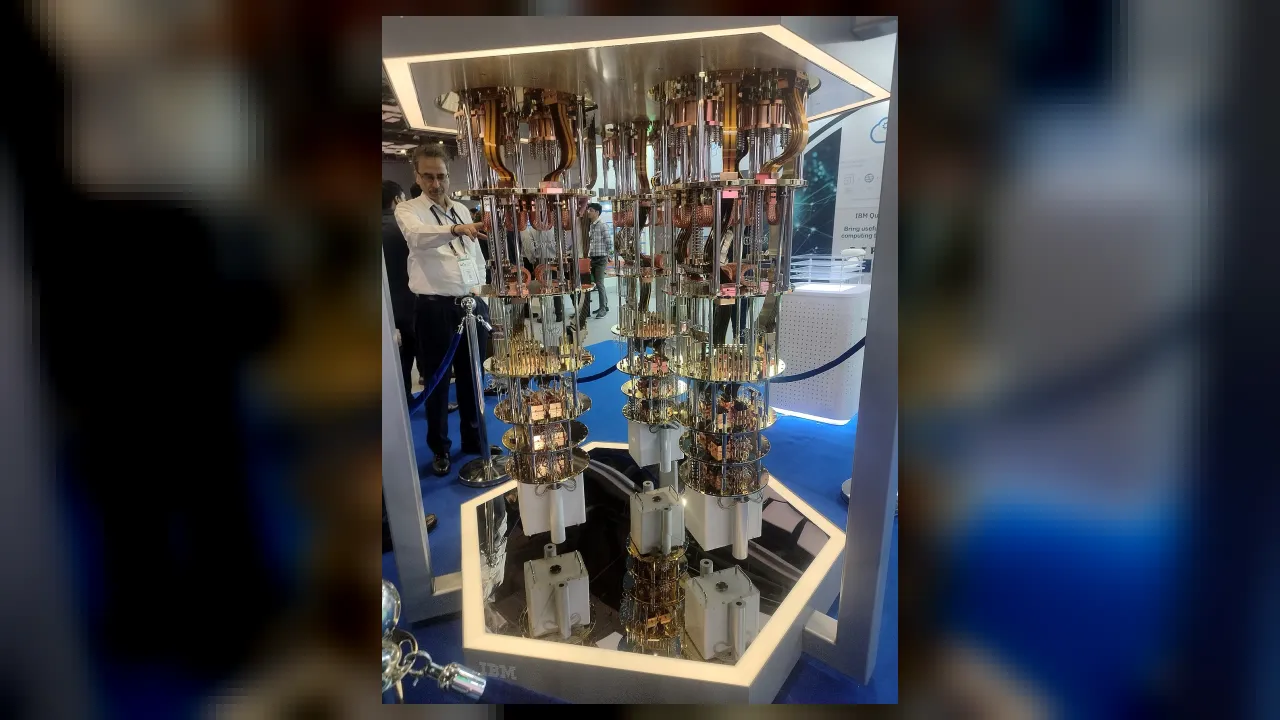
Golden chandelier-shaped 'dilution refrigerators' cool quantum computer chips down to minus 459 degrees Fahrenheit—just a tiny fraction of a degree above absolute zero!
✨ Word Sparks (Grade 3 Glossary)
Tap 🔊 to hear
superposition
Being in mixed quantum states until measured
qubit
A quantum computer unit holding mixed states
absolute zero
The coldest temperature possible in nature
🪝
How can a tiny electron explore two paths at the exact same time—and power a brand-new kind of computer?
1
Inside an Optics Lab
Put on protective laser goggles and step up to a heavy steel table floating on cushions of air so passing trucks won't shake it! Adjusting tiny crystal mirrors by hair-thin fractions, a quantum physicist steers single photons through a maze.
2
Jumping Stair Steps
Inside an atom, electrons cannot float just anywhere—they hop between exact energy 'stair steps,' never hovering halfway in between. Even stranger, until a detector measures one, a quantum particle can exist in a blend of states at once, called !
3
Building Quantum Computers
Regular laptops store information as switches called bits that are either 0 or 1. Quantum computers use —quantum bits that harness to test many possibilities together for tricky chemistry and medicine puzzles.
4
Unbreakable Secret Codes
Because peeking at a photon instantly changes it, quantum communication can alert banks and satellites the split second anyone tries to eavesdrop!
1. How is a quantum computer's 'qubit' different from a regular computer bit?
2. Why do laser tables in quantum labs float on air cushions?
🤯 Mind-Blowing Fact • Grade 4
Albert Einstein won his 1921 Nobel Prize in Physics not for relativity, but for explaining how quantum light packets knock electrons loose—the science behind every solar panel and digital camera sensor!
✨ Word Sparks (Grade 4 Glossary)
Tap 🔊 to hear
entanglement
Deep quantum link connecting distant twin particles
transistor
Tiny electronic switch inside computer chips
semiconductor
Material like silicon controlling electric flow
🪝
What did Albert Einstein call 'spooky action at a distance'—and how do engineers use it today?
1
Twin Particles Miles Apart
Imagine flipping two magical coins—one in Richmond, Virginia, and one in Tokyo—that were linked in a lab so whenever one lands heads, its partner instantly shows tails! In nature, a quantum physicist creates linked pairs of photons or atoms through quantum , a phenomenon so surprising that Albert Einstein nicknamed it 'spooky action at a distance.'
2
How the Quantum Revolution Began
Around 1900, scientists noticed classical physics couldn't explain why hot metal glows red, then yellow, then white, or how sunlight knocks electrons off metal plates (the photoelectric effect behind solar panels!). Pioneers Max Planck, Albert Einstein, Niels Bohr, and Erwin Schrödinger discovered that energy at the atomic scale comes in discrete packets—quanta—governed by probabilities and waves.
3
Microchips in Every Pocket
Quantum physics isn't just futuristic theory; it already runs the modern world. Understanding how electrons tunnel and flow through silicon crystals allowed physicists in 1947 to invent the —billions of which now pack inside a single smartphone processor!
4
Quantum Sensors Underground and in Space
Today, ultra-sensitive quantum gravity sensors help geologists spot underground water aquifers, while optical atomic clocks keep time so precisely they wouldn't lose a single second in fifteen billion years!
1. Which everyday invention relies on billions of quantum-engineered silicon transistors?
2. What happens when two particles are 'quantum entangled'?
🤯 Mind-Blowing Fact • Grade 5
Optical lattice atomic clocks built by quantum physicists at NIST in Colorado are so sensitive to gravity that lifting the clock just two centimeters higher off the floor measurably speeds up its ticking!
✨ Word Sparks (Grade 5 Glossary)
Tap 🔊 to hear
wave-particle duality
Matter and light acting as waves and particles
decoherence
Outside noise disrupting fragile quantum states
optical tweezers
Focused laser beams holding microscopic particles
🪝
How are quantum physicists moving from silicon transistors to fault-tolerant quantum computers that simulate molecules atom by atom?
1
Laser Tweezers Holding Single Atoms
Inside an ultra-high vacuum glass cell emptied of nearly every stray air molecule, crossed laser beams cool rubidium atoms to microkelvin temperatures—slowing them from jet-plane speeds to a gentle crawl. Sitting at the control console, an experimental quantum physicist arranges individual neutral atoms into a defect-free crystal grid using made of pure focused light.
2
Wave-Particle Duality and Uncertainty
Formulated in the 1920s by Niels Bohr, Werner Heisenberg, Erwin Schrödinger, and Paul Dirac, quantum mechanics revealed that subatomic matter exhibits . Rather than following deterministic trajectories, an electron is described by a mathematical wavefunction predicting probability amplitudes, while Heisenberg's Uncertainty Principle proves nature forbids knowing both a particle's exact position and exact momentum simultaneously.
3
First vs. Second Quantum Revolutions
The first quantum revolution harnessed bulk quantum behavior of trillions of electrons and photons together—giving civilization transistors, fiber-optic lasers, Magnetic Resonance Imaging (MRI), and flash memory. Today's second quantum revolution manipulates individual quantum states directly through superposition, interference, and entanglement.
4
Overcoming Decoherence
Building scalable quantum processors—whether from superconducting circuits, trapped ions, or neutral atoms—faces a formidable engineering hurdle called : the slightest stray heat vibration or magnetic field collapses fragile qubit states in milliseconds. Theoretical and experimental physicists design clever quantum error-correction codes that spread one logical qubit across dozens of physical qubits.
5
Designing Tomorrow's Medicines and Materials
Because molecules themselves obey quantum mechanics, future quantum simulators promise to model complex enzyme catalysis, cleaner room-temperature fertilizer production, next-generation solar batteries, and lossless power-grid superconductors that classical supercomputers could not calculate in a million years.