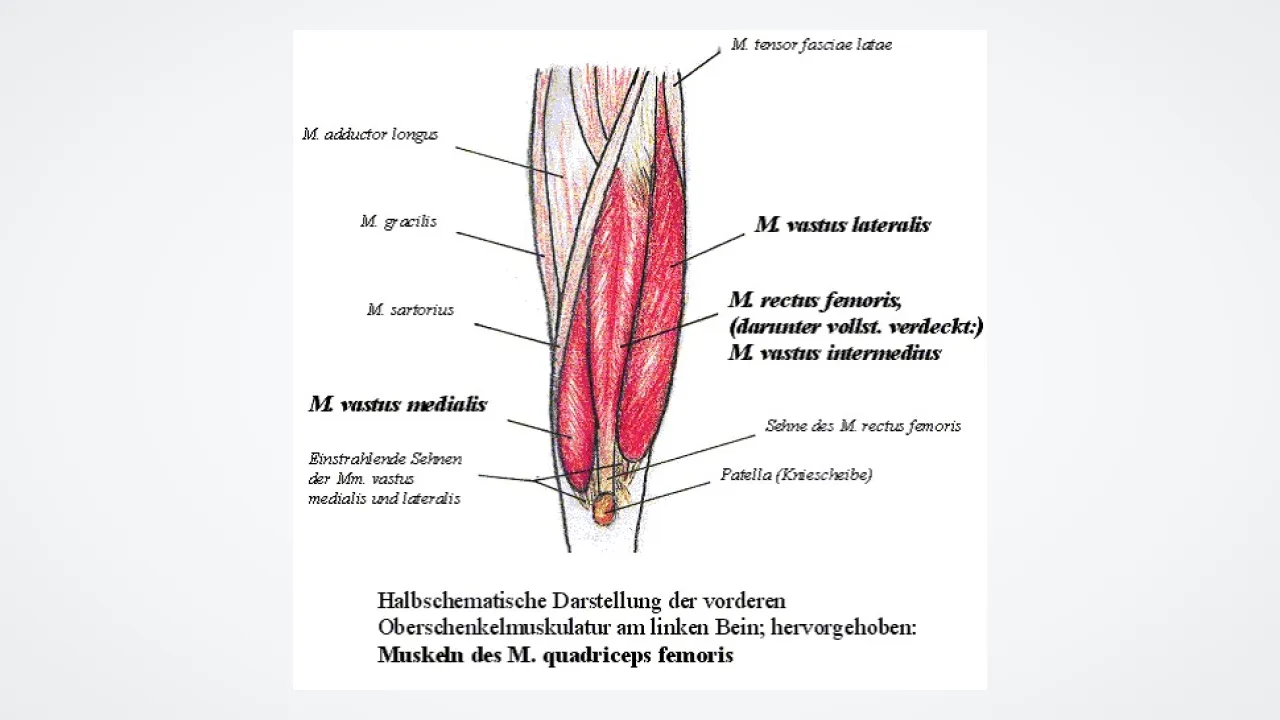
1. How many partner muscles join together to make one quadriceps group?
2. Which playground activity uses your quadriceps muscles the most?
🤯 Mind-Blowing Fact • Grade 2
Your kneecap is actually tucked right inside your quadriceps tendon to act like a smooth pulley wheel over your knee!
✨ Word Sparks (Grade 2 Glossary)
Tap 🔊 to hear
Quad
Word beginning that always means four
Kneecap
Round shield bone protecting your front knee
Reflex
Super-fast automatic move controlled by spinal nerves
🪝
Why did the doctor tap right below your kneecap with a tiny rubber hammer at your checkup?
1
Four Heads, One Giant Tendon
Think of a four-wheeled bike! 'Quad' means four in Latin. Down the front and sides of your thigh bone run four big muscle bellies that join together at the bottom into one super-strong tendon.
2
Wrapping Around Your Kneecap
That thick quadriceps tendon wraps right around your shield-shaped and anchors onto the top of your shinbone. When all four muscles pull at once, your lower leg swings straight out with tremendous force!
3
The Famous Knee-Jerk Test
When a doctor gently taps below your , your quadriceps senses the quick stretch and automatically kicks out—proving your spinal nerves are super healthy!
1. Where do all four muscles of your quadriceps connect at the bottom to pull your lower leg?
2. What makes your foot pop forward during a doctor's gentle knee-tap checkup?
🤯 Mind-Blowing Fact • Grade 3
Wait—in 2016, Swiss anatomists discovered a hidden fifth muscle layer tucked inside the human quadriceps, though we still call the classic group 'quads'!
✨ Word Sparks (Grade 3 Glossary)
Tap 🔊 to hear
Femur
Longest, strongest bone inside your upper thigh
Rectus Femoris
Middle quad muscle crossing hip and knee
Shock Absorption
Soaking up heavy landing forces safely
🪝
How do your quadriceps launch you skyward one second and cushion your landing the very next second?
1
Meet the Fantastic Four
Covering the front and sides of your —your body's longest bone—sits the quadriceps femoris. Three 'vastus' muscles hug the outer side, inner teardrop edge, and deep center of your thighbone, while a fourth straight muscle called the runs right down the middle.
2
One Special Double-Joint Member
While three quad muscles only straighten your knee, the middle starts higher up on your hip bone! Because it crosses both hip and knee, it helps swing your thigh forward with every running stride and high knee march.
3
Shock Absorbers Going Downhill
Try hiking down a steep hill or landing from a skateboard hop. Instead of letting your knees buckle to the ground, your quadriceps lengthen slowly under tension like giant spring brakes, absorbing shock several times your body weight.
4
Keeping Your Kneecap On Track
The inner teardrop quad muscle pulls gently inward to keep your kneecap gliding straight down the center groove of your knee!
1. What makes the middle 'rectus femoris' muscle different from the other three quadriceps muscles?
2. Why do your front thighs feel so worked out after hiking DOWN a long mountain trail?
🤯 Mind-Blowing Fact • Grade 4
Your patella (kneecap) acts like a built-in wedge pulley that boosts your quadriceps' kicking and climbing leverage by nearly 30 percent!
✨ Word Sparks (Grade 4 Glossary)
Tap 🔊 to hear
Sesamoid Bone
Round bone embedded inside a tendon pulley
Vastus Lateralis
Largest outer muscle belly of the quadriceps
Synapse
Tiny signaling gap connecting two nerve cells
🪝
How did scientists still manage to discover a hidden muscle layer inside the human thigh in the 21st century?
1
Anatomy of the Anterior Thigh Powerhouse
Stand up from a low squat without using your hands—your quadriceps femoris just lifted nearly your entire upper-body weight against gravity! Traditionally comprising four large muscle bellies— on the outer thigh, teardrop-shaped vastus medialis on the inner knee, deep vastus intermedius hugging the femoral shaft, and biarticular rectus femoris—the quadriceps forms the most voluminous lean muscle mass in the human skeleton.
2
The Patellar Pulley Advantage
All heads unite into the thick quadriceps tendon, which encases the patella (the body's largest ) and continues downward as the patellar ligament anchored onto the tibial tuberosity of your shin. By holding the tendon's pull line farther forward from the knee's hinge center, the patella increases your quadriceps' mechanical leverage by up to thirty percent!
3
A 2016 Anatomical Surprise!
People assumed human gross anatomy held zero mysteries left—until 2016, when researchers in Switzerland carefully examined twenty-six thighs and confirmed a distinct, consistent fifth muscle layer nestled between and vastus intermedius, naming it the tensor of the vastus intermedius!
4
Monosynaptic Patellar Reflex Speed
The classic doctor's knee-jerk test checks your L2–L4 spinal nerves using the body's fastest reflex arc: just one direct in the spinal cord flashes a stretch signal from quad spindles straight back to quad motor fibers in roughly twenty milliseconds!
1. Why is the patellar 'knee-jerk' reflex one of the fastest reflexes in the entire human body?
2. What surprising anatomical discovery did researchers publish about the human quadriceps in 2016?
🤯 Mind-Blowing Fact • Grade 5
Because quadriceps fibers angle inward like feather barbs ('pennate' architecture), your thighs pack enough microscopic pulling units side by side to generate nearly a ton of peak tendon tension during explosive jumps!
✨ Word Sparks (Grade 5 Glossary)
Tap 🔊 to hear
Pennate
Feather-angled fiber layout packing extra muscle strength
Vastus Medialis
Inner teardrop quad muscle centering your kneecap
Tibial Tuberosity
Bony bump below knee anchoring patellar tendon
🪝
How do pennate fiber angles and sesamoid lever geometry allow the quadriceps to withstand over 8,000 newtons of force?
1
Pennate Fiber Packing for Massive Force
Generating peak contractile forces exceeding 8,000 newtons—nearly one ton of tension—during Olympic weightlifting squats and sprint accelerations, the quadriceps femoris dominates the anterior compartment of the thigh. Rather than running strictly parallel from hip to knee, muscle fibers within the vastus lateralis, , vastus intermedius, and bipennate rectus femoris attach at slanting angles to central aponeurosis sheets like barbs on a bird's feather. This geometry packs far more cross-sectional sarcomeres into a compact thigh volume.
2
Extensor Mechanism and Patellofemoral Tracking
Converging distally into a trilaminar quadriceps tendon, the muscle bellies envelop the patella before inserting onto the anterior via the patellar tendon. Because the femur angles slightly inward from the wide human pelvis (the Q-angle), contraction naturally tugs the patella laterally; obliquely angled lower fibers of the obliquus (VMO) supply essential counter-traction to keep the kneecap centered inside the femoral trochlear groove.
3
Biarticular Energy Transfer in Sprinting and Jumping
Originating on the anterior inferior iliac spine of the pelvis, the rectus femoris functions as an ingenious mechanical conduit during vertical jumps: as powerful hip extensors drive the torso upward, the taut rectus femoris transfers hip power directly down across the knee to amplify push-off velocity.
4
Eccentric Deceleration and Metabolic Role
During gait heel-strike and stair descent, controlled eccentric lengthening of the quadriceps prevents tibiofemoral collapse while storing elastic strain energy. Metabolically, its vast fiber volume also serves as the human body's single largest insulin-sensitive sink for blood glucose clearance.
5
Westphal, Erb, and the Fifth Head Revision
In 1875, German neurologists Carl Westphal and Wilhelm Erb simultaneously described the patellar tendon reflex as a diagnostic window into lumbar spinal segments L2–L4—and 141 years later, Karl Grob's 2016 anatomical team proved this classic four-headed muscle consistently harbors a fifth belly, the tensor vasti intermedii.