1. What makes Proxima Centauri b so special to Earth?
2. About how long is one full year on Proxima Centauri b?
🤯 Mind-Blowing Fact • Grade 2
Astronomers found Proxima Centauri b by spotting its star wobbling back and forth at just three miles per hour—about as fast as a person walking!
✨ Word Sparks (Grade 2 Glossary)
Tap 🔊 to hear
wobble
Tiny back-and-forth tug on a star
companion
Partner star traveling through space together
shield
To protect from harm or fierce rays
🪝
What would the sky look like from the closest alien planet to Earth?
1
Next Door in Space
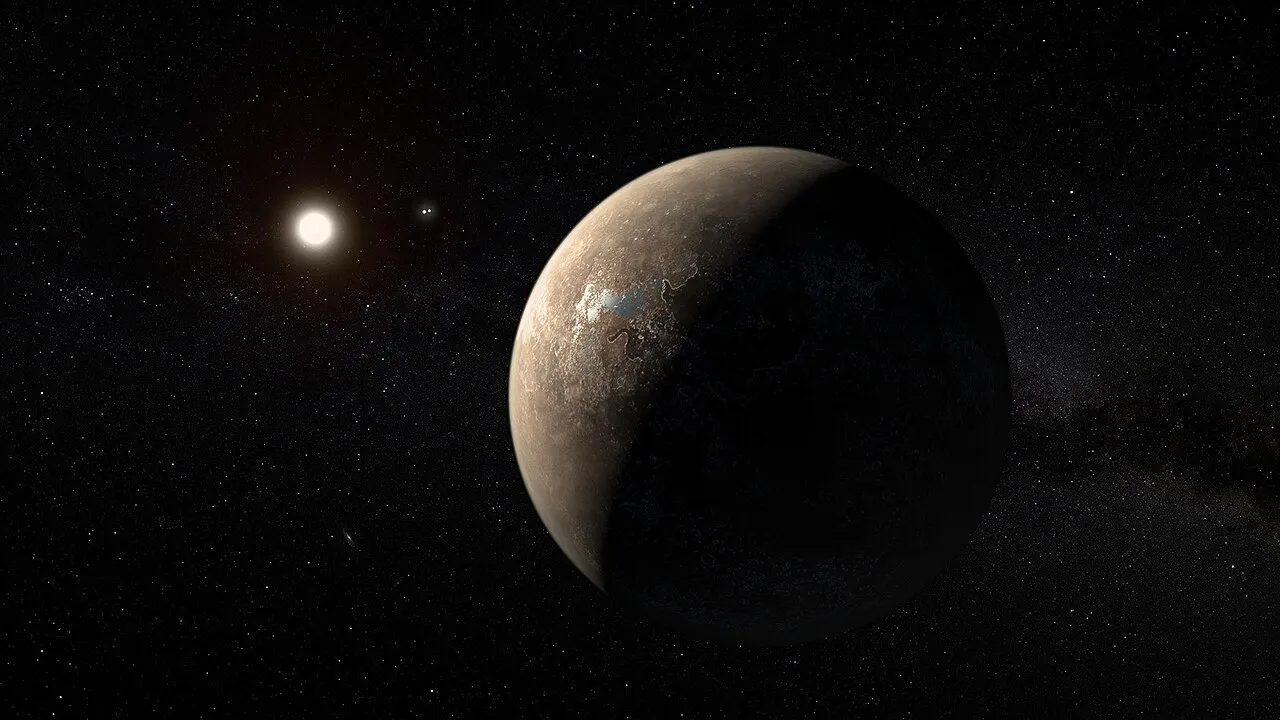
Pack your imagination for a trip 4.24 light-years away to the southern sky! There shines a dim red dwarf star called Proxima Centauri, our Sun's nearest stellar neighbor. Orbiting right around it is Proxima Centauri b, a rocky planet slightly heavier than Earth.
2
Three Suns in One Sky
Stand on this planet's surface and look up. A big salmon-red sun hangs overhead, three times wider in the sky than our Sun looks from Earth! Farther away, two bright stars—Alpha Centauri A and B—sparkle like twin diamonds.
3
Wild Stellar Weather
Although Proxima Centauri b sits inside the mild liquid-water zone, its red star often erupts with giant flares. Only a thick protective sky could oceans on its surface.
2. How fast does Proxima Centauri wobble from its planet's gravity?
🤯 Mind-Blowing Fact • Grade 3
If you stood on the night side of Proxima Centauri b and looked back toward home, our own Sun would shine as a bright star in the constellation Cassiopeia!
✨ Word Sparks (Grade 3 Glossary)
Tap 🔊 to hear
twilight
Soft glow between day and night
X-rays
High-energy invisible light from hot stars
observatory
Building with big telescopes studying space
🪝
How can a planet orbit twenty times closer to its star than Earth does without roasting?
1
Discovery of the Pale Red Dot
In August 2016, astronomers working at an high in the mountains of Chile shared thrilling news. After watching our Sun's closest neighbor star, Proxima Centauri, they detected a rocky world tugging gently on it just 4.24 light-years from Earth!
2
Cozy Around a Cool Star
Proxima Centauri b circles only 4.6 million miles from its star—twenty times closer than Earth orbits our Sun! On Mercury, being that close would melt lead. However, Proxima Centauri is a tiny red dwarf shining with less than two-thousandths of our Sun's total light, keeping the planet pleasantly mild.
3
Twilight Ring World
Because it orbits so close, gravity likely locks one side of Proxima Centauri b toward its star in permanent daylight while the far side freezes. A gentle ring between day and night could offer mild temperatures!
4
Facing Superflares
Red dwarfs are famous for fiery magnetic storms. Proxima Centauri blasts its planet with hundreds of times stronger than Earth receives, testing whether an atmosphere can survive.
1. Why doesn't Proxima Centauri b burn up even though it orbits only 4.6 million miles from its star?
2. Where would our Sun appear in the sky if you looked toward home from the Alpha Centauri system?
🤯 Mind-Blowing Fact • Grade 4
With today's fastest chemical rockets, reaching Proxima Centauri b would take over 70,000 years—which is why engineers are designing light-sail nanocraft pushed by laser beams!
✨ Word Sparks (Grade 4 Glossary)
Tap 🔊 to hear
Doppler shift
Wave stretch or squeeze from motion
radial velocity
Motion toward or away from Earth
light sail
Ultra-thin mirror pushed by light beams
🪝
How did astronomers catch a rocky planet that never crosses in front of its star as seen from Earth?
1
Catching a Walking-Speed Wobble
Unlike the TRAPPIST-1 planets, Proxima Centauri b's orbit is tilted so it does not transit across the face of its star from Earth's viewpoint. Instead, astronomers in the Pale Red Dot campaign used the HARPS spectrograph in Chile to watch Proxima Centauri's light shift slightly bluer and redder every 11.186 days—betraying a gravitational tug of just 1.4 meters per second!
2
Earth-Sized in the Habitable Zone
That subtle proved a planet with a minimum mass of roughly 1.07 Earth masses orbits just 0.0485 astronomical units from Proxima Centauri. Even at that tight distance, it receives about sixty-five percent of the total radiant energy Earth gets from the Sun, placing it squarely inside the liquid-water habitable zone.
3
Magnetic Storms Versus Oceans
Habitability around an M5.5 red dwarf comes with fierce cosmic weather challenges. Proxima Centauri frequently unleashes extreme ultraviolet and X-ray superflares that momentarily brighten the star dozens of times over, threatening to strip away unprotected water vapor and atmospheric gases unless a strong planetary magnetic field shields the surface.
4
First Stop for Interstellar Probes
Sitting only 4.24 light-years (about 25 trillion miles) from Earth, Proxima Centauri b stands as humanity's number-one destination for proposed laser-pushed light-sail micro-probes—tiny wafer spacecraft traveling at twenty percent of light speed that could fly past and beam close-up pictures home within twenty-five years of launch!
1. Which detection method revealed Proxima Centauri b in 2016?
2. Roughly how much stellar energy does Proxima Centauri b receive compared to Earth?
🤯 Mind-Blowing Fact • Grade 5
Chile's ESPRESSO spectrograph measured Proxima Centauri's motion to a precision of 30 centimeters per second—slower than a crawling baby turtle!
✨ Word Sparks (Grade 5 Glossary)
Tap 🔊 to hear
adaptive optics
Fast-bending mirrors canceling blurry air shimmer
volatiles
Compounds like water that vaporize easily
magnetic dynamo
Churning core metal generating magnetic shields
🪝
What will next-generation giant telescopes look for to find out if our nearest exoplanet is a lush ocean world or barren rock?
1
Triumph of Ultra-Precise Velocimetry
Orbiting Alpha Centauri C—better known as Proxima Centauri—at a Gaia parallax distance of just 1.30 parsecs (4.24 light-years), Proxima Centauri b holds an unbeatable cosmic title: no exoplanet outside our Solar System can ever lie closer to Earth unless another hides inside the same star system. Announced in August 2016 after the ESO HARPS Pale Red Dot campaign and later refined to 30-centimeter-per-second precision by the ESPRESSO spectrograph on Chile's Very Large Telescope, its 11.186-day Doppler reflex signal yields a minimum mass (m sin i) of 1.07 Earth masses.
2
Irradiation History of an M-Dwarf World
Orbiting just 0.0485 astronomical units from its 3,042-kelvin M5.5Ve host star, Proxima Centauri b receives 65 percent of Earth's bolometric solar flux—ideal for liquid surface water today. However, low-mass M-dwarfs spend several hundred million years contracting onto the main sequence while shining far brighter than their adult state, potentially triggering a runaway greenhouse early on unless the planet accreted abundant deep-mantle water ice beyond the snow line or outgassed a fresh volcanic atmosphere later.
3
Space Weather Extremes
Simultaneous ALMA millimeter and Hubble far-ultraviolet monitoring caught Proxima Centauri erupting with colossal flares that multiplied its ultraviolet brightness 14,000 times within seconds—requiring a vigorous molten-iron core dynamo to deflect charged stellar-wind particles and prevent atmospheric erosion.
4
Neighbors in the Proxima Family
Ultra-precise ESPRESSO tracking also uncovered Proxima d—a tiny sub-Earth planet of roughly 0.26 Earth masses skimming around the star every 5.12 days inside b's orbit—alongside candidate cold super-Earth Proxima c orbiting much farther out near 1.5 AU.
5
Direct Imaging on the Horizon
Upcoming thirty-meter-class observatories such as Chile's Extremely Large Telescope (ELT) will pair extreme with high-dispersion coronagraphic spectrographs to isolate Proxima b's reflected starlight at a 37-milliarcsecond angular separation and hunt directly for atmospheric water vapor, carbon dioxide, and biosignature oxygen.