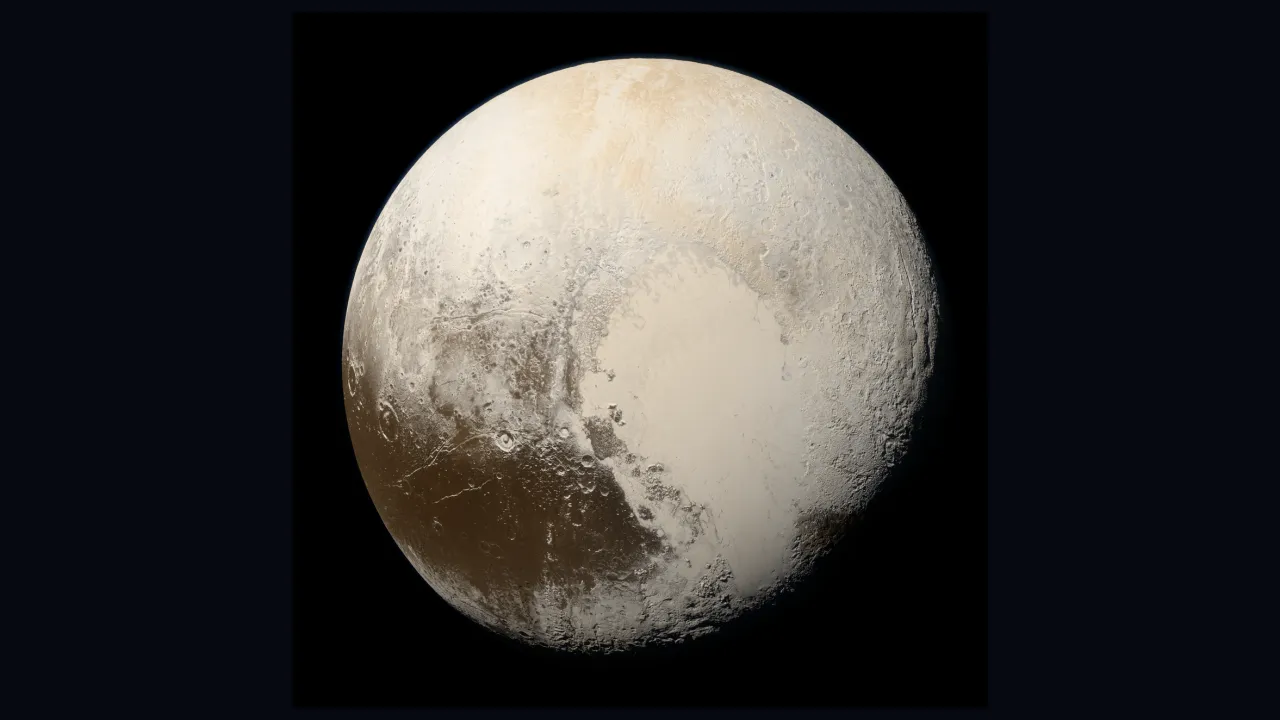
1. What famous bright shape did NASA cameras spot on Pluto?
2. How does Pluto's size compare to Earth's Moon?
🤯 Mind-Blowing Fact • Grade 2
Pluto could fit comfortably inside the United States—stretching just from Northern California to Kansas!
✨ Word Sparks (Grade 2 Glossary)
Tap 🔊 to hear
Reclassify
To sort something into a more accurate science group.
Flyby
When a fast spacecraft zooms close past a world.
Haze
Thin misty layers floating high in a sky.
🪝
Why did Pluto change from the ninth planet to king of the dwarf planets?
1
Spotted by Blinking Stars
In 1930, young astronomer Clyde Tombaugh flipped back and forth between night-sky photos until he spotted a tiny dot hopping across the stars: Pluto! For 76 years, kids learned Pluto as the ninth planet.
2
A Whole Family of Cousins
Then astronomers found thousands of other icy worlds sharing Pluto's zone—the Kuiper Belt! In 2006, scientists grouped Pluto with its round icy neighbors in a brand-new class called dwarf planets.
3
New Horizons Zooms By
After a nine-year trip, NASA's New Horizons spacecraft zipped past Pluto in 2015, revealing two-mile-tall water-ice mountains, five moons, and churning glaciers!
1. Which NASA spacecraft flew close past Pluto in July 2015?
2. Why did astronomers reclassify Pluto as a dwarf planet in 2006?
🤯 Mind-Blowing Fact • Grade 3
Between 1979 and 1999, Pluto's oval orbit actually brought it closer to the Sun than giant Neptune!
✨ Word Sparks (Grade 3 Glossary)
Tap 🔊 to hear
Convection
Slow churning motion as warm material rises upward.
Bedrock
Solid underlying crust—made of frozen water on Pluto!
Elliptical
Shaped like a stretched oval rather than a circle.
🪝
How can giant glaciers slowly churn and bubble at minus 380 degrees Fahrenheit?
1
Inside Sputnik Planitia
Look closely at the left half of Pluto's bright Heart—Tombaugh Regio—and you won't find a single impact crater! Named Sputnik Planitia, this 600-mile basin is filled with soft, toothpaste-thick nitrogen ice. Faint internal heat makes giant twenty-mile ice cells slowly rise in the middle and sink around the edges, erasing craters every million years!
2
Floating Mountains of Water Ice
On frigid Pluto, nitrogen ice is heavier and softer than frozen water. That means giant blocks of water-ice actually float like icebergs along the edges of Sputnik Planitia, forming two-mile-high peaks!
3
Five Moons in Orbit
Pluto travels with an entire miniature moon system: giant partner Charon plus four tumbling little moons named Styx, Nix, Kerberos, and Hydra.
4
A Tilted 248-Year Path
Pluto's oval orbit tilts seventeen degrees and even swings closer to the Sun than Neptune for twenty years of each 248-year lap—without ever colliding!
1. Why are there zero impact craters anywhere on Pluto's Sputnik Planitia glacier?
2. How many moons are known to orbit Pluto?
🤯 Mind-Blowing Fact • Grade 4
Jagged methane-ice blades in Pluto's highlands tower 1,600 feet tall—like endless rows of icy skyscrapers standing side by side!
✨ Word Sparks (Grade 4 Glossary)
Tap 🔊 to hear
Plutino
Kuiper Belt world sharing Pluto's 3:2 resonance with Neptune.
Bladed terrain
Skyscraper-tall ridges of jagged sublimated methane ice.
Gas hydrate
Insulating ice layer trapping gas molecules inside crystals.
🪝
Why hasn't Pluto collided with Neptune even though their orbital distances cross?
1
Protected by a 3:2 Cosmic Rhythm
Spanning from 29.7 to 49.3 astronomical units from the Sun, Pluto's eccentric orbit appears on flat diagrams to cross Neptune's path. Yet the two worlds can never collide! Pluto is locked in a stable 3:2 mean-motion resonance: for every three laps Neptune completes around the Sun, Pluto completes exactly two, ensuring they always stay over a billion miles apart when Pluto crosses inward.
2
Ice Volcanoes and Skyscraper Blades
South of Sputnik Planitia rise Wright Mons and Piccard Mons—broad domes up to four miles tall with deep central depressions that planetary geologists interpret as giant cryovolcanoes built from oozing water-ammonia slush! Meanwhile, across high-altitude Tartarus Dorsa, sublimating methane frost carves razor-sharp '' spires towering higher than the Empire State Building!
3
Insulated Subsurface Ocean
How did tiny Pluto keep a deep liquid water ocean from freezing solid over 4.5 billion years? Computer simulations discovered a protective 'gas-hydrate' cap—water ice cages trapping methane gas—that acts like a high-tech thermos blanket between the cold crust and warm ocean!
4
Twenty Blue Haze Decks
Backlit New Horizons images revealed twenty distinct blue atmospheric haze layers extending over 120 miles high, formed as ultraviolet sunlight links methane and nitrogen into tiny tholin particles that scatter blue light.
1. Why can Pluto never crash into Neptune even when Pluto swings closer to the Sun than Neptune?
2. What acts like an insulating thermos blanket to keep Pluto's underground ocean from freezing solid?
🤯 Mind-Blowing Fact • Grade 5
Pluto's nitrogen glacier Heart plus the uplifted ocean underneath weighed so much that they physically rolled the entire dwarf planet 60 degrees sideways in 'true polar wander' until the Heart lined up opposite Charon!
✨ Word Sparks (Grade 5 Glossary)
Tap 🔊 to hear
True polar wander
When heavy surface mass rolls a whole world's crust.
Blink comparator
Device flipping between sky photos to spot moving worlds.
Rayleigh scattering
Tiny sky particles bouncing blue light in all directions.
🪝
How did a heavy nitrogen glacier literally tip the entire dwarf planet Pluto over on its axis?
1
Blink-Comparator Discovery to Kuiper Archetype
On February 18, 1930, twenty-four-year-old Clyde Tombaugh identified Pluto at Lowell Observatory by spotting a fifteenth-magnitude point shifting across photographic plates inside a Zeiss . Following the 1992 discovery of fellow trans-Neptunian objects by Jane Luu and David Jewitt—and massive Eris in 2005—the International Astronomical Union established 'dwarf planet' in 2006 for worlds in hydrostatic equilibrium that have not dynamically cleared their orbital neighborhood, crowning 2,377-kilometer Pluto king of the Kuiper Belt by volume.
2
True Polar Wander Driven by Sputnik Planitia
Notice something uncanny about Sputnik Planitia: this 1,000-kilometer impact basin sits almost squarely opposite Charon along Pluto's tidal axis! Geophysical analysis proved that as kilometres of dense solid nitrogen accumulated inside the ancient basin AND a dense subsurface liquid ocean uplifted beneath the thinned crust, that positive mass anomaly generated centrifugal torque—physically rolling Pluto's entire shell roughly sixty degrees via '' until its heavy Heart locked onto the anti-Charon equator!
3
Rayleigh Scattering in a Microbar Atmosphere
Pluto's tenuous 10-microbar nitrogen-methane-carbon-monoxide atmosphere undergoes dramatic vapor-pressure equilibrium swings across its 248-year orbit and 119.6-degree retrograde axial tilt. High-altitude ultraviolet photolysis synthesizes nanometer-scale tholin aggregates that scatter short-wavelength sunlight via —wrapping frigid Pluto in cerulean blue skies above crimson Cthulhu Macula tholin plains.
4
Cryovolcanic Resurfacing at Wright and Piccard Mons
New Horizons topography around Wright Mons (150 kilometers wide, 4 kilometers tall) revealed hummocky, crater-free flanks totaling thousands of cubic kilometers of extruded water-ammonia ice—requiring surprisingly late internal heat flux inside a 1.85-gram-per-cubic-centimeter world.
5
Circumbinary Moonlet Architecture
Orbiting outside the Pluto-Charon binary in near-circular, coplanar 1:3:4:5:6 period ratios, tiny bright-ice moons Styx, Nix, Kerberos, and Hydra tumble chaotically—accreted debris from the giant impact that forged Pluto and Charon!