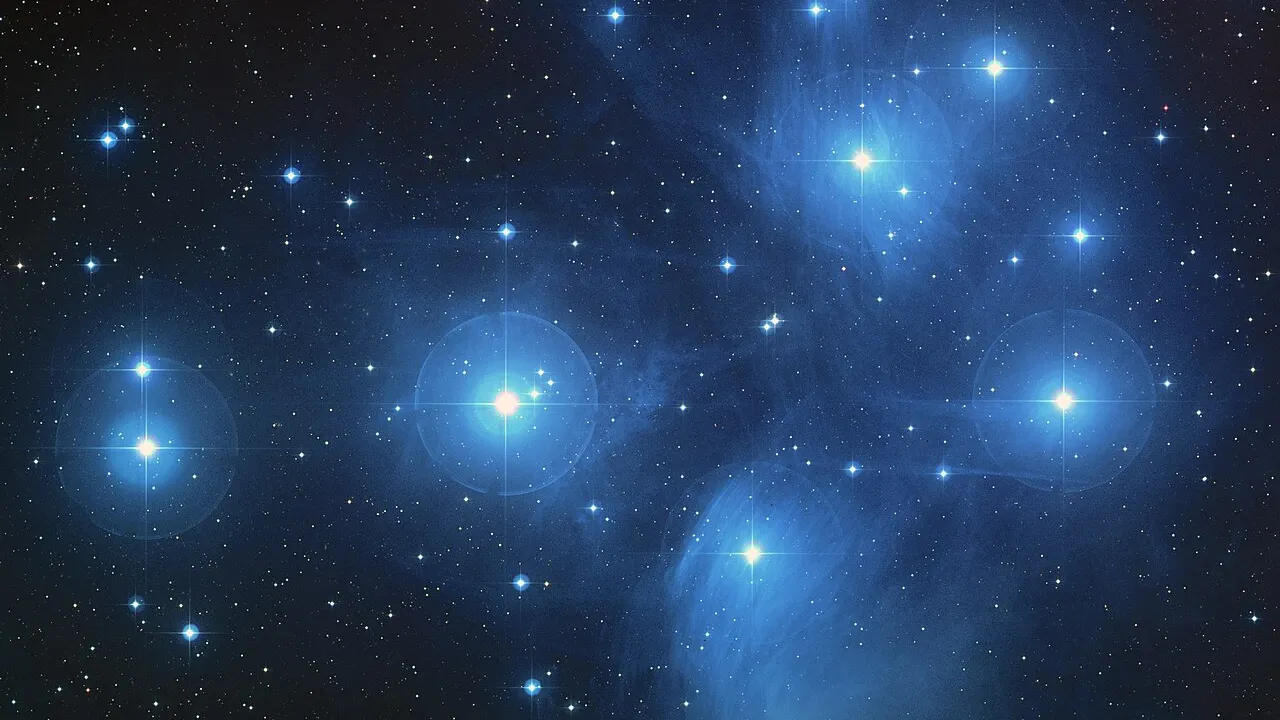
🪐 Scale / Diameter~35 light-years across • Over 1,000 stars
☄️ Composition & OrbitHot blue B-type stars • ~100 million years old
⚡ Cosmic SparkLights up ghostly blue cosmic dust clouds like glowing starlight mist
🤯 Mind-Blowing Fact • Grade 1
In Japan, this star cluster is called Subaru, and its bright stars appear on the famous car badge!
✨ Word Sparks (Grade 1 Glossary)
Tap 🔊 to hear
cluster
A close group of stars shining together
telescope
A tool that makes faraway stars look close
glow
To shine with steady, bright light
🪝
Have you ever spotted a tiny dipper of bright blue stars winking in the winter sky?
1
Seven Bright Sisters
Look up on a crisp winter night! A tight group of bright blue stars shines together. People call them the Seven Sisters. Most eyes can spot six or seven stars right away.
2
A Big Star Family
show a big secret. More than one thousand young stars live in this ! They were all born from the same giant cloud of gas.
3
Glowing Blue Mist
Soft blue dust wraps around these hot stars. Their bright light bounces off the dust and makes space like icy mist.
1. What nickname do stargazers often give the Pleiades?
2. About how many stars actually live inside the Pleiades cluster?
🤯 Mind-Blowing Fact • Grade 2
Dinosaurs were already stomping across Earth BEFORE the young stars of the Pleiades were even born!
✨ Word Sparks (Grade 2 Glossary)
Tap 🔊 to hear
constellation
A pattern of stars named after a picture
astronomer
A scientist who studies stars, planets, and space
scatter
To bounce and spread out in many directions
🪝
How can a thousand fiery stars travel across the galaxy like a flock of glowing birds?
1
Jewels in the Bull
Step outside on a clear autumn or winter evening and look toward the Taurus the Bull. Right on the bull's shoulder sits a shimmering patch of blue-white jewels. Without a telescope, sharp eyes can count six or seven stars huddled close together.
2
Young and Super Hot
call the Pleiades an open star cluster because its stars sit loosely together. Over one thousand stars share this cosmic neighborhood! Its brightest members are young blue stars that burn much hotter and brighter than our yellow Sun.
3
Drifting Through Cosmic Dust
Right now, the cluster is zooming through an icy cloud of space dust. Blue starlight off the tiny dust grains, painting delicate, wispy ribbons around the stars.
1. In which constellation can you find the Pleiades Star Cluster?
2. Why do wispy blue clouds glow around the Pleiades?
🤯 Mind-Blowing Fact • Grade 3
Light leaving the Pleiades today won't reach Earth for 444 years—meaning the starlight you see tonight began its trip in the late 1500s!
✨ Word Sparks (Grade 3 Glossary)
Tap 🔊 to hear
light-year
The huge distance light travels in one year
reflection nebula
A space dust cloud lit by nearby stars
gravity
The invisible pull between objects with mass
🪝
Why are the glowing blue dust clouds around the Pleiades actually cosmic strangers just passing through?
1
A Naked-Eye Treasure
Sweep your gaze across the winter sky and a tiny, glittering dipper catches your eye. Cataloged by astronomers as Messier 45, the Pleiades sit about 444 from Earth. That makes them one of the closest and brightest star clusters in our Milky Way neighborhood.
2
Born in a Stellar Nursery
Roughly 100 million years ago, a massive cloud of hydrogen gas collapsed under and ignited over a thousand sibling stars. Compared to our 4.6-billion-year-old Sun, the Pleiades are energetic cosmic youngsters. Their largest stars shine with fierce blue-white heat, glowing hundreds of times brighter than the Sun.
3
The Reflection Nebula Surprise
For decades, scientists thought the lacy blue clouds around the Pleiades were leftover gas from the stars' birth. Careful measurements proved a surprise! The cluster is simply plowing through an unrelated cloud of interstellar dust, creating a glowing .
4
Slowly Drifting Apart
Because an open cluster holds its stars loosely, galactic gently tugs them apart. Over the next 250 million years, these starry siblings will scatter across the galaxy.
1. What surprised astronomers about the blue dust cloud around the Pleiades?
2. What will eventually happen to the stars in the Pleiades over hundreds of millions of years?
🤯 Mind-Blowing Fact • Grade 4
Alcyone, the brightest star in the Pleiades, shines nearly 2,400 times brighter than our Sun and spins so fast it bulges at its equator!
✨ Word Sparks (Grade 4 Glossary)
Tap 🔊 to hear
open cluster
A loosely bound group of young sibling stars
brown dwarf
A dim object bigger than planets, smaller than stars
wavelength
The distance between peaks of a light wave
🪝
How did one sparkling cluster guide ancient farmers, sailors, and modern astrophysicists all at once?
1
Ancient Sky Calendar
Long before printed calendars existed, civilizations from Polynesia and Greece to the Maya and Māori watched a compact jewel box of stars rise at dusk or dawn. Known to astronomers as Messier 45, the Pleiades cluster lies roughly 444 light-years away in Taurus. Because its brightest stars shine starkly against dark skies, ancient mariners and farmers used its seasonal rising to time ocean voyages and harvests.
2
Anatomy of an Open Cluster
Although six to nine stars stand out to unaided eyes, telescopes reveal over 1,000 gravitationally bound members packed within a core spanning about 16 light-years, with tidal tails stretching past 35 light-years. Dominated by luminous B-type stars such as Alcyone, Atlas, and Electra, these hot blue suns burn through nuclear fuel rapidly while hundreds of fainter red dwarfs and orbit quietly nearby.
3
Rayleigh Scattering in Deep Space
Photographs of M45 showcase gossamer blue filaments called the Merope and Maia nebulae. Rather than leftover birth gas, this dust belongs to the Taurus-Auriga molecular complex, colliding with the cluster at about 11 kilometers per second. Fine carbon-rich dust grains scatter shorter blue far more efficiently than red light—the exact optical physics that paints Earth's daytime sky blue.
4
Galactic Dispersal
Because lack the dense mass of globular clusters, passing giant molecular clouds and Milky Way tides steadily strip stars away, dispersing the family within 250 million years.
1. Why does the dust around the Pleiades glow blue instead of red?
2. Which star is the brightest member of the Pleiades cluster?
🤯 Mind-Blowing Fact • Grade 5
In 1610, Galileo Galilei sketched 36 stars in the Pleiades through his early telescope, proving the night sky held countless stars invisible to human eyes!
✨ Word Sparks (Grade 5 Glossary)
Tap 🔊 to hear
parsec
An astronomical distance unit equal to 3.26 light-years
luminosity
The total amount of light energy a star radiates
parallax
Apparent shift in star position used to measure distance
🪝
Why do astrophysicists treat a 100-million-year-old star cluster as a Rosetta Stone for stellar evolution?
1
A Cosmic Laboratory in Taurus
Rising like frosted sapphires above the autumn horizon, Messier 45—the Pleiades—is far more than a mythological icon. Positioned approximately 444 light-years (136 ) away in Taurus, this open cluster contains more than 1,000 confirmed members formed simultaneously from a single collapsing molecular cloud roughly 100 to 125 million years ago. Because every star shares an identical age and chemical composition, only mass separates how fast each sibling evolves.
2
From Brilliant B-Stars to Brown Dwarfs
Nine hot B-type stars dominate the cluster's total , led by Alcyone, whose surface temperature exceeds 12,000 kelvins—more than double our Sun's 5,778 K. Yet these dazzling giants represent a tiny fraction of the population. Sensitive infrared surveys uncovered hundreds of low-mass red dwarfs alongside dozens of substellar brown dwarfs like Teide 1, the first brown dwarf verified inside an open cluster in 1995.
3
Kinematics of a Chance Encounter
Long-exposure astrophotography reveals intricate cobalt-blue reflection nebulae threading between Merope and Maia. Proper-motion measurements from space observatories proved the dust and stars move at different velocities, intersecting at roughly 11 kilometers per second. Radiation pressure from the hottest stars actively sorts the dust grains by size, pushing microscopic particles into striated magnetic filaments.
4
Calibrating the Cosmic Distance Ladder
Measuring the exact distance to M45 tested modern astrometry. When Europe's Gaia spacecraft mapped stellar with micro-arcsecond precision, it resolved earlier satellite discrepancies and anchored stellar models used across distant galaxies.
5
Tidal Destiny
With a total mass near 800 solar masses, M45 cannot resist galactic gravitational shear forever. Within 250 million years, orbital tides will disperse its siblings into solitary travelers like our Sun.