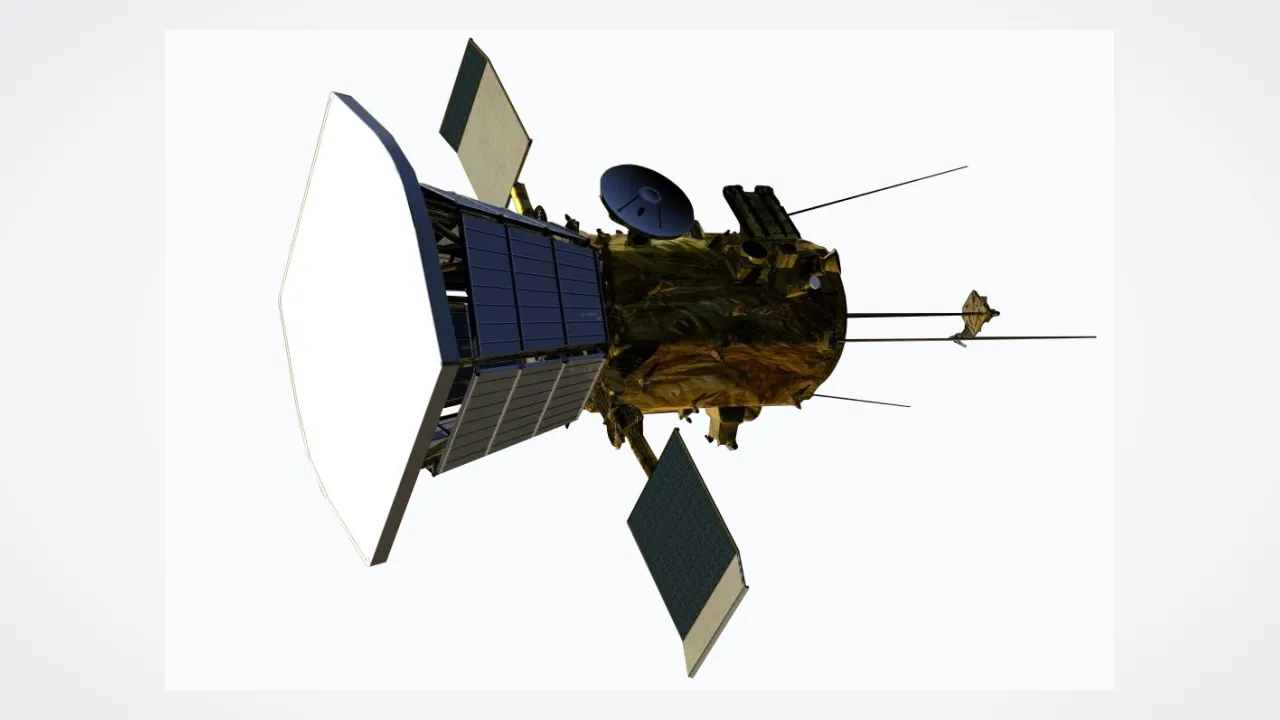
1. What keeps the spacecraft's science tools from melting near the Sun?
2. Where does Parker Solar Probe fly?
🤯 Mind-Blowing Fact • Grade 2
It is the first spacecraft named after a living scientist, Dr. Eugene Parker, who watched its rocket launch in person!
✨ Word Sparks (Grade 2 Glossary)
Tap 🔊 to hear
corona
The glowing outer atmosphere around the Sun
reflect
To bounce light and heat back away
gravity
An invisible pull between planets and stars
🪝
What happens when a spacecraft dives straight into the Sun's outer crown?
1
Daring to Touch a Star
Imagine flying straight toward a roaring ball of fire! Launched by NASA in 2018, this car-sized explorer dives right into the Sun's glowing outer atmosphere, called the .
2
Cool in the Furnace
Outside, temperatures reach a sizzling 2,500 degrees Fahrenheit. Yet a special carbon-foam shield the blinding light away, keeping the computer and cameras inside as comfy as a classroom.
3
Chasing the Solar Wind
As the probe whips around Venus, it trades speed to swing even closer to the Sun. Sensors scoop up fast particles to solve mysteries about stormy space weather.
1. Which planet helps the probe adjust its path to swing closer to the Sun?
2. What is the Sun's glowing outer atmosphere called?
🤯 Mind-Blowing Fact • Grade 3
At top speed, Parker Solar Probe hits 430,000 miles per hour, making it the fastest human-made object ever built!
✨ Word Sparks (Grade 3 Glossary)
Tap 🔊 to hear
plasma
Superheated gas full of electrically charged particles
solar wind
A fast stream of particles from the Sun
orbit
The curved path an object takes in space
🪝
Why is the Sun's outer atmosphere actually hotter than its glowing surface?
1
Flying Into a Solar Mystery
Picture a spacecraft diving through ribbons of superheated ! In 2018, NASA launched Parker Solar Probe to solve a huge puzzle: why the Sun's outer corona burns millions of degrees hotter than the surface below it.
2
Armor Made of Carbon Foam
Surviving near a star takes brilliant engineering. At the front sits an eight-foot-wide heat shield built from light carbon foam sandwiched between carbon plates and painted bright white. Even when the front bakes at 2,500 degrees Fahrenheit, instruments in its shadow stay near 85 degrees.
3
Using Venus as a Brake
To fall closer to the Sun, a spacecraft must actually slow its sideways orbital motion. Seven flybys of Venus gently trim its , bringing it within 3.8 million miles of the Sun.
4
Tracking Space Weather
Along the way, magnetic sensors measure the , a nonstop stream of charged particles that triggers auroras and can disrupt satellites around Earth.
1. How warm do the science instruments stay behind the heat shield?
2. What does the solar wind create when its particles reach Earth's sky?
🤯 Mind-Blowing Fact • Grade 4
If you scaled the Earth-Sun distance down to a one-yard stick, Parker Solar Probe hovers just one and a half inches from the glowing bulb!
✨ Word Sparks (Grade 4 Glossary)
Tap 🔊 to hear
density
How tightly packed particles are inside a space
switchback
A sharp zigzag bend in solar magnetic lines
supersonic
Traveling faster than the local speed of sound
🪝
How can temperatures reach millions of degrees without melting a spacecraft flying right through them?
1
Crossing Into the Corona
In April 2021, human engineering crossed an unforgettable cosmic boundary. For the first time, Parker Solar Probe dipped inside the Alfven critical surface, the invisible border where solar material is still bound to the Sun by magnetic fields before escaping into deep space. By entering this zone, the spacecraft literally touched the Sun's corona.
2
The Physics of Heat Versus Temperature
How did the probe survive plasma exceeding two million degrees Fahrenheit? Scientists distinguish between temperature, which measures how fast particles move, and heat transfer, which depends on how many particles strike a surface. Because the corona has very low , relatively few roaring particles hit the spacecraft at once. Its 4.5-inch-thick carbon-composite Thermal Protection System handles the intense sunlight while water-cooled solar arrays tuck safely into its shadow.
3
Switchbacks in the Magnetic Field
As the probe swooped inward, its instruments detected surprising zigzags in the solar magnetic field called . These violent magnetic kinks whip plasma outward like cracks of a bullwhip, helping explain how the solar wind accelerates to speeds.
4
Shielding Modern Life on Earth
Understanding how solar storms form near their source gives forecasters earlier warnings to protect astronauts, power grids, and GPS satellites across Earth.
1. Why doesn't the two-million-degree corona instantly melt the spacecraft?
2. What surprising magnetic features did the probe discover whipping plasma outward?
🤯 Mind-Blowing Fact • Grade 5
To keep its solar panels from overheating near perihelion, the probe folds them back like wings and circulates just one gallon of deionized water as coolant!
✨ Word Sparks (Grade 5 Glossary)
Tap 🔊 to hear
perihelion
The point in orbit closest to the Sun
photosphere
The visible light-emitting surface layer of a star
autonomous
Able to make decisions independently without human control
🪝
Why did a sixty-year-old prediction about invisible starlight winds require the fastest machine in history to prove?
1
From Bold Theory to Launchpad
Back in 1958, young astrophysicist Eugene Parker proposed a radical idea: the Sun constantly blasts a supersonic stream of magnetized plasma across the solar system. Critics initially doubted him, yet early space probes soon proved his solar wind was real. Sixty years later, NASA and the Johns Hopkins Applied Physics Laboratory honored him with Parker Solar Probe, a 685-kilogram observatory engineered to sample the Sun's birthplace of storms firsthand.
2
Celestial Mechanics and Venus Flybys
Reaching the inner corona requires shedding enormous orbital energy inherited from Earth's 67,000-mile-per-hour trip around the Sun. Rather than carrying impossible amounts of fuel, navigators designed a seven-year trajectory featuring seven precision gravity assists at Venus. Each encounter transfers orbital momentum to the planet, tightening to just 3.8 million miles above the solar while accelerating the probe to 430,000 miles per hour.
3
Autonomous Survival Behind Carbon Armor
At closest approach, solar irradiance is nearly 500 times stronger than in Earth orbit, and radio signals take over eight minutes to travel home. Because human controllers cannot steer in real time, tiny edge sensors detect the slightest sliver of sunlight if the spacecraft tilts, firing thrusters within seconds to keep everything tucked behind its 11.4-centimeter carbon-foam heat shield.
4
Peering Inside the Whispering Corona
Four instrument suites work together during each blistering pass. Electromagnetic antennas map magnetic switchbacks, particle detectors count protons and electrons, and the WISPR wide-field imager photographs coronal streamers and reveals a surprise dust-free zone sculpted by intense solar radiation.
5
A New Era of Heliophysics
By tracing coronal heating and coronal mass ejections at point-blank range, Parker Solar Probe transforms our star from a distant disk into an explored neighborhood—and teaches astronomers how stars across the universe shape the worlds orbiting them.