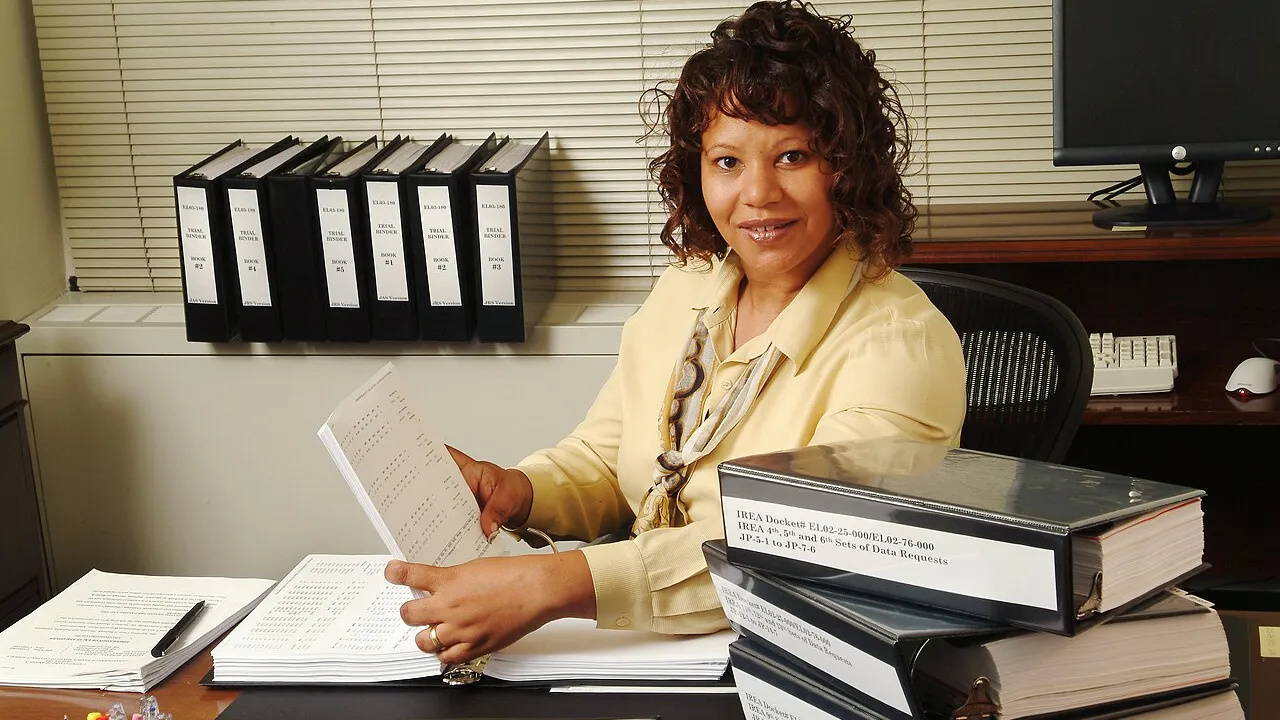
1. Who does a paralegal work closely with to prepare for court?
2. Why does a paralegal put colored tabs and labels on case folders?
🤯 Mind-Blowing Fact • Grade 2
The prefix 'para-' comes from an ancient Greek word meaning 'beside,' because paralegals work right beside lawyers!
✨ Word Sparks (Grade 2 Glossary)
Tap 🔊 to hear
timeline
A chart showing events in date order
deadline
The latest date something must be finished
record
Written or digital proof of past events
🪝
What happens behind the scenes when a legal team has ten thousand pages of clues to sort?
1
Fact Detectives at the Desk
Imagine trying to find one tiny receipt inside twenty boxes of papers! That is where a super-organized detective steps in to save the day. Using computers and checklists, a paralegal searches through until the exact fact pops up.
2
Drafting and Checking
Paralegals help lawyers get ready for meetings and trials. They interview witnesses, type first drafts of court forms, and build showing what happened first, next, and last.
3
Keeping Deadlines on Track
Courts have strict calendar rules for turning in paperwork. Paralegals track every single date so no important report is ever late.
1. What does the Greek prefix 'para-' in the word paralegal mean?
2. Why is tracking a calendar so important for a paralegal?
🤯 Mind-Blowing Fact • Grade 3
Paralegal became an officially recognized American career in the late 1960s to help make legal services faster and more affordable for everyday families!
✨ Word Sparks (Grade 3 Glossary)
Tap 🔊 to hear
database
A searchable computer collection of organized information
regulation
An official rule made by government agencies
draft
A first version of a written document
🪝
How can someone work in the exciting world of law without spending three years in law school?
1
The Engine Room of a Law Office
Walk past the conference rooms of a busy law firm or city hall, and you will find paralegals powering every active case. While lawyers argue in court and give official legal advice, paralegals handle the deep research and organization that make winning arguments possible.
2
Searching Digital Law Libraries
Suppose a town wants to build a solar farm and needs to check environmental rules. A paralegal searches specialized legal , gathers state , and summarizes similar past cases for the attorney.
3
Preparing Witnesses and Exhibits
Before a trial starts, paralegals contact witnesses to schedule interviews, assemble numbered exhibit binders for the judge and jury, double-check every date on timeline charts, and verify every quote for complete accuracy.
4
Many Places to Work
Not all paralegals work on courtroom trials! Many help families buy homes in real estate offices, protect new inventions at technology companies, support hospital compliance teams, or assist state and federal government agencies.
1. Which task is a key responsibility of a paralegal?
2. Besides trial law firms, where else might a paralegal work?
🤯 Mind-Blowing Fact • Grade 4
The U.S. Department of Justice employs thousands of paralegal specialists across the country to help investigate civil rights, environmental protection, and consumer safety cases!
✨ Word Sparks (Grade 4 Glossary)
Tap 🔊 to hear
subpoena
A court order requiring records or testimony
deed
A legal document transferring ownership of property
ethics
Moral rules guiding honest professional behavior
🪝
What CAN a paralegal do on a tough case, and what rules separate their job from an attorney's?
1
Masters of Detail and Evidence
Picture two wide computer monitors glowing with county property maps, contract clauses, and witness interview notes. When a complicated case arrives at a Virginia law firm or federal justice office, a paralegal immediately transforms stacks of scattered clues into logical order by indexing every record, verifying dates against public calendars, and spotting tiny contradictions that nobody else noticed.
2
Drafting Legal Documents
Working closely under a lawyer's supervision, paralegals write careful first drafts of court motions, business contracts, real estate , and —official court orders requiring a person or company to share records or testify. Once drafted and proofread, a licensed attorney reviews, refines, and signs the document before filing it electronically with the clerk of court.
3
Important Professional Boundaries
Because paralegals are not licensed bar attorneys, state legal rules establish crystal-clear boundaries to protect the public. A paralegal may interview clients to gather factual timelines and explain courthouse schedules, yet they cannot set legal fees, argue before a judge at the courtroom lectern, or give independent legal advice about what a client should do.
4
Technology in Modern Cases
Today's paralegals master specialized electronic discovery software to search hundreds of thousands of emails, engineering logs, and spreadsheets in minutes. Their speed and organization lower legal costs for everyday families while ensuring vital evidence is preserved accurately.
1. What is a subpoena that a paralegal might help draft?
2. Which action must be performed by a licensed attorney rather than a paralegal?
🤯 Mind-Blowing Fact • Grade 5
In major commercial cases, a single gigabyte of digital data managed by an e-discovery paralegal equals roughly 65,000 printed pages—taller than a two-story house if stacked!
✨ Word Sparks (Grade 5 Glossary)
Tap 🔊 to hear
metadata
Hidden digital details showing when files changed
interrogatories
Written pretrial questions answered under oath
compliance
Following all official laws, rules, and standards
🪝
How do litigation paralegals manage millions of digital files during high-stakes court battles?
1
Precision Behind the Lectern
Midway through a fast-moving federal patent trial, an opposing witness claims an invention design was never shared prior to March 2021. Within three seconds, the litigation paralegal seated beside counsel calls up Exhibit 118—page 412 of an archived engineering log—and projects the exact highlighted timestamp onto the courtroom monitors. That effortless precision reflects months of disciplined pre-trial case architecture.
2
Electronic Discovery and Fact Investigation
Contemporary lawsuits rarely fit inside cardboard bankers' boxes. Instead, complex commercial, environmental, and civil-rights disputes revolve around electronic discovery (e-discovery)—collecting, preserving, and indexing terabytes of emails, engineering CAD blueprints, medical charts, and financial ledgers. Paralegals construct Boolean search strings and inspect file to isolate relevant evidence while redacting private medical details or confidential communications protected by attorney-client privilege.
3
Substantive Legal Writing and Citation Checking
Beyond managing evidence databases, senior paralegals perform substantive legal drafting that would otherwise consume an attorney's billable hours. They compose initial pleadings, written discovery , settlement agreements, and estate probate petitions, then cross-check every statutory and appellate citation against standardized legal manuals such as The Bluebook so court filings contain zero technical errors.
4
Specializations Across Industries
Paralegals specialize across nearly every sector of the economy: intellectual property paralegals track global trademark and patent applications with the U.S. Patent and Trademark Office in Alexandria, Virginia; corporate paralegals manage board governance and regulatory ; and legal-aid paralegals help veterans, seniors, and families navigate housing or benefits rules.
5
Education and National Certification
Most professionals enter the career by earning an associate's or bachelor's degree paired with an American Bar Association (ABA)-approved paralegal studies certificate, and many distinguish themselves by passing rigorous voluntary national exams such as the Certified Paralegal (CP) credential while completing ongoing ethics education.