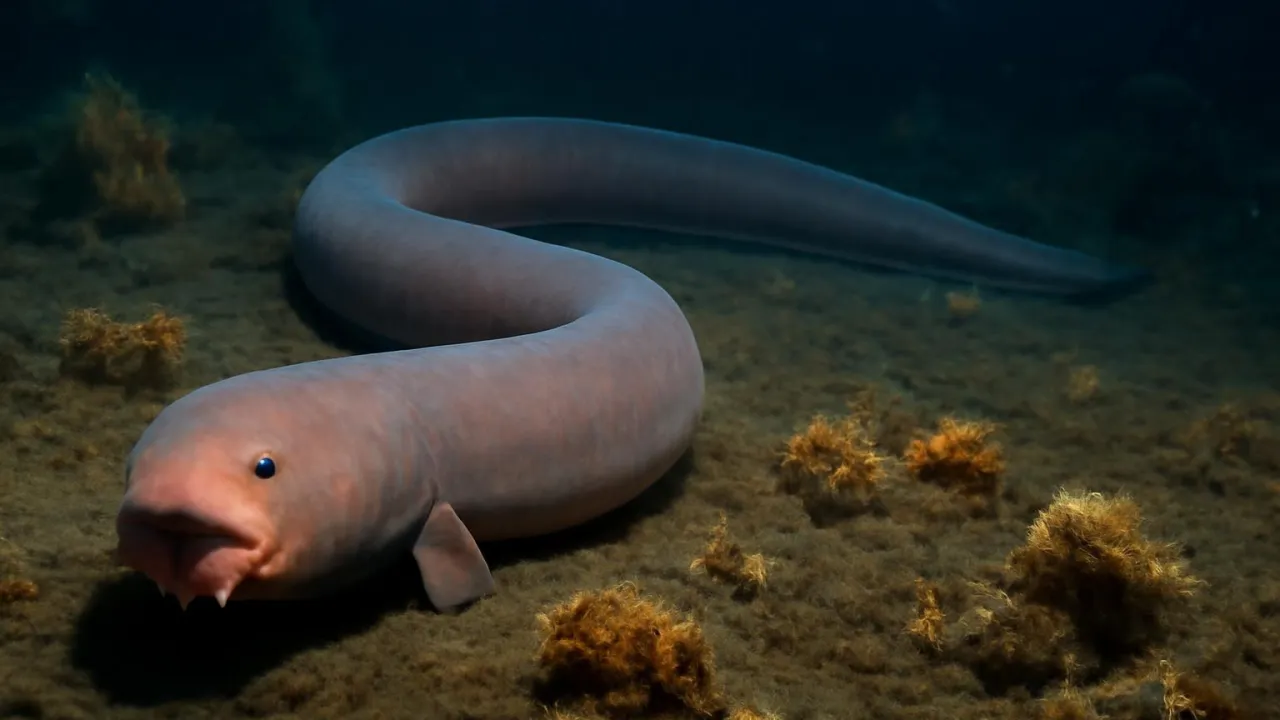
A Pacific Hagfish can produce slime so fast it can fill a bucket in seconds!
✨ Word Sparks (Grade 2 Glossary)
Tap 🔊 to hear
predator
An animal that hunts other animals
scavenge
To find and eat dead animals
crevice
A small crack or hole to hide in
🪝
Have you ever heard of a fish that makes slime to escape danger?
1
What Does the Pacific Hagfish Look Like?
The Pacific Hagfish is long and slimy with no bones. It wriggles like a snake to swim. Its skin is smooth and slippery. It has tiny eyes that help it see in the dark.
2
Where Does It Live and Hide?
This fish lives deep in the cold Pacific Ocean. It hides in muddy ocean floors and rocky . It likes places where it can stay safe from . The deep sea is dark and cold for the hagfish.
3
How Does It Eat and Stay Safe?
The hagfish eats dead animals by tearing their bodies with sharp teeth. It cleans the ocean floor by scavenging. When danger comes, it makes thick slime to escape quickly. The slime scares away bigger fish that want to eat it.
The Pacific Hagfish can produce slime threads 100 times thinner than a human hair!
✨ Word Sparks (Grade 3 Glossary)
Tap 🔊 to hear
adaptation
A body change that helps survival
scavenger
An animal that eats dead things
nutrients
Food parts that help living things grow
🪝
Did you know the Pacific Hagfish uses slime as a clever defense called adaptation?
1
Amazing Appearance and Movement
The Pacific Hagfish has a long, eel-like body covered with smooth skin. It moves by wriggling its body in a snake-like way to swim. Its tiny eyes can detect light but not clear images. This helps it live in dark ocean depths where sunlight is scarce.
2
Deep Ocean Habitat
This fish lives in the cold, deep waters of the Northeast Pacific Ocean. It hides in mud and rocky crevices on the ocean floor. The deep sea is a place with high pressure and little food. The hagfish’s body is adapted to survive in this harsh environment.
3
Feeding and Role in the Ecosystem
The hagfish is a that feeds on dead animals, breaking down their bodies. This process helps recycle in the ocean ecosystem. It uses its tooth-like structures to tear flesh from carcasses. By cleaning the ocean floor, it helps keep the environment healthy.
4
Slime Defense Adaptation
When threatened, the hagfish produces thick slime that clogs predators’ gills. This slime acts as a defense by making it hard for predators to breathe. The slime also makes the hagfish slippery and hard to catch. This helps it escape from dangerous animals.
2. What role does the hagfish play in its ecosystem?
🤯 Mind-Blowing Fact • Grade 4
Pacific Hagfish slime can expand to 10 liters from just a small amount of mucus!
✨ Word Sparks (Grade 4 Glossary)
Tap 🔊 to hear
metabolism
How the body uses energy to live
scavenger
An animal that eats dead animals
ecosystem
All living things and their home
🪝
How does the Pacific Hagfish’s slime affect its ocean ecosystem and survival?
1
Unique Body and Movement
The Pacific Hagfish has a flexible, eel-like body covered with smooth skin that secretes mucus. It moves by wriggling its body in a snake-like motion, which helps it glide through the water efficiently. Its small eyes are adapted to detect low light levels in deep ocean habitats. This body design allows it to survive in cold, dark, and high-pressure environments.
2
Deep-Sea Habitat and Distribution
This fish inhabits the deep waters of the Northeast Pacific Ocean, often found at depths between 100 and 1,200 meters. It prefers muddy ocean floors and rocky crevices where it can hide from predators. The deep-sea environment is nutrient-poor and cold, so the hagfish’s slow suits this habitat. Its presence plays an important role in deep-sea food webs.
3
Ecological Role and Feeding Behavior
As a , the Pacific Hagfish feeds on dead or dying animals by using its tooth-like structures to tear flesh apart. This feeding behavior recycles nutrients back into the and supports other marine life. The hagfish’s scavenging helps maintain a clean ocean floor, preventing the buildup of decaying matter. It also serves as prey for larger predators, linking food chains.
4
Slime Production and Defense Mechanism
When threatened, the hagfish produces a thick, sticky slime that expands rapidly in water, clogging predators’ gills and deterring attacks. This slime also makes the hagfish slippery, making it difficult for predators to grasp. The slime production is an effective defense that increases the hagfish’s chances of survival. Humans have studied this slime for materials science due to its unique properties.
1. Why is the hagfish’s slime important in its defense?
2. What role does the hagfish play in the ocean ecosystem?
🤯 Mind-Blowing Fact • Grade 5
Pacific Hagfish slime threads are 100 times thinner than human hair but stronger than steel fibers!
✨ Word Sparks (Grade 5 Glossary)
Tap 🔊 to hear
notochord
A flexible rod that supports the body
mucus
Slimy liquid made by animals to protect skin
biodegradable
Can break down naturally without pollution
🪝
How does the Pacific Hagfish’s unique physiology and slime production help it thrive in deep ocean environments?
1
Taxonomy and Scientific Classification
The Pacific Hagfish, scientifically named Eptatretus stoutii, belongs to the class Myxini, a group of jawless fishes. Unlike most fishes, hagfish lack vertebrae but have a flexible for support. They are considered primitive chordates and are closely related to lampreys. Their evolutionary history dates back over 300 million years, making them living fossils.
2
Physiological Adaptations and Mechanics
This species has a slender, elongated body covered with smooth, scaleless skin that secretes copious . The hagfish moves by rhythmic body contractions, allowing it to wriggle through narrow crevices. It possesses four pairs of barbels around its mouth to sense food in dark environments. Its slime glands can release up to 40 milliliters of slime that expands rapidly upon contact with seawater.
3
Ecological Role and Conservation Status
As a scavenger, the Pacific Hagfish plays a critical role in nutrient recycling by consuming dead or dying marine animals. This cleaning action supports deep-sea ecosystem health and stability. Although not currently endangered, hagfish face threats from deep-sea fishing and habitat disturbance. Conservation efforts focus on sustainable fishing practices and habitat protection.
4
Slime Composition and Material Science Interest
The slime consists of mucins and protein threads that create a fibrous network, giving it remarkable strength and elasticity. These protein threads are about 100 times thinner than human hair, making the slime lightweight yet tough. Scientists study hagfish slime for potential applications in materials and medical sutures. The slime’s rapid expansion can produce up to 10 liters from just a few milliliters of .
5
Quantitative Comparisons and Environmental Conditions
Pacific Hagfish can grow up to 24 inches (60 centimeters) in length and weigh around 1.5 pounds (0.7 kilograms). They inhabit depths ranging from 100 to 1,200 meters, where temperatures can drop to near freezing at about 2 degrees Celsius. Their slow metabolism suits these cold, low-oxygen environments. The slime production rate can reach up to 10 liters per minute, providing an effective defense against predators.