🧬 HUMAN BODY
🧬 Nephron • Renal Microanatomy & Urinary System
VA Science & Health SOL 1.1, 3.1, 4.2, 5.1 (Cells, Organs & Body Systems)
Nephrons
Two Million Microscopic Twisty Blood-Cleaning Tubes
Grade 5 • Advanced • 255 words
🩺 Body System & LocationRenal Cortex & Medulla • Packed Inside Both Kidneys
🔬 Size / Cell Count~1 million per kidney • 1.2–2 in (3–5 cm) each; ~60 mi (100 km) combined
⚙️ Core JobFilters blood plasma at high pressure and selectively reclaims water and nutrients
⚡ Body SuperpowerStretched end to end, your nephrons would span over 60 miles (100 km)
🤯 Mind-Blowing Fact • Grade 1
If you lined up all the tiny nephron tubes from both of your kidneys end to end, they would stretch for more than sixty miles!
✨ Word Sparks (Grade 1 Glossary)
Tap 🔊 to hear
Nephron
Tiny filtering tube working inside a kidney
Loop
A curved path that bends back around
Cup
Round hollow shape that catches drops
🪝
How can two million twisty water slides fit inside your two small kidneys?
1
Teeny-Tiny Cleaners
Zoom deep inside a kidney with a super microscope! Packed side by side sit one million tiny tubes called . You have two kidneys, so you own two million!
2
A Little Catcher's Mitt
Each starts with a tiny knot of blood tubes inside a little . Watery liquid squeezes into the cup, while red blood cells stay safe inside.
3
Down the Twisty Slide
Next, the liquid zooms down a long, -de-loop tube! Good water and sugar jump back into your blood, leaving yucky waste behind as pee.
1. About how many tiny nephrons are packed inside just ONE healthy human kidney?
2. What happens to red blood cells when liquid squeezes into a nephron's starting cup?
🤯 Mind-Blowing Fact • Grade 2
Each individual nephron is thinner than a single strand of hair on your head, yet it works twenty-four hours a day without taking a break!
✨ Word Sparks (Grade 2 Glossary)
Tap 🔊 to hear
Capillaries
Smallest, thinnest blood vessels in your body
Pores
Microscopic holes that let tiny drops pass
Reclaim
Take back something useful before losing it
🪝
What looks like a tiny ball of yarn tucked inside a teacup—and cleans your blood nonstop?
1
Yarn Ball in a Teacup
Picture a microscopic ball of red yarn sitting neatly inside a tiny funnel cup! Every nephron inside your kidneys begins just like that. Blood flows into the yarn-ball , and gentle pressure pushes water, salts, sugar, and waste through tiny into the cup.
2
The Rescue Roller Coaster
Right away, that liquid rides down a twisty roller-coaster tube. Friendly cells lining the tube grab every bit of sugar and almost all the water, handing them back to nearby blood vessels!
3
Only Waste Reaches the End
By the time the ride finishes, only leftover waste and extra water drip out the end as clean urine.
1. How thick is a single nephron tube compared to something you can see?
2. What happens to helpful glucose sugar after it enters the nephron tube?
🤯 Mind-Blowing Fact • Grade 3
The sharp U-turn in the middle of every nephron is called the loop of Henle, named after German anatomist Friedrich Gustav Jakob Henle who mapped it in 1862!
✨ Word Sparks (Grade 3 Glossary)
Tap 🔊 to hear
Glomerulus
Tiny capillary knot that filters incoming blood
Reabsorption
Pulling water and nutrients back into blood
Secretion
Moving extra wastes from blood into urine
🪝
How do three clever steps inside a microscopic nephron sort useful nutrients from leftover cellular trash?
1
Step One: Glomerular Filtration
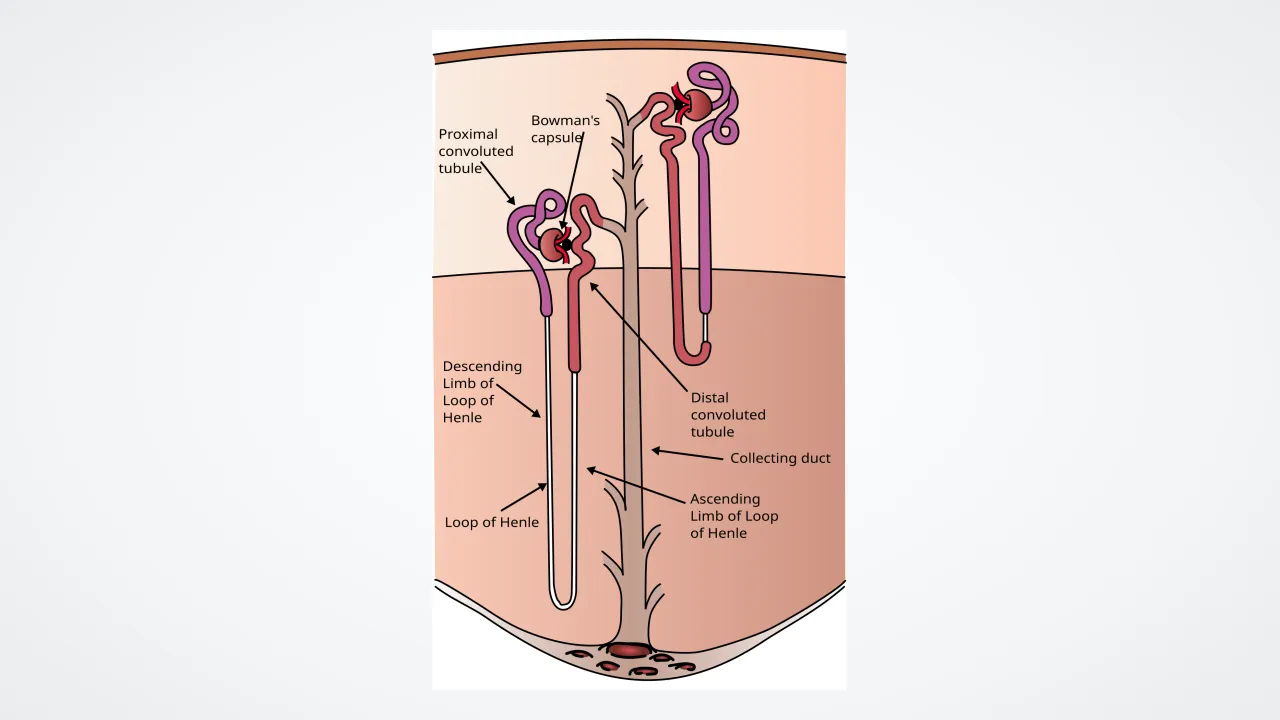
Zoom in 400 times on the outer layer of a kidney, and you will meet the kidney's true MVP: the nephron! Each nephron begins with a tangled tuft of leaky capillaries called the , cupped inside a hollow sphere named Bowman's capsule. Blood pressure squeezes watery plasma through microscopic slits while blocking large blood cells and proteins.
2
Step Two: Tubular Reabsorption
From Bowman's capsule, the filtered fluid twists through the proximal tubule and plunges down a sharp hairpin turn called the loop of Henle. Along this winding journey, hardworking wall cells pump glucose, amino acids, vitamins, and 99 percent of the water back into surrounding blood capillaries.
3
Step Three: Secretion and Final Tuning
Near the end, in the distal tubule, nephron cells actively toss extra potassium, acid ions, or leftover medicine molecules from the blood into the tube so your blood chemistry stays spot-on.
4
Meeting at the Collecting Duct
Finally, several nephrons empty into a shared collecting duct, listening to brain hormones to decide whether to save even more water on hot days!
What octopus-shaped cells wrap their tiny 'feet' around nephron capillaries to build a self-cleaning biological sieve?
1
Podocytes: Cells With Tiny Feet
Peer at a nephron's glomerulus through an electron microscope, and it looks like an alien coral reef! Wrapping tightly around the porous capillaries are star-shaped cells called —from Greek roots meaning 'foot cells.' Thousands of interlocking foot processes leave narrow 30-nanometer gaps called filtration slits. Paired with negatively charged basement membranes, these slits block negatively charged blood proteins like albumin while letting water, glucose, ions, and urea zip freely into Bowman's capsule.
2
Workhorse of the Proximal Tubule
Immediately downstream, the proximal convoluted tubule performs heavy-duty recycling. Packed with mitochondria and feathery microvilli, its cells reclaim 100 percent of filtered glucose and amino acids alongside roughly two-thirds of all filtered water and sodium before fluid ever reaches the loop!
3
Salty Magic of the Loop of Henle
Why dive deep into the renal medulla? The descending limb of the loop of Henle lets water slip out easily but blocks salt, whereas the thick ascending limb actively pumps salt out into medullary tissue while blocking water! This clever multiplier makes the deep medulla super salty.
4
ADH Opens the Water Gates
When your brain senses dehydration, it releases antidiuretic hormone (), inserting aquaporin water channels into collecting ducts so the salty medulla draws water right back into your blood!
1. How do the two sides of the loop of Henle create a salty environment deep in the kidney medulla?
2. What happens in the collecting duct when your brain releases antidiuretic hormone (ADH) on a hot, sweaty afternoon?
🤯 Mind-Blowing Fact • Grade 5
Unlike skin or liver cells, you are born with your lifetime supply of roughly two million nephrons—and desert kangaroo rats have extra-long loops of Henle that concentrate urine over fifteen times more than blood!
Membrane protein moving two molecules across together
Vasopressin
Scientific name for water-saving antidiuretic hormone
🪝
How do desert mammals and humans alike concentrate urine up to four times saltier than blood without owning a single active 'water pump' molecule?
1
Bowman, Malpighi, and the Three-Layer Barrier
First glimpsed as tiny 'corpuscles' by Italian microscopist Marcello Malpighi in 1666 and mapped to tubular ducts by twenty-six-year-old British surgeon William Bowman in 1842, the nephron is the fundamental functional unit of the vertebrate kidney. Each human kidney houses roughly 900,000 to 1.2 million nephrons—a finite endowment completed before birth! Filtration across the renal corpuscle relies on a three-layered molecular sieve: fenestrated glomerular endothelium, a negatively charged glomerular basement membrane rich in heparan sulfate, and slit diaphragms bridging podocyte pedicels.
2
Hemodynamic Control: Twin Arterioles
Uniquely in human circulation, the glomerulus sits sandwiched between two resistance —an incoming afferent arteriole and a narrower outgoing efferent arteriole—maintaining high hydrostatic capillary pressure (~55 mmHg) even when systemic blood pressure fluctuates. Downstream, low-pressure peritubular capillaries and hairpin vasa recta hug the tubules to reclaim resorbed solutes.
3
Cotransporters in the Proximal Convoluted Tubule
Powered by basolateral sodium-potassium ATPase pumps, proximal tubule epithelial cells drive secondary active transport via SGLT2 and SGLT1 sodium-glucose , reclaiming ~67 percent of filtered water, sodium, chloride, and potassium plus virtually 100 percent of filtered glucose and amino acids unless blood glucose exceeds the renal threshold (~180 mg/dL).
4
Countercurrent Multiplication in Juxtamedullary Nephrons
While 85 percent of nephrons are cortical, 15 percent are juxtamedullary nephrons plunging deep into the inner medulla. Using NKCC2 salt transporters in the water-impermeable thick ascending limb alongside urea recycling, they build a steep interstitial gradient rising from 300 mOsm/L in the cortex to 1,200 mOsm/L at the papilla—driving passive osmotic water recovery whenever (ADH) deploys aquaporin-2 channels.
5
Protecting Lifetime Nephrons
Because adult humans cannot grow brand-new nephrons, staying well hydrated and maintaining healthy blood pressure preserves these microscopic marvels for a lifetime.