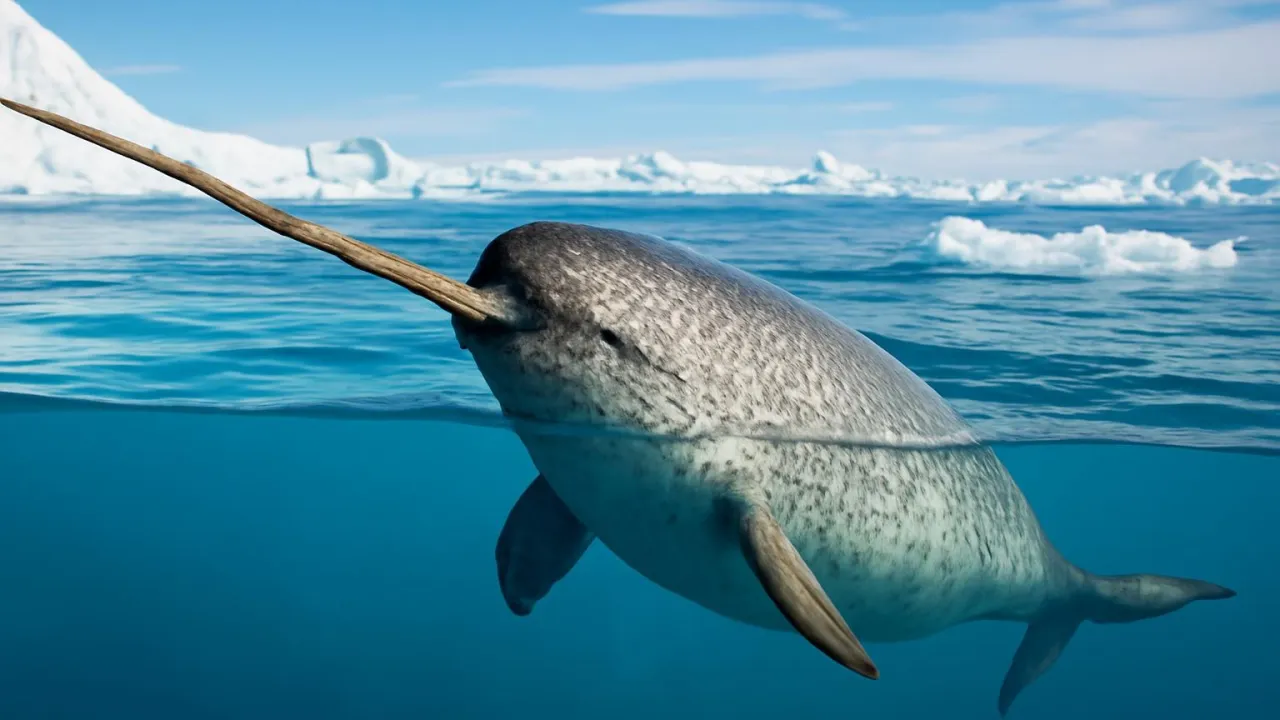
Narwhal tusks have millions of nerve endings to sense the environment!
✨ Word Sparks (Grade 2 Glossary)
Tap 🔊 to hear
tusk
A long tooth that sticks out
echolocation
Using sound to find things
pod
A group of animals living together
🪝
Have you ever heard of a whale with a magical spiral horn?
1
Narwhal’s Unique Tusk
Narwhals have a long, spiral that can grow up to ten feet long. This tusk is actually a tooth that grows out of their head. Scientists believe the tusk helps narwhals sense their surroundings in icy waters. It is a very special feature that only male narwhals usually have.
2
Where Narwhals Live
Narwhals live in the cold Arctic Ocean where there is lots of sea ice. They swim under the ice to find food and stay safe from predators. The Arctic is very cold, but narwhals are well adapted to live there all year round. They often travel in groups called .
3
What Narwhals Eat
Narwhals eat fish, squid, and shrimp that live in cold water. They use to find food in dark water under the ice. Their diet gives them the nutrients they need to stay strong and healthy. Narwhals can dive deep to catch their prey.
Narwhal tusks contain up to ten million nerve endings to sense their environment!
✨ Word Sparks (Grade 3 Glossary)
Tap 🔊 to hear
echolocation
Using sound waves to find things
adaptation
A body change that helps survival
predator
An animal that hunts other animals
🪝
Did you know narwhals use their tusks to sense icy water changes?
1
The Amazing Narwhal Tusk
Narwhals have a long, spiral tusk that can reach up to ten feet in length. This tusk is actually an enlarged tooth with millions of nerve endings inside. It helps narwhals detect changes in water temperature and pressure around them. This gives them an advantage in the cold Arctic Ocean.
2
Narwhal Habitat and Behavior
Narwhals live in the Arctic Ocean where sea ice covers the water much of the year. They swim in pods to protect each other from like orcas and polar bears. Narwhals use to find food and navigate through dark, icy waters. Their bodies are adapted to cold water with thick blubber for warmth.
3
What Narwhals Eat
Narwhals feed on fish, squid, and shrimp found deep under the Arctic ice. They dive up to 1,500 meters to catch their prey using . Their diet provides essential nutrients needed for energy and survival. Narwhals have sharp teeth to help them catch slippery fish.
4
Narwhal’s Role in the Arctic
Narwhals are an important part of the Arctic food web, serving as prey for larger . They help balance the ecosystem by controlling fish and squid populations. Humans also rely on narwhals for cultural and subsistence hunting in Arctic communities. Protecting narwhals helps keep the Arctic environment healthy.
Narwhal tusks can detect tiny changes in water pressure and temperature to find prey.
✨ Word Sparks (Grade 4 Glossary)
Tap 🔊 to hear
salinity
How salty the water is
ecosystem
All plants and animals living together
migration
Moving from one place to another
🪝
How does a narwhal’s tusk help it survive in icy Arctic waters?
1
Narwhal Tusk and Sensory Powers
The narwhal’s tusk is a long, spiral tooth that can grow over ten feet long, filled with millions of nerve endings. This unique tusk acts like a sensory organ, allowing the narwhal to detect changes in water temperature, pressure, and , which helps it find food and avoid danger. This cause-and-effect relationship between tusk sensitivity and survival is a remarkable adaptation to the Arctic environment. Male narwhals usually have the tusk, while females rarely grow one.
2
Arctic Habitat and Behavior
Narwhals live in the Arctic Ocean and surrounding seas where sea ice forms much of the year, creating a challenging environment. They travel in pods to protect each other from predators such as orcas and polar bears, which rely on them for food. Narwhals use echolocation to navigate and hunt in the dark, icy waters under the ice. Their thick blubber insulates them from freezing temperatures, allowing them to thrive in cold habitats.
3
Narwhal’s Role in the Arctic Ecosystem
As mid-level predators, narwhals help control populations of fish, squid, and shrimp, maintaining balance in the Arctic food web. They are also prey for larger predators, linking different levels of the together. Indigenous Arctic peoples have hunted narwhals sustainably for centuries, relying on them for food and cultural traditions. Human activities like climate change and pollution threaten narwhal habitats, showing the impact of humans on this fragile ecosystem.
4
Geographic Distribution and Migration
Narwhals are found mainly in the Arctic waters of Canada, Greenland, and Russia, migrating seasonally to follow food sources and ice conditions. During summer, they move closer to coastal areas, while in winter, they stay under dense sea ice. This pattern helps them access the best feeding grounds and avoid predators. Understanding their movement is important for conservation efforts.
1. Why is the narwhal tusk important for survival?
2. What role do narwhals play in the Arctic ecosystem?
🤯 Mind-Blowing Fact • Grade 5
Narwhal tusks contain millions of nerve endings that detect water temperature and pressure changes precisely.
✨ Word Sparks (Grade 5 Glossary)
Tap 🔊 to hear
cetacean
A group of sea mammals like whales
trophic
Relating to feeding levels in food chains
blubber
Thick fat that keeps animals warm
🪝
How does the narwhal’s unique tusk function as a sensory organ in the Arctic Ocean?
1
Taxonomy and Scientific Classification
The narwhal, scientifically named Monodon monoceros, belongs to the family Monodontidae, which includes only one other species, the beluga whale. It is a mammal adapted to Arctic marine environments. Its closest relatives are dolphins and other toothed whales. The species name ‘monoceros’ means ‘one horn,’ referring to its distinctive tusk.
2
Physiological Mechanics of the Tusk
The narwhal’s tusk is an elongated left canine tooth that spirals counterclockwise and can grow up to ten feet long. It contains millions of sensory nerve endings beneath the enamel, allowing it to detect subtle changes in water temperature, pressure, and salinity. This sensory capability helps narwhals locate prey and navigate the icy Arctic waters efficiently. The tusk’s structure also provides mechanical strength despite its length.
3
Conservation Status and Human Impact
Narwhals are currently classified as Near Threatened due to climate change, habitat loss, and increased human activities in the Arctic. Melting sea ice affects their migration and feeding patterns, while pollution and noise disrupt their communication. Indigenous communities have sustainably hunted narwhals for centuries, but modern threats require international conservation efforts. Protecting narwhals helps preserve Arctic biodiversity.
4
Ecological Role and Food Web Interactions
Narwhals occupy a mid-level position in the Arctic marine food web, preying on fish, squid, and shrimp while serving as prey for orcas and polar bears. Their feeding behavior influences prey population dynamics and nutrient cycling. The balance they help maintain supports the health of Arctic ecosystems. Changes in narwhal populations can have cascading effects throughout the food web.
5
Quantitative Comparisons and Adaptations
Adult narwhals measure between 13 and 18 feet in length and weigh up to 3,500 pounds. They can dive to depths exceeding 1,500 meters and hold their breath for up to 25 minutes. Their thick insulates against water temperatures as low as -1.8 degrees Celsius. The tusk grows approximately 7 centimeters per year and is stronger than human bone despite its slender shape.