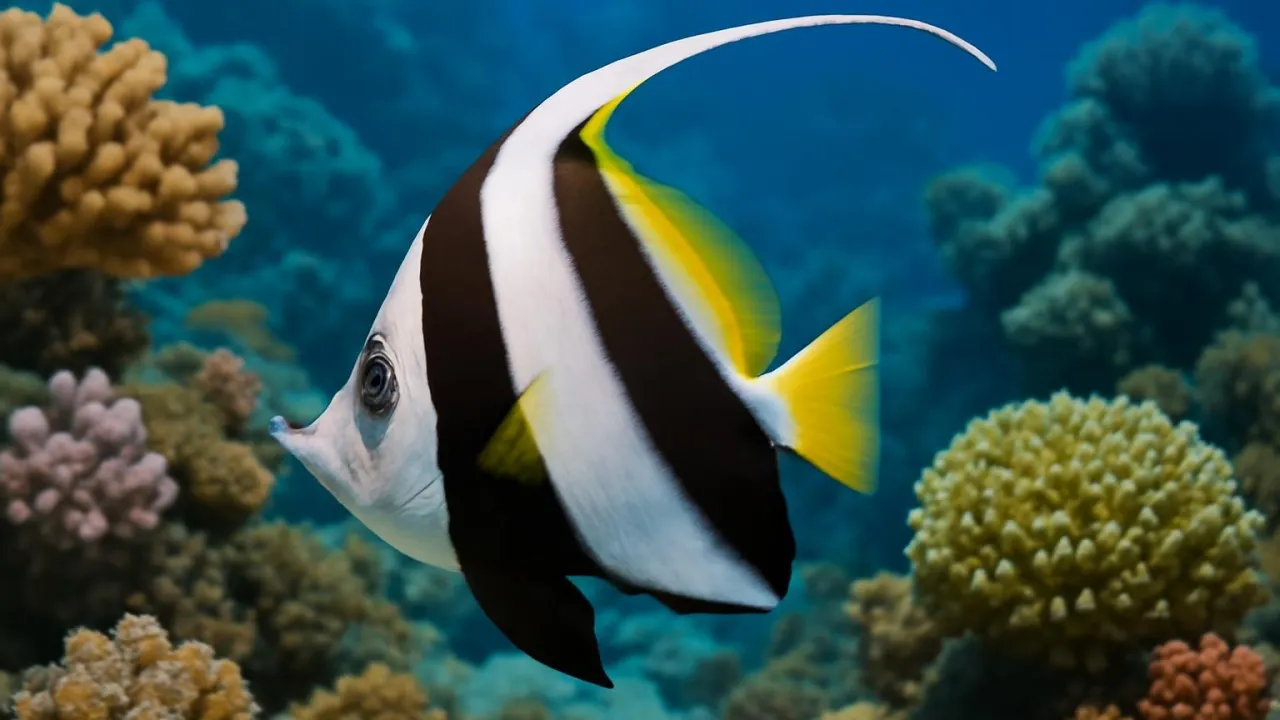
Moorish Idols can swim backward by quickly moving their fins!
✨ Word Sparks (Grade 2 Glossary)
Tap 🔊 to hear
dorsal fin
The fin on a fish’s back
predators
Animals that hunt other animals
nutrients
Food parts that help living things grow
🪝
Have you ever seen a fish with a long, ribbon-like fin?
1
Colorful Stripes and Fin
The Moorish Idol has bold black and white stripes with bright yellow highlights. Its long looks like a ribbon waving in the water. These colors help it blend into coral reefs. The fin also helps it swim quickly and turn sharply.
2
Home in Coral Reefs
This fish lives in warm tropical waters around coral reefs. It hides among the coral branches to stay safe from . The reefs provide food and shelter. Moorish Idols often swim in pairs or small groups near the reef.
3
Eating Algae and Sponges
Moorish Idols eat tiny plants called algae and small animals called sponges. They use their small mouths to pick food from crevices. Their diet helps keep the reef clean and healthy. Eating sponges also gives them important .
1. What does the Moorish Idol use its long fin for?
2. What does the Moorish Idol eat?
🤯 Mind-Blowing Fact • Grade 3
Moorish Idols are one of the few fish that can swim backward to avoid threats.
✨ Word Sparks (Grade 3 Glossary)
Tap 🔊 to hear
camouflage
Colors that help animals hide
ecosystem
All living things and places together
crevices
Small cracks or spaces in rocks
🪝
Did you know the Moorish Idol uses its stripes to hide from predators?
1
Stripes and Camouflage
The Moorish Idol’s black, white, and yellow stripes help it blend into coral reefs. This protects it from predators. Its long dorsal fin helps it make quick turns to escape danger. These adaptations improve its chances of survival in the ocean.
2
Coral Reef Habitat
Moorish Idols live in warm tropical waters near coral reefs. Coral reefs provide shelter and food for many fish. The reefs’ complex structures offer hiding spots from predators. This fish often swims in pairs, which helps with protection and finding food.
3
Diet and Feeding
Moorish Idols eat algae and sponges found on coral reefs. Their small, tube-like mouths allow them to reach food in narrow . Eating sponges helps control their growth on reefs. This diet provides essential nutrients for the fish’s health.
4
Role in the Ecosystem
By eating algae and sponges, Moorish Idols help keep coral reefs healthy. This cleaning role supports other reef animals that depend on coral. Their presence contributes to the reef’s balanced food web. Protecting Moorish Idols helps protect coral reef .
2. Why is the Moorish Idol important to coral reefs?
🤯 Mind-Blowing Fact • Grade 4
Moorish Idols’ long dorsal fin can be over half their body length, helping them maneuver expertly.
✨ Word Sparks (Grade 4 Glossary)
Tap 🔊 to hear
adaptation
A trait that helps animals survive
overgrowth
Too much growth that causes harm
sustainable
Using resources without harming nature
🪝
How does the Moorish Idol’s unique fin shape help it survive in coral reefs?
1
Adaptations for Survival
The Moorish Idol’s long, trailing dorsal fin allows it to make swift turns and quick escapes from predators in coral reefs. Its bold black, white, and yellow stripes provide effective camouflage among the colorful corals. These work together to increase its chances of survival in a competitive ecosystem.
2
Ecological Role in Coral Reefs
By feeding on algae and sponges, the Moorish Idol helps control their growth on coral reefs, which prevents that can harm coral health. This cleaning role supports the entire reef ecosystem by maintaining balance and providing habitat for many marine species. Its presence benefits both coral and other reef animals.
3
Geographic Range and Habitat
Moorish Idols are found throughout the Indo-Pacific region, including the Red Sea, Hawaii, and Australia’s Great Barrier Reef. They prefer shallow, warm waters where coral reefs thrive. These habitats provide abundant food and shelter necessary for their survival and reproduction.
4
Human Impact and Conservation
Although popular in aquariums, Moorish Idols are difficult to keep in captivity due to their specialized diet and habitat needs. Overfishing and coral reef destruction threaten their wild populations. Conservation efforts focus on protecting coral reefs and fishing to preserve this species for future generations.
1. Why does the Moorish Idol have stripes and a long fin?
2. What threatens Moorish Idols in the wild?
🤯 Mind-Blowing Fact • Grade 5
Moorish Idols are the only living species in their family, making them a one-of-a-kind fish in the ocean!
✨ Word Sparks (Grade 5 Glossary)
Tap 🔊 to hear
taxonomic
How scientists group living things
physiological
How a body works and moves
specialized
Designed to do one specific job
🪝
What fascinating features help the Moorish Idol thrive in diverse Indo-Pacific coral reefs?
1
Taxonomy and Scientific Classification
The Moorish Idol, scientifically named Zanclus cornutus, belongs to the family Zanclidae. It is the only extant species in this family, making it unique among reef fishes. Its classification places it within the order Perciformes, which includes many popular reef fish species. This uniqueness highlights its evolutionary importance.
2
Physiological Mechanics and Adaptations
The Moorish Idol’s elongated dorsal fin, which can exceed half its body length, provides remarkable maneuverability in complex reef environments. Its small, protruding mouth allows precise feeding on sponges and algae hidden in narrow crevices. The fish’s coloration serves as both camouflage and a communication signal to other fish. These traits enhance its survival and reproductive success.
3
Ecological Role and Conservation Challenges
As a feeder on sponges and algae, the Moorish Idol plays a critical role in maintaining coral reef health by preventing overgrowth. However, habitat degradation from coral bleaching and human activities threatens its populations. Due to its dietary specialization, it is challenging to sustain Moorish Idols in captivity, complicating conservation efforts. Protecting reef habitats is essential for their survival.
4
Botanical and Culinary Clarifications
Unlike some reef species mistakenly called 'fruits' or 'vegetables' in culinary contexts, the Moorish Idol is a true fish with no botanical classification. Its diet includes sponges and algae, which are plant-like and animal-like organisms respectively, showing the complexity of reef food webs. Understanding these distinctions helps clarify marine biology concepts.
5
Quantitative Comparisons and Behavior
Moorish Idols typically grow between 7 to 9 inches (18 to 23 centimeters) and can swim at speeds up to 5 miles per hour (8 kilometers per hour). Their dorsal fin length can be more than 4 inches (10 centimeters), aiding in precise movements. They inhabit waters ranging from 3 to 100 feet (1 to 30 meters) deep, adapting to various reef zones. These measurements illustrate their niche in coral ecosystems.