1. How many twin cells are made when one cell finishes mitosis?
2. What does mitosis help fix when you fall on the playground?
🤯 Mind-Blowing Fact • Grade 2
Every human on Earth started out as just one single microscopic cell before mitosis multiplied it into trillions!
✨ Word Sparks (Grade 2 Glossary)
Tap 🔊 to hear
Divide
To split one whole thing into separate parts
Identical
Exactly the same in every single detail
Fiber
A tiny thread that pulls DNA sets apart
🪝
How does your skin heal a scratch without leaving a hole behind?
1
A Busy Copying Dance
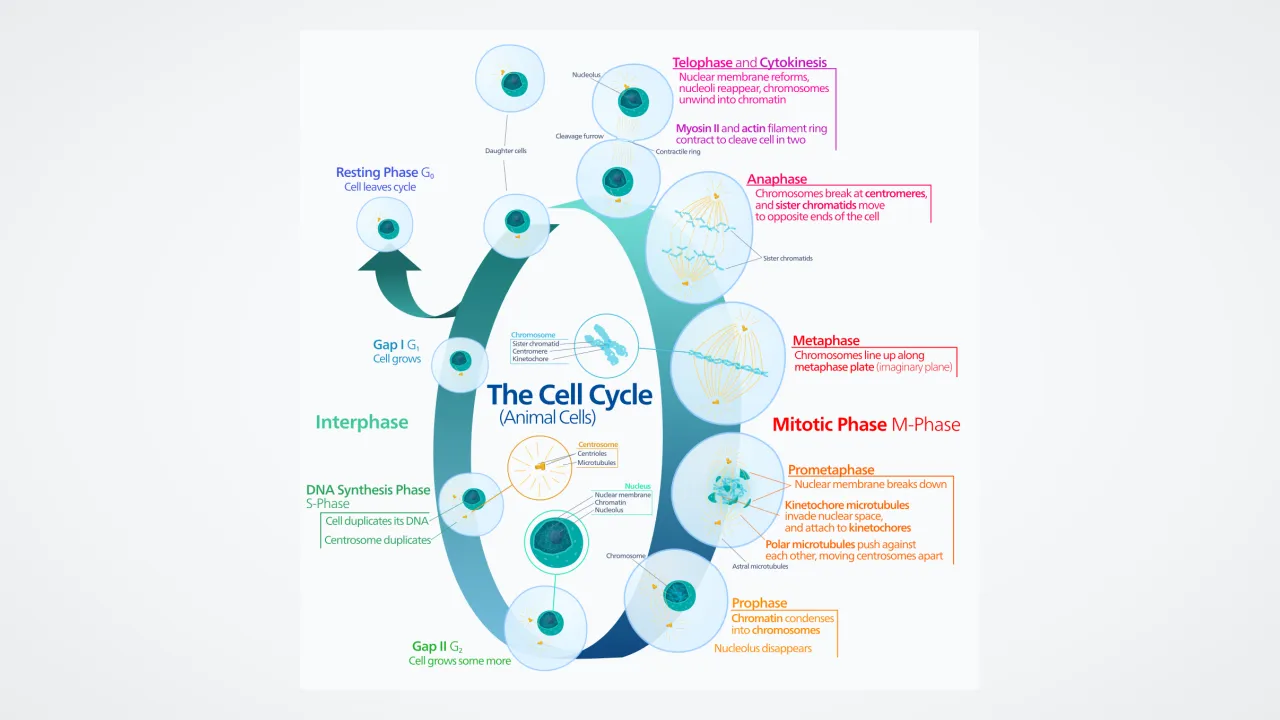
Picture one microscopic cell getting ready to . Before it splits, the cell carefully copies all of its DNA instructions so nothing gets lost. This amazing cell-splitting dance is called mitosis!
2
Line Up and Pull Apart
Inside the cell, tiny grab the copied DNA bundles and line them up down the middle. Then the fibers pull one full set to each side. Finally, the middle pinches shut to form two daughter cells.
3
Growing and Healing
Your body uses mitosis every day to grow longer bones and replace old skin flakes. Stomach lining cells super fast, while most brain nerve cells almost never divide once they finish growing!
2. Where do copied DNA bundles line up right before pulling apart?
🤯 Mind-Blowing Fact • Grade 3
Cells lining your small intestine work so hard that mitosis replaces them with fresh cells every three to five days!
✨ Word Sparks (Grade 3 Glossary)
Tap 🔊 to hear
Spindle
Tiny protein threads that guide chromosomes apart
Metaphase
Mitosis stage where chromosomes line up centered
Cytokinesis
Final pinch splitting one cell into two
🪝
How can one cell divide into two without either new cell missing a single chromosome?
1
Preparing During Interphase
Long before a cell visibly splits, it spends hours preparing during a stage called interphase. The cell grows larger, builds extra organelles, and duplicates all forty-six chromosomes so each has an exact twin.
2
Four Smooth Steps: PMAT
Scientists remember the four main steps of mitosis with the letters PMAT! In prophase, chromosomes coil tightly and the nucleus wrapper dissolves. During , fibers line every chromosome pair neatly along the cell's center.
3
Pulling to Opposite Poles
Next comes anaphase, when fibers reel one copy of each chromosome toward opposite ends of the cell. In telophase, two brand-new nuclei form around the separated chromosome sets so each side is safe.
4
Pinching Into Two
Right at the end, a process called pinches the squishy cell membrane down the middle like a drawstring bag. Pop! Two genetically identical daughter cells are ready to heal cuts and help you grow.
2. What is the final pinch that separates the two new daughter cells called?
🤯 Mind-Blowing Fact • Grade 4
In the 1870s, biologist Walther Flemming stained salamander cells with fabric dye and watched dancing threads split—naming the process mitosis from the Greek word for thread!
✨ Word Sparks (Grade 4 Glossary)
Tap 🔊 to hear
Chromatid
One of two identical halves of copied chromosomes
Centromere
Central pinch point holding sister chromatids together
Checkpoint
Safety pause checking DNA before a cell splits
🪝
What keeps trillions of dividing cells organized so every new skin or bone cell gets all forty-six chromosomes?
1
Doubling the Blueprint First
Imagine photocopying a forty-six-volume encyclopedia without making a single typo, then handing complete sets to two builders. Before mitosis begins, a cell completes interphase, duplicating its DNA so each chromosome consists of two identical sister fastened together at a central hub called a .
2
Choreography of the Spindle
Once mitosis launches with prophase, loose DNA condenses into sturdy X-shaped chromosomes while protein cables called spindle fibers extend from opposite sides of the cell. During metaphase, those spindle cables attach to every and tug gently until all chromosomes align along the cell's equator.
3
Precision Separation
In anaphase, the latches snap open, and motor proteins reel sister toward opposite poles like tiny winches. Telophase wraps a fresh nuclear membrane around each cluster of forty-six chromosomes, and cytokinesis squeezes a ring of muscle-like protein around the middle to pinch the cytoplasm into two identical somatic cells.
4
Built-In Safety Checkpoints
Cells never rush blindly through division. Special proteins inspect the DNA for damage and verify that every single chromosome is hooked properly to spindle fibers before allowing anaphase to start. Different tissues set different speeds: skin and bone marrow divide constantly, liver cells divide mainly when repairs are needed, and mature heart muscle cells rarely divide at all.
1. What holds two identical sister chromatids together before anaphase?
2. Why do cells pause at safety checkpoints during the cell cycle?
🤯 Mind-Blowing Fact • Grade 5
During prophase, cells pack two meters of fragile DNA thread so tightly that chromosomes become ten thousand times shorter and thick enough to view through a classroom microscope!
✨ Word Sparks (Grade 5 Glossary)
Tap 🔊 to hear
Diploid
Containing two complete sets of forty-six chromosomes
Kinetochore
Protein handle where spindle fibers grab chromosomes
Microtubule
Hollow protein tube forming mitotic spindle cables
🪝
How does a single cell orchestrate molecular motors, protein cables, and quality-control sensors to replace two trillion human cells every day?
1
The Somatic Cell Cycle
Every day, the human body loses billions of worn-out skin, blood-precursor, and digestive cells, replacing them seamlessly through mitosis—nuclear division that yields two genetically identical daughter cells. Mitosis actually occupies only about one hour of a much longer cell cycle. During the preceding interphase—divided into G1 growth, S synthesis, and G2 preparation phases—enzymes replicate three billion DNA base pairs, linking identical sister chromatids at their centromeres.
2
Prophase and Metaphase Mechanics
When mitosis commences in prophase, chromatin coils roughly ten thousand times tighter into compact chromosomes that resist tangling, while centrosomes migrate to opposite poles spinning a web of spindle fibers. After the nuclear envelope disassembles, spindle microtubules capture protein complexes called on each centromere. By metaphase, balanced tug-of-war forces align all forty-six replicated chromosomes precisely along the equatorial metaphase plate.
3
Anaphase Motors and Cytokinesis
Only when every registers proper tension does the spindle assembly checkpoint give the green light. Instantly, enzymes snip the glue proteins holding sister chromatids together, launching anaphase as shorten and haul separated chromosomes to opposite poles. During telophase, nuclear envelopes reassemble and chromosomes uncoil, while a contractile ring of actin and myosin filaments pinches the plasma membrane inward during cytokinesis.
4
Guardians of Cellular Order
Molecular regulators called cyclins and cyclin-dependent kinases act like traffic signals pacing the cell cycle, while guardian proteins such as p53 halt division if DNA damage appears. If repairs succeed, division resumes; if damage is beyond repair, the cell safely retires itself so faulty instructions are not copied.
5
Flemming's Threads to Modern Medicine
German anatomist Walther Flemming first sketched chromosomal choreography in 1882 using aniline dyes on translucent salamander fins, coining mitosis from mitos, Greek for thread. Today, studying mitotic checkpoints helps biomedical researchers accelerate wound regeneration and design targeted therapies when cells ignore stop signals and divide uncontrollably.