2. What two meanings does the Russian word 'Mir' have?
🤯 Mind-Blowing Fact • Grade 2
Scientists aboard Mir grew the very first wheat crops from seed to new seed in outer space—proving space gardens can feed future travelers!
✨ Word Sparks (Grade 2 Glossary)
Tap 🔊 to hear
weightlessness
Floating freely in orbit without feeling heavy
docking port
Doorway ring where visiting spacecraft connect tightly
treadmill
Moving belt machine used for indoor running exercise
🪝
What was daily life like floating 240 miles up for more than a year straight?
1
Growing Over Ten Years
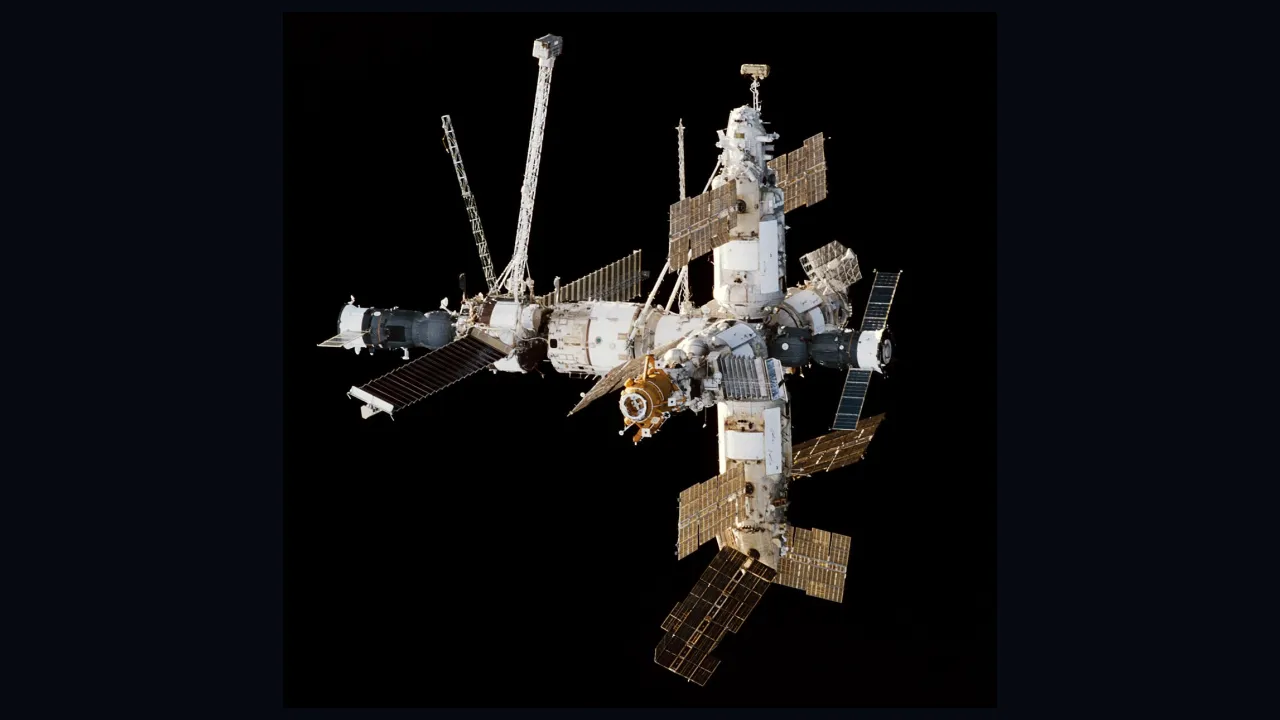
Earlier space stations were single tubes launched all at once. Starting in 1986, the Soviet Union launched Mir's main core with a six-port docking ball on its nose, adding six science labs over ten years until it bristled like a giant dragonfly!
2
Sixteen Sunrises Every Day
Zipping around Earth at 17,500 miles per hour, crews watched sixteen sunrises every day! To keep bones and muscles strong in , cosmonauts strapped onto for two hours daily.
3
Shuttle-Mir Handshakes
During the 1990s, NASA Space Shuttles docked with Mir eleven times, paving the way for today's International Space Station!
1. Why did cosmonauts and astronauts strap themselves onto treadmills every day on Mir?
2. How many sunrises did Mir's crew zoom past every twenty-four hours?
🤯 Mind-Blowing Fact • Grade 3
The very first citizen from Britain in space, chemist Helen Sharman, won her seat to Mir in 1991 after answering an ad she heard on her car radio!
✨ Word Sparks (Grade 3 Glossary)
Tap 🔊 to hear
grapple
To grab and lock onto hardware securely
reentry
Returning downward from space into Earth's thick atmosphere
modular
Built from separate units combined into a whole
🪝
How did swinging robot arms walk giant bus-sized rooms from one doorway to another in orbit?
1
A Five-Way Docking Hub
Think of Mir's nose as a round cosmic roundabout with five doorways! Each time a twenty-ton laboratory module like Kvant-2, Kristall, Spektr, or Priroda arrived on an automated rocket, it docked straight onto the front port first.
2
Swinging Rooms Into Place
Next, a short pivoting mechanical arm called the Lyappa grappled a socket on the core and swung the entire school-bus-sized room ninety degrees sideways onto a permanent side port—clearing the front door for visiting Soyuz crews!
3
Teamwork Through Tough Tests
Planned to last just five years, Mir worked for fifteen! In 1997, Russian cosmonauts and NASA astronauts worked heroically together to overcome an oxygen-canister fire and a cargo-ship collision that punctured the Spektr lab.
4
Safe Splash in the Pacific
Having welcomed 104 spacefarers from twelve nations, aging Mir made a controlled into the empty South Pacific Ocean in March 2001.
1. How did Mir move newly arrived laboratory modules from its front docking port to its side ports?
2. How long did Mir operate in orbit compared to its original five-year design plan?
🤯 Mind-Blowing Fact • Grade 4
Mir's unlaunched twin sister core module didn't stay in a warehouse—it was upgraded into the Zvezda module and is STILL orbiting Earth today as part of the International Space Station!
Splitting water molecules with electricity to make oxygen
scrubber
Filter system removing exhaled carbon dioxide from air
🪝
Why must space engineers study Mir before daring to send human crews on a two-year round trip to Mars?
1
Medical Laboratory for Deep Space
Before humanity could dream of multi-year voyages to Mars, doctors had to answer a vital question: can the human heart, bones, balance system, and immune cells endure more than a year of and bounce back on Earth? Physician-cosmonaut Valeri Polyakov volunteered himself as the test subject aboard Mir from January 1994 to March 1995—logging 437 days and 18 hours straight in orbit, then walking proudly from his Soyuz capsule to a nearby lawn chair under his own power!
2
Recycling Air and Water in Closed Loops
Delivering every liter of water by rocket is enormously expensive. Mir pioneered Elektron units that split recycled cabin humidity and wastewater into breathable oxygen, alongside Vozdukh carbon-dioxide —systems whose descendants still sustain crews on the International Space Station today.
3
Lessons Forged in Crisis
During the 1990s Shuttle-Mir partnership, seven continuous NASA astronauts—including Shannon Lucid and Jerry Linenger—shared Mir's cramped, cable-lined corridors. Surviving 1997's Progress cargo-ship collision taught joint Houston-Moscow teams crisis communication, hatch-sealing protocols, and zero-power attitude recovery that directly shaped ISS safety rules.
4
Direct Ancestor of the ISS
In fact, Mir's intended backup core module—upgraded and renamed Zvezda—was launched in 2000 as the living-quarters heart of the International Space Station!
1. Why was Valeri Polyakov's 437-day stay aboard Mir a landmark for future Mars missions?
2. What happened to the backup core module originally built as Mir-2?
🤯 Mind-Blowing Fact • Grade 5
Cosmonaut Sergei Krikalev was orbiting aboard Mir in December 1991 when the Soviet Union dissolved on Earth—earning him the nickname 'the last Soviet citizen' until he landed in 1992!
✨ Word Sparks (Grade 5 Glossary)
Tap 🔊 to hear
monolithic
Built and launched as one single undivided structure
gyrodyne
Heavy spinning flywheel tilting a space station without fuel
Point Nemo
Remote South Pacific ocean spot farthest from any land
🪝
How did a Cold War outpost launched in 1986 outlive the nation that built it and unite former space rivals in orbit?
1
Third-Generation Evolution Beyond Salyut
Earlier Soviet Salyut stations and America's Skylab were single-launch cylinders with only one or two axial docking ports—limiting both interior volume and resupply flexibility. Launched atop a Proton-K rocket on February 20, 1986, Mir's DOS-7 Core Module introduced a five-berth spherical node at its forward end. Between 1987 and 1996, Kvant-1 astrophysics observatory, Kvant-2 airlock lab, Kristall materials furnace, Spektr Earth-science module, a Shuttle Docking Module, and Priroda radar lab expanded Mir into a 130-metric-ton research complex.
2
Gyrodynes and Regenerative Life Support
Steering a sprawling, asymmetric cluster without burning mountains of thruster fuel required arrays of electrically spun control-moment gyroscopes called inside Kvant-1 and Kvant-2. Inside the hull, regenerative environmental systems reclaimed condensed breath and wash water, grew dwarf wheat and brassica across multiple generations in the Svet greenhouse, and ran X-ray astronomy observations of Supernova 1987A.
3
Geopolitical Pivot and Cosmonaut Sergei Krikalev
Mir literally outlived its birthplace: cosmonaut Sergei Krikalev launched from the Soviet Union in May 1991 and landed ten months later as a citizen of the newly independent Russian Federation! Soon after, the 1994–1998 Shuttle-Mir Program merged American Space Shuttle upmass with Russian long-duration expertise across eleven Atlantis, Endeavour, and Discovery dockings.
4
Trial by Fire and Decompression in 1997
When a manual TORU docking test went awry in June 1997, the seven-ton Progress M-34 freighter slammed into Spektr's solar wing and punctured its hull. Crewmembers Vasily Tsibliyev, Aleksandr Lazutkin, and NASA's Michael Foale raced to sever cables and seal Spektr's hatch as cabin pressure hissed downward, later restoring power via internal spacewalks.
5
Controlled Fiery Farewell
After 86,331 orbits and twenty-eight long-duration expeditions, Progress M1-5 fired retro-burns on March 23, 2001 to guide Mir safely into —the remote spacecraft cemetery of the South Pacific.