2. Besides bad germs, what else do macrophages clean up every day?
🤯 Mind-Blowing Fact • Grade 2
Special macrophages live right inside the tiny air sacs of your lungs to sweep up specks of dust every time you breathe!
✨ Word Sparks (Grade 2 Glossary)
Tap 🔊 to hear
Microscope
Tool with lenses for seeing tiny cells
Enzyme
Natural helper chemical that breaks things down
Recycle
Break down old parts to use again
🪝
How can a cell with no legs chase down germs and swallow them whole?
1
Shapeshifting Crawlers
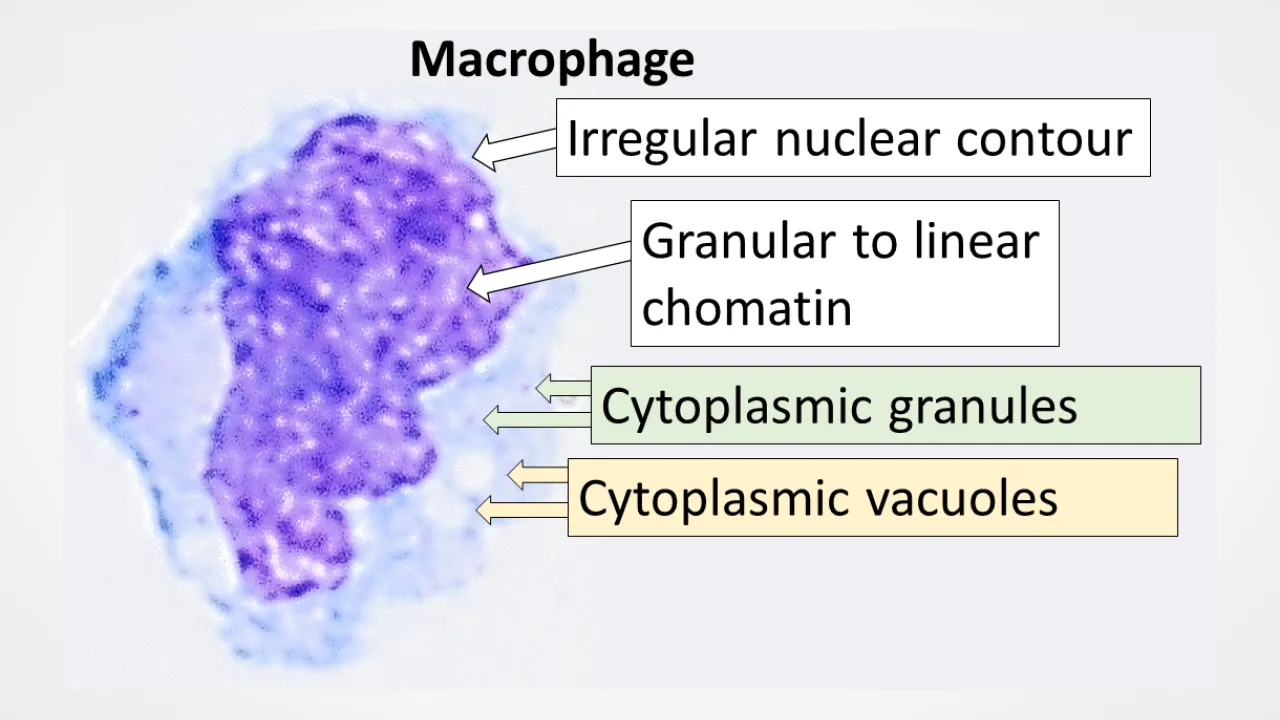
Watch a macrophage under a and you will see it flow like a living water balloon! Measuring about three times wider than a red blood cell, it squeezes out stretchy extensions to crawl through your skin, lungs, and organs.
2
Swallowing Trouble Bubbles
Whenever a macrophage sniffs chemical trails left by bacteria, it wraps around the germs and pulls them into a sealed bubble inside itself. Special digestive juices break the germs into harmless tiny pieces.
3
Calling Backup Helpers
Macrophages are great teammates too. After catching a germ, they send chemical signals that invite extra white blood cells to join the cleanup crew!
1. How does a macrophage break down germs after wrapping around them?
2. Why do macrophages live inside the air sacs of your lungs?
🤯 Mind-Blowing Fact • Grade 3
Without macrophages recycling iron from old red blood cells in your spleen and liver, you would have to eat giant piles of iron-rich spinach every day!
✨ Word Sparks (Grade 3 Glossary)
Tap 🔊 to hear
Monocyte
Blood cell that matures into a macrophage
Phagocytosis
Process where a cell engulfs tiny particles
Pseudopod
Temporary stretchy arm helping a cell crawl
🪝
What happens to the two hundred billion red blood cells your body wears out every single day?
1
From Travelers to Neighborhood Guards
Many macrophages begin life in bone marrow as round white blood cells called . After drifting through your bloodstream for a day or two, monocytes slip through capillary walls into body tissues and grow up into giant, starry-edged macrophages.
2
The Art of Phagocytosis
Scientists call cellular eating . Stretching out temporary arms called , a macrophage latches onto bacteria, pollen, or antibody-tagged viruses and pulls them inside a pouch. Tiny enzyme sacs called lysosomes fuse with that pouch and break invaders into harmless building blocks.
3
Master Recyclers of Iron
Fighting germs is only half their job! In your liver and spleen, resident macrophages dismantle billions of aged red blood cells daily, carefully saving precious iron so bone marrow can build fresh blood.
4
Showing Clues to T-Cells
After digesting a microbe, a macrophage places a tiny piece of it on its outer coat like a wanted poster so T-cells know exactly which invader to target.
1. What is a macrophage called while it is still traveling in the bloodstream as a young cell?
2. What important mineral do spleen and liver macrophages save from worn-out red blood cells?
🤯 Mind-Blowing Fact • Grade 4
Your brain has its own dedicated macrophage crew called microglia, which not only clear debris but also trim unused nerve connections to help you learn faster!
✨ Word Sparks (Grade 4 Glossary)
Tap 🔊 to hear
Chemotaxis
Moving toward or away from chemical trails
Lysosome
Cell pouch filled with strong digestive enzymes
Microglia
Specialized macrophages protecting and tidying the brain
🪝
Why do macrophages wear different names depending on whether they live in your brain, your liver, or your bones?
1
Specialists in Every Organ
While wandering macrophages rush to scraped knees whenever monocytes exit blood vessels, permanent macrophage crews live full-time inside nearly every organ! Anatomists give these local guardians special titles: Kupffer cells filter blood in the liver, alveolar macrophages patrol lung air sacs, and tidy connections between neurons in your brain.
2
Tracking Chemical Breadcrumbs
How does a macrophage find hidden bacteria in pitch darkness? Through —following faint chemical trails released by microbes or stressed tissues. Using pattern-recognition sensors on its membrane, the macrophage distinguishes bacterial cell walls from healthy human cells in milliseconds.
3
Inside the Phagolysosome
Once pseudopods zip shut around a target to form an internal bubble called a phagosome, enzyme-packed dock right beside it. Merging into a single chamber called a phagolysosome, the cell lowers the pH into an acidic bath and releases reactive oxygen bursts alongside enzymes that dismantle tough microbes safely inside.
4
Switching From Fighter to Healer
Remarkably, macrophages can shift personalities once the microbial threat ends! Early in an infection they act as bold defenders that alert nearby T-cells with peptide clues, then later switch into gentle repair directors that sweep away cellular leftovers and release growth signals so fresh skin, blood vessels, and muscle fibers rebuild smoothly.
1. How does a macrophage navigate through dark tissue to find hiding bacteria?
2. What second job do macrophages switch into once all germs at an injury site are cleared?
🤯 Mind-Blowing Fact • Grade 5
Every single day, human macrophages quietly recycle about two hundred billion worn-out cells—preserving roughly twenty-five milligrams of iron for brand-new red blood cells!
✨ Word Sparks (Grade 5 Glossary)
Tap 🔊 to hear
Toll-Like Receptor
Sensor spotting common molecular patterns on microbes
How did a scientist peeking at a transparent starfish larva with a rose thorn uncover the body's greatest cellular guardian?
1
A Starfish, a Rose Thorn, and a Nobel Prize
On a quiet afternoon in Messina, Sicily, in 1882, zoologist Élie Metchnikoff gently poked a microscopic rose thorn into a glassy, transparent starfish larva. Peering through his microscope the next morning, he marveled as wandering ameboid cells swarmed the splinter trying to swallow it. Metchnikoff coined the term phagocyte—and named the largest mammalian versions macrophages—earning a share of the 1908 Nobel Prize for unveiling innate cellular immunity.
2
Dual Origins of Tissue-Resident Guards
Measuring twenty to twenty-five micrometers in diameter, macrophages are heavyweight champions among leukocytes. Modern lineage-tracing reveals two distinct origins: during infections, bone-marrow monocytes extravasate from capillaries to become inflammatory macrophages, whereas many resident populations—such as brain microglia and hepatic Kupffer cells—actually seed organs before birth and renew themselves for decades.
3
Molecular Recognition and the Respiratory Burst
Macrophages bridge innate and adaptive immunity effortlessly. detect conserved microbial patterns immediately, while Fc receptors grab antibody-coated pathogens with high speed. Inside the fused , proton pumps drop the pH near 4.5, activating hydrolytic enzymes alongside an NADPH oxidase respiratory burst that neutralizes swallowed microbes while sparing surrounding tissues.
4
M1 Defenders and M2 Tissue Architects
Immunologists describe macrophage versatility along a spectrum from M1 to M2 activation states. Interferon-gamma from T-cells polarizes M1 macrophages to crank up microbe-clearing power and display peptide antigens on MHC Class II molecules. Conversely, interleukin-4 shifts macrophages into an M2 reparative state that clears apoptotic cell debris and stimulates collagen remodeling and new blood vessel growth.
5
Silent Housekeeping at Massive Scale
Even on a completely healthy day without a single sniffle, your macrophages quietly engulf roughly two hundred billion senescent cells—recycling amino acids, lipids, and nearly twenty-five milligrams of elemental iron daily without triggering a hint of inflammation.