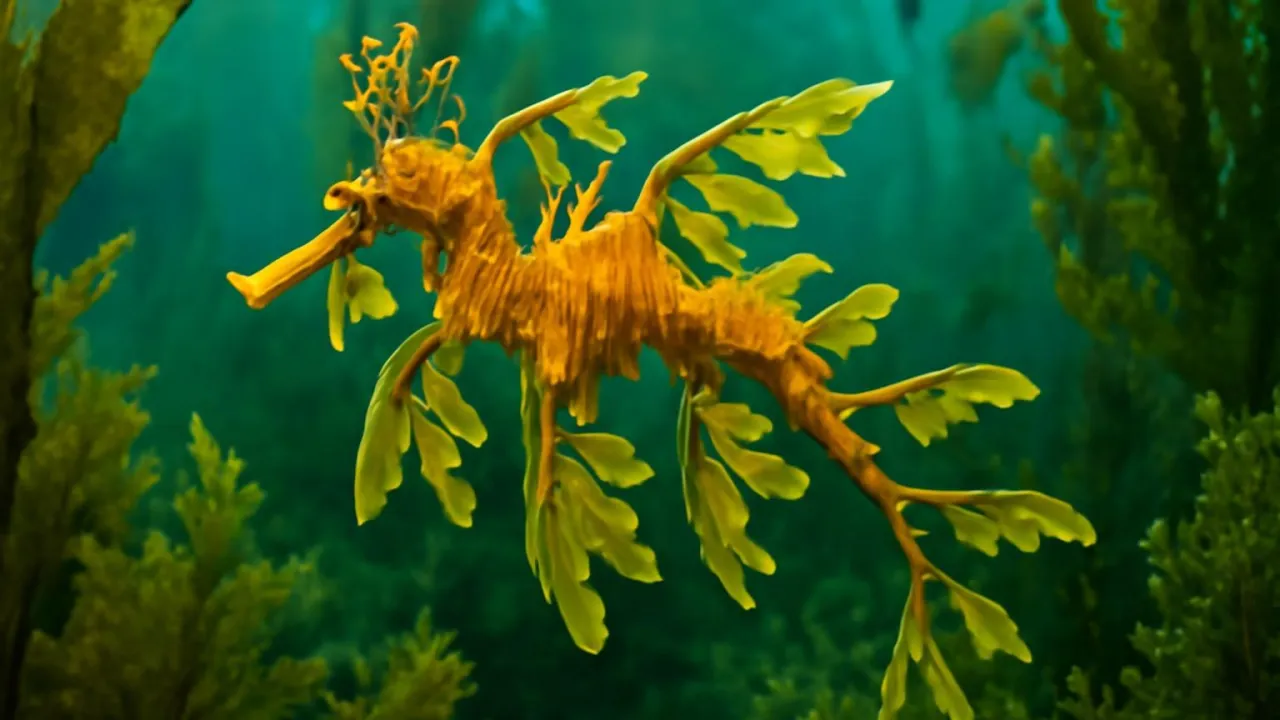
Leafy seadragons use their leaf-like fins as perfect camouflage to hide from predators.
✨ Word Sparks (Grade 2 Glossary)
Tap 🔊 to hear
crustaceans
Small animals with hard shells in water
kelp
Big sea plants that grow underwater
snout
The long nose part of some animals
🪝
Have you ever seen a fish that looks like seaweed waving in water?
1
Amazing Camouflage
The leafy seadragon has leaf-like fins that help it blend with seaweed. It moves slowly to avoid being seen. Its colors match the ocean plants around it.
2
Home in the Ocean
Leafy seadragons live along southern Australia’s rocky coasts. They swim near forests and seaweed beds. The water there is calm and cool.
3
Eating Tiny Food
They eat tiny and plankton by sucking them in with a long . They cannot chew food, so they swallow it whole. This helps them eat quickly.
Leafy seadragons’ camouflage is so good that divers often mistake them for floating seaweed.
✨ Word Sparks (Grade 3 Glossary)
Tap 🔊 to hear
adaptation
A body change that helps survival
predator
An animal that hunts other animals
nutrition
Food that helps animals grow strong
🪝
How does the leafy seadragon’s body help it survive in the ocean?
1
Master of Camouflage
The leafy seadragon’s leaf-like appendages act as camouflage among seaweed and kelp. This helps it avoid by blending into its environment. Its colors and shapes mimic floating plants perfectly. This disguise is a key survival strategy.
2
Habitat and Range
Leafy seadragons live in the coastal waters of southern Australia. They prefer rocky reefs and kelp forests where they find shelter. These habitats provide nutrients and protection from strong currents. The seadragon’s slow movements suit these calm waters.
3
Feeding and Nutrition
Leafy seadragons feed on small crustaceans and plankton using suction from their long snouts. Because they lack teeth, they swallow prey whole. This feeding method requires patience and stealth. Their diet provides essential nutrients for growth.
4
Body Design and Movement
Unlike most fish, leafy seadragons have no strong tail for swimming fast. Instead, they use tiny fins along their body for gentle propulsion. This slow movement helps maintain their camouflage. Their body shape reduces detection by .
1. What helps leafy seadragons hide from predators?
2. Why do leafy seadragons move slowly?
🤯 Mind-Blowing Fact • Grade 4
Leafy seadragons play a vital role in their ecosystem by balancing tiny sea creature populations.
✨ Word Sparks (Grade 4 Glossary)
Tap 🔊 to hear
ecosystem
All living and nonliving things in one place
endemic
Found only in one special place
biodiversity
Many different kinds of living things
🪝
Why is the leafy seadragon’s camouflage important for its role in the ocean ecosystem?
1
Camouflage and Survival
The leafy seadragon’s intricate leaf-like appendages provide excellent camouflage that helps it avoid predators. Because it moves slowly, this disguise is essential to protect it from being eaten. This camouflage also allows it to sneak up on tiny prey. Without this adaptation, its survival chances would decrease dramatically.
2
Ecosystem Role and Habitat
Leafy seadragons live primarily in southern Australia’s kelp forests and rocky reefs where they contribute to the food web. They help control populations of small crustaceans and plankton, which affects other marine life. Their presence supports by maintaining balance. Human activities like pollution and habitat destruction threaten these .
3
Feeding Behavior and Adaptations
These fish feed by sucking small crustaceans and plankton through their long snouts without chewing. Their slow, deliberate movements reduce detection by both prey and predators. This feeding strategy is efficient in nutrient-rich waters. Their specialized mouthparts are an adaptation to their unique diet.
4
Geographic Distribution and Conservation
Leafy seadragons are found only along the southern coast of Australia, making them species. Their limited range makes them vulnerable to environmental changes. Conservation efforts focus on protecting their habitats and reducing pollution. Public awareness helps support these measures to preserve this unique fish.
1. How does the leafy seadragon’s camouflage help it survive?
2. Why is the leafy seadragon’s habitat important?
🤯 Mind-Blowing Fact • Grade 5
Leafy seadragons’ leaf-like appendages evolved to mimic seaweed so perfectly that they can avoid nearly all predators.
✨ Word Sparks (Grade 5 Glossary)
Tap 🔊 to hear
endemic
Found only in one special place
morphology
The shape and structure of living things
locomotion
How animals move from place to place
🪝
What scientific secrets make the leafy seadragon a marvel of marine adaptation?
1
Taxonomy and Scientific Classification
The leafy seadragon, Phycodurus eques, belongs to the Syngnathidae family, which includes seahorses and pipefish. It is classified as a marine fish to southern Australia’s temperate coastal waters. Its unique distinguishes it from related species through elaborate leaf-like appendages. These structures are evolutionary adaptations for camouflage within kelp and seaweed habitats.
2
Physiological Mechanics and Movement
Leafy seadragons propel themselves using small pectoral fins on the sides of their necks and a dorsal fin along their back. These fins move rapidly but produce minimal water disturbance, allowing near-silent, slow movement. This stealthy supports their camouflage strategy by preventing detection from predators and prey. Their elongated bodies and leaf-like protrusions further reduce visibility.
3
Feeding Adaptations and Diet
They feed primarily on small crustaceans such as mysid shrimp and planktonic organisms by suction feeding through their tubular snouts. Lacking teeth, they rely on rapid suction to capture prey whole. Their feeding efficiency depends on the ability to approach prey without alarming them, aided by their camouflage and slow movements. This specialized diet provides necessary nutrients for growth and reproduction.
4
Conservation Status and Botanical History
The leafy seadragon is currently listed as Near Threatened due to habitat degradation and collection for the aquarium trade. Conservation programs in Australia aim to protect kelp forests and regulate human impacts. Historically, indigenous Australians recognized the seadragon’s unique appearance and included it in cultural stories. Scientific interest has increased as its ecological importance became better understood.
5
Quantitative Comparisons and Environmental Adaptations
Leafy seadragons grow up to 18 inches (45 centimeters) and weigh approximately 0.5 pounds (225 grams). They inhabit water temperatures ranging from 50 to 68 degrees Fahrenheit (10 to 20 degrees Celsius). Their slow swimming speed, about 0.5 miles per hour (0.8 kilometers per hour), complements their camouflage strategy. These quantitative traits reflect adaptations to temperate marine environments with moderate currents.