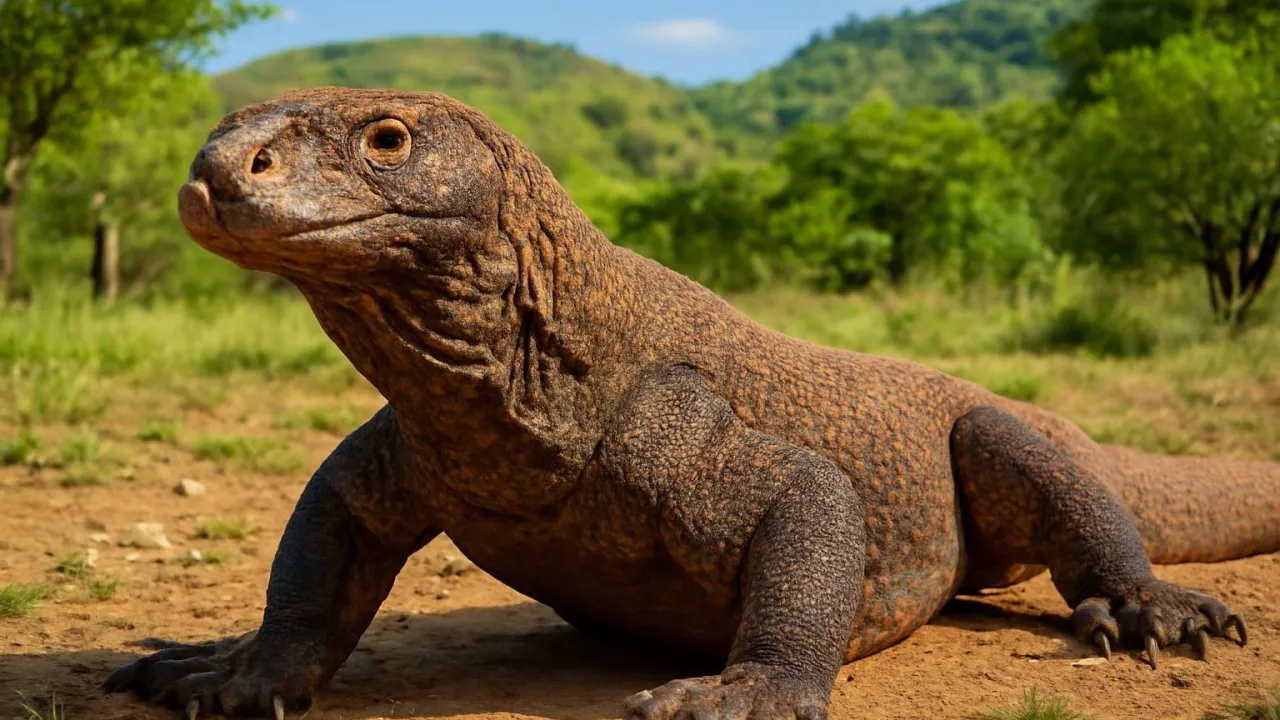
A Komodo dragon’s bite contains venom that helps weaken its prey quickly.
✨ Word Sparks (Grade 2 Glossary)
Tap 🔊 to hear
venomous
Having poison that can hurt other animals
prey
An animal that is hunted and eaten
forked tongue
A tongue split in two to smell better
🪝
Have you ever seen a lizard as big as a small car before?
1
Huge Lizard Body
The Komodo dragon is the largest lizard in the world and can grow very long. It has rough, scaly skin that helps protect it from harm. Its strong legs allow it to walk and run quickly across the hot island land.
2
Hungry Carnivore
This giant lizard eats meat like deer, birds, and even smaller dragons. It uses its sharp teeth and bite to catch . The Komodo dragon can smell food from far away using its .
3
Island Home
Komodo dragons live on a few islands in Indonesia where it is hot and dry. They hide in bushes and trees to stay safe and cool. These islands have many other animals that the dragons hunt or avoid.
1. What special body part helps Komodo dragons smell food?
2. Where do Komodo dragons live?
🤯 Mind-Blowing Fact • Grade 3
Komodo dragons can smell dead animals from over two miles away using their forked tongues.
✨ Word Sparks (Grade 3 Glossary)
Tap 🔊 to hear
camouflage
Colors that help hide an animal from others
carrion
Dead animals that animals eat
ecosystem
A community of living things and their home
🪝
Did you know Komodo dragons use venom to help catch their prey?
1
Largest Lizard on Earth
The Komodo dragon is the biggest lizard species, growing up to ten feet long. Its tough, scaly skin acts as armor to protect it from attacks. Strong legs and sharp claws help it move quickly and climb trees when young.
2
Venom and Hunting
Komodo dragons have venom glands that release toxins to weaken prey after biting. This venom stops blood clotting and causes shock, making it easier to catch animals like deer. Their forked tongue helps them detect scents in the air for hunting.
3
Adapted to Island Life
They live on several Indonesian islands with hot, dry climates and sparse vegetation. Their coloring helps them blend into rocky and forested areas to avoid predators. Komodo dragons eat , meaning they also scavenge dead animals for nutrients.
4
Role in the Ecosystem
As top predators, Komodo dragons control populations of deer and wild boar on their islands. They compete with other predators but also clean the environment by eating . Their presence helps maintain a balanced .
Komodo dragons can run up to 12 miles per hour despite their large size and weight.
✨ Word Sparks (Grade 4 Glossary)
Tap 🔊 to hear
apex predator
Top animal hunter with no natural enemies
paralysis
When a body part cannot move
habitat
The natural home of an animal or plant
🪝
How do Komodo dragons survive as giant predators on small Indonesian islands?
1
Physical Adaptations for Survival
Komodo dragons have thick, armored skin that protects them from injuries during fights or hunts, enabling survival in harsh environments. Their powerful limbs and sharp claws allow them to climb trees when young and run swiftly on land to catch prey. The venom in their bite causes and blood loss, which helps subdue large animals effectively.
2
Ecosystem Role and Food Web
As , Komodo dragons regulate populations of deer, wild boar, and smaller animals, maintaining ecological balance on their islands. They also scavenge carrion, cleaning up dead animals and preventing disease spread. Their hunting habits influence prey behavior and contribute to a complex food web involving many species.
3
Geographic Distribution and Habitat
Komodo dragons are found only on a few Indonesian islands such as Komodo, Rinca, Flores, and Gili Motang, where the climate is hot and dry with sparse vegetation. These islands’ rocky terrain and forests provide ideal camouflage and shelter. Human activity and loss pose threats to their limited range.
4
Human Impact and Conservation
Conservation efforts protect Komodo dragons through national parks and breeding programs to prevent extinction. Illegal hunting and destruction have reduced their numbers, but education and eco-tourism help raise awareness. Protecting their habitat ensures the survival of this unique species and the island ecosystems they support.
1. What role do Komodo dragons play in their ecosystem?
2. Why is habitat protection important for Komodo dragons?
🤯 Mind-Blowing Fact • Grade 5
Komodo dragons’ venomous bite combined with bacteria causes prey death within hours, a unique hunting adaptation.
✨ Word Sparks (Grade 5 Glossary)
Tap 🔊 to hear
anticoagulants
Chemicals that stop blood from clotting
IUCN
Group that protects wild animals and plants
venom
Poison made by animals to catch prey
🪝
What scientific secrets help Komodo dragons dominate as the largest living lizards?
1
Taxonomy and Scientific Classification
Komodo dragons belong to the genus Varanus and are scientifically named Varanus komodoensis. They are part of the family Varanidae, which includes monitor lizards. Their evolutionary history traces back millions of years, showing adaptations that helped them become apex predators in their island ecosystems.
2
Physiological Mechanics and Venom Function
The Komodo dragon’s contains and toxins that lower blood pressure and induce shock in prey. This venom, combined with bacteria in their saliva, causes rapid blood loss and weakens prey within hours. Their muscular bodies enable bursts of speed up to 12 miles per hour, essential for ambushing prey.
3
Conservation Status and Human Interaction
Currently listed as vulnerable by the , Komodo dragons face threats from habitat loss, poaching, and climate change. Conservation programs include protected national parks and captive breeding to increase population numbers. Eco-tourism helps fund these efforts while educating the public about their ecological importance.
4
Geographic Range and Habitat Specifics
Komodo dragons inhabit only five Indonesian islands, including Komodo, Rinca, Flores, Gili Motang, and Padar. These islands feature tropical savanna climates with dry seasons lasting several months. Their habitat consists of grasslands, savannas, and tropical forests with rocky outcrops providing shelter.
5
Quantitative Comparisons and Unique Traits
Adult Komodo dragons can weigh up to 150 kilograms and measure up to 3 meters in length, making them the largest living lizards. Their bite force measures around 600 newtons, and they can detect carrion from over 3 kilometers away. Their venomous bite and powerful limbs make them formidable hunters unmatched by other reptiles. They can survive without food for up to a month, showing great endurance.