2. What does the killdeer do to protect its babies?
🤯 Mind-Blowing Fact • Grade 2
Killdeer use a fake broken wing to trick predators and protect their eggs.
✨ Word Sparks (Grade 2 Glossary)
Tap 🔊 to hear
camouflage
Colors that help animals hide from others
predator
An animal that hunts other animals for food
nest
A place where birds lay and keep their eggs
🪝
Have you ever seen a bird pretend to be hurt to save its babies?
1
What Does a Killdeer Look Like?
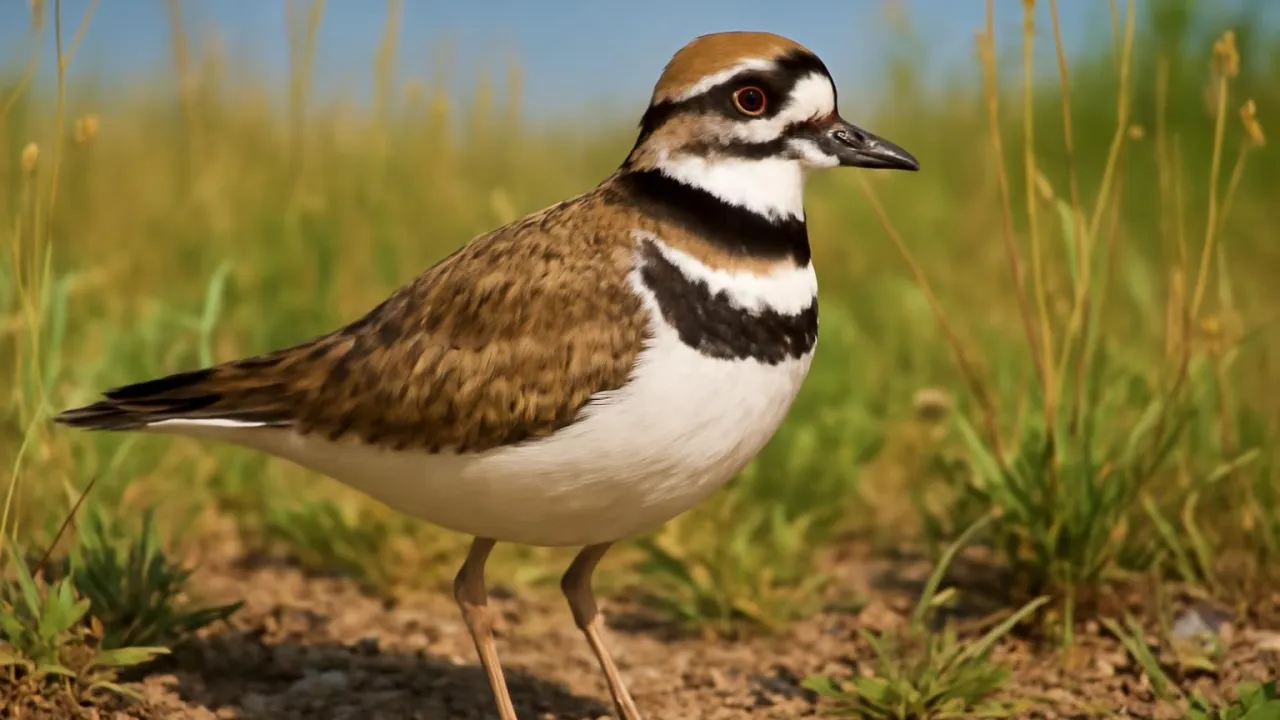
The killdeer has brown and white feathers with two black bands on its chest. It has long, thin legs that help it run fast. Its eyes are big and round, helping it see well. The bird is about ten to twelve inches long.
2
Where Do Killdeer Live and Nest?
Killdeer live in open fields, grasslands, and near water like lakes and rivers. They make their on the ground, often hiding their eggs among rocks or dirt. The eggs are camouflaged to blend in with the surroundings. This helps keep them safe from .
3
How Does It Protect Its Babies?
When a comes near, the killdeer pretends to have a broken wing by flapping and limping. This fake injury tricks the predator into following the adult bird away from the . After leading the danger far enough, the killdeer flies away quickly. This clever trick helps keep its babies safe.
1. What helps killdeer eggs stay safe in their nests?
2. How does the killdeer trick predators?
🤯 Mind-Blowing Fact • Grade 3
Killdeer use a broken-wing trick called a distraction display to save their young.
✨ Word Sparks (Grade 3 Glossary)
Tap 🔊 to hear
camouflage
Colors or patterns that help hide animals
distraction display
A trick to draw attention away from danger
predator
An animal that hunts other animals for food
🪝
Did you know the killdeer uses a clever trick to protect its young from predators?
1
How Killdeer Look and Move
The killdeer has brown and white feathers with two black bands on its chest. Its long legs help it run fast across open fields and shores. The bird’s sharp eyes spot insects and small animals to eat. Its coloring acts as , blending well with dirt and rocks.
2
Where Killdeer Live and Nest
Killdeer live in open places like grasslands, fields, and near freshwater lakes or rivers. They build nests on the ground among gravel or bare soil. The eggs are speckled and blend in with the surroundings to avoid . This is an important survival adaptation.
3
The Broken-Wing Trick
When a comes near, the killdeer pretends to have a broken wing by flapping and limping. This draws the predator’s attention away from its eggs. After leading the predator far away, the killdeer flies off quickly. This clever behavior helps keep its young safe.
4
Killdeer’s Role in Nature
Killdeer eat insects like beetles, ants, and worms, helping control their numbers. They are prey for larger birds and mammals, making them part of a balanced food web. Their nesting disturbs soil and small plants, affecting the ground environment. They also indicate healthy open habitats.
1. Why does the killdeer’s coloring help it survive?
2. What is a distraction display?
🤯 Mind-Blowing Fact • Grade 4
Killdeer use a broken-wing act to distract predators and protect their young in open habitats.
✨ Word Sparks (Grade 4 Glossary)
Tap 🔊 to hear
camouflage
Colors or patterns that help animals blend in
distraction display
A behavior to draw attention away from danger
ecosystem
A community of living things and their environment
🪝
How does the killdeer’s broken-wing act protect its chicks in open habitats?
1
Physical Traits and Survival Adaptations
The killdeer’s brown and white feathers with two black chest bands provide excellent in open fields and shorelines. Its long legs enable it to run quickly to escape danger or lure predators away. The bird’s sharp vision helps it spot insects and small prey from a distance. These traits work together to help the killdeer survive in its habitat.
2
Habitat, Nesting, and Geographic Range
Killdeer are found across much of North America in open grasslands, fields, and near freshwater bodies like lakes and rivers. They build simple nests on the ground, often among gravel or bare soil, where their speckled eggs blend into the environment. This reduces the chance of predators finding the nest. Their wide range shows how well they adapt to different open habitats.
3
Behavioral Defense: The Broken-Wing Display
When a predator approaches, the killdeer performs a broken-wing display by flapping its wings and limping as if injured. This behavior distracts the predator and draws it away from the nest, protecting the eggs and chicks. After leading the predator far enough, the killdeer flies away quickly. This cause-and-effect behavior increases the survival of its young.
4
Ecological Role and Human Impact
Killdeer play an important role in controlling insect populations by feeding on beetles, ants, and worms. They serve as prey for larger animals, connecting food webs in their . Human activities like farming and urban development can impact their open habitats, sometimes reducing nesting areas. Conservation of open fields helps maintain healthy killdeer populations and biodiversity.
1. Why does the killdeer build nests on the ground?
2. How does the broken-wing display help killdeer chicks?
🤯 Mind-Blowing Fact • Grade 5
Killdeer use a complex broken-wing display that can last minutes to protect their nests from predators.
✨ Word Sparks (Grade 5 Glossary)
Tap 🔊 to hear
taxonomy
How scientists group and name living things
physiology
How a living thing’s body works
conservation
Protecting animals and their homes
🪝
What scientific secrets help the killdeer survive and protect its young in diverse environments?
1
Taxonomy and Scientific Classification
The killdeer, scientifically named Charadrius vociferus, belongs to the Charadriidae family, which includes plovers and lapwings. This species is notable for its loud, piercing call used to communicate across open habitats. Its genus name, Charadrius, refers to birds typically found near water, while vociferus means 'loud' or 'noisy,' describing its vocal behavior. Understanding its classification helps scientists study its evolutionary relationships.
2
Physiological Mechanics and Adaptations
Killdeer have long legs and toes adapted for running quickly over open ground and rocky surfaces. Their feathers provide camouflage with brown and white coloration and two distinct black chest bands. The broken-wing display involves coordinated wing flapping and limping that mimics injury, fooling predators into following the adult bird away from the vulnerable nest. Their sharp eyesight allows detection of small insects and predators from afar.
3
Conservation Status and Habitat Challenges
While killdeer are currently classified as Least Concern by groups, habitat loss from urbanization and agriculture poses threats. Their preference for open fields and shorelines means that human development can reduce suitable nesting areas. Conservation efforts focus on preserving grasslands and wetlands to maintain healthy populations. Monitoring killdeer also helps track ecosystem health in these environments.
4
Ecological Role and Food Web Connections
Killdeer play a vital role in controlling insect populations by feeding on beetles, ants, and other invertebrates, which helps maintain ecological balance. They serve as prey for larger birds of prey and mammals, linking multiple trophic levels in food webs. Their nesting behavior influences soil and plant life by disturbing ground surfaces, which can affect seed dispersal and soil aeration. This interconnectedness highlights their ecological importance.
5
Quantitative Comparisons and Behavioral Insights
Killdeer measure about 10 to 12 inches in length and weigh around 3.5 to 5 ounces. They can run at speeds up to 15 miles per hour to escape predators. Their nests are simple scrapes on the ground, often less than 2 inches deep, camouflaged by surrounding gravel. The broken-wing distraction display can last several minutes, effectively diverting predators. These behaviors showcase remarkable survival strategies among shorebirds.