2. What do your kidneys keep inside your blood while washing away waste?
🤯 Mind-Blowing Fact • Grade 2
Your two fist-sized kidneys wash every single drop of blood in your body about forty times a day!
✨ Word Sparks (Grade 2 Glossary)
Tap 🔊 to hear
Ureters
Two tubes carrying urine from kidneys downward
Balance
Keeping just the right amount inside you
Hydrated
Having plenty of healthy water in cells
🪝
Why does your pee look pale yellow when you drink plenty of water?
1
Master Water Balancers
Imagine lifeguards watching the water level in a swimming pool every second! Sitting on either side of your spine, your two kidneys check how much water is inside your body. Because your liver takes up room on the right, your right kidney sits slightly lower than your left.
2
Smart Color Clues
When you drink plenty of water on a sunny day, your kidneys let extra water leave in your urine, making it pale lemonade yellow. When you are thirsty and sweaty, they save water so urine looks darker!
3
Down the Ureter Tubes
Drop by drop, clean urine trickles out of both kidneys down two narrow tubes called , heading straight to your bladder.
1. Why does your right kidney sit slightly lower than your left kidney?
2. What does pale, light-yellow urine usually tell you about your body?
🤯 Mind-Blowing Fact • Grade 3
Every minute, about five cups of blood zoom through your kidneys—enough to fill a giant bathtub more than five times each day!
✨ Word Sparks (Grade 3 Glossary)
Tap 🔊 to hear
Renal
Science word meaning related to the kidneys
Cortex
Outer filtering layer of each kidney
Medulla
Inner cone-patterned zone inside a kidney
🪝
Besides cleaning your blood, how do your kidneys help build strong bones and fresh red blood cells?
1
High-Speed Filtration
Step behind the scenes of your urinary system, and prepare to be amazed! Even though your two kidneys make up less than one percent of your body weight, they receive about twenty percent of all the blood pumped out by your heart every minute. Blood rushes in through wide arteries and leaves sparkling clean through renal veins.
2
Two Layers Inside
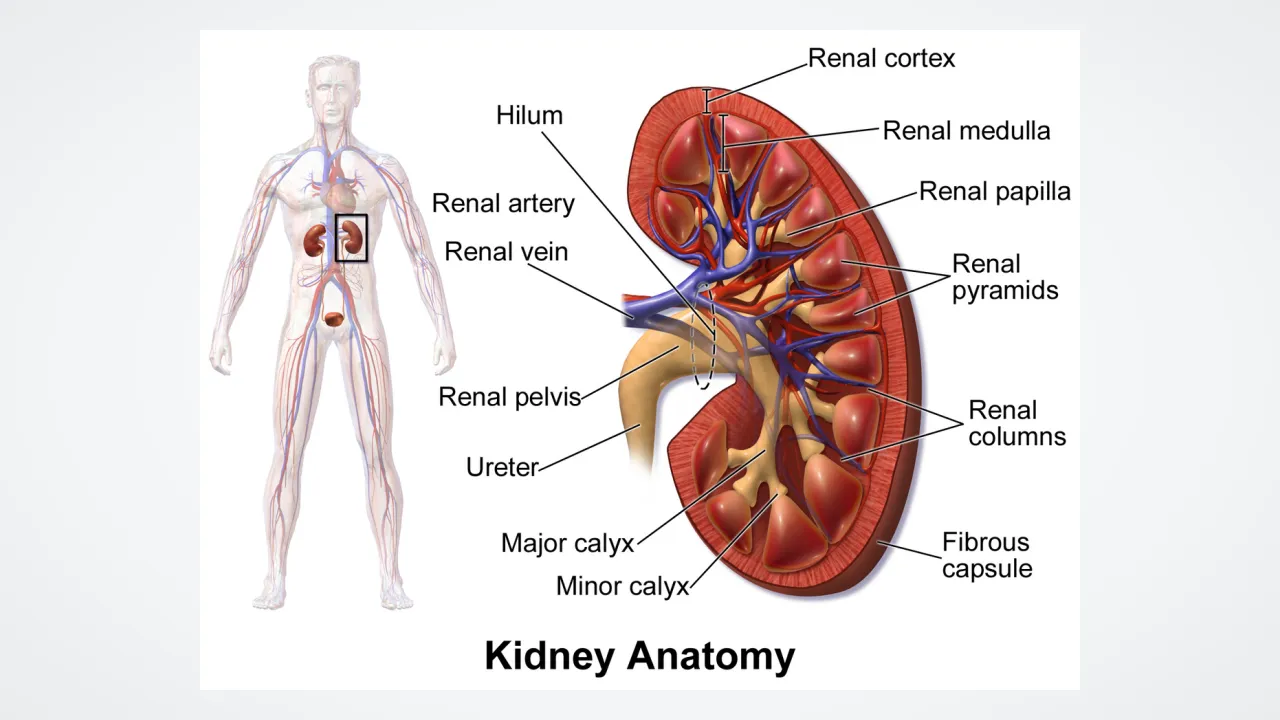
Slice open a plastic classroom model of a kidney, and you will spot an outer shell called the and a striped inner zone of cone shapes called the renal . Packed across both zones sit roughly one million microscopic filters per kidney! They remove urea from protein breakdown while rescuing sugar, amino acids, and balanced salts.
3
Surprise Jobs: Bones and Blood!
Kidneys are secret multitaskers. They switch vitamin D into its active form so your intestines can absorb bone-building calcium. They also check blood oxygen levels and release a hormone that tells bone marrow to make more red blood cells!
4
Living Well With One
Each kidney is so powerful that a person born with—or donating—one healthy kidney can live a completely normal, active life.
1. How do your kidneys help keep your skeleton strong?
2. About what fraction of your heart's pumped blood goes straight to your kidneys each minute?
🤯 Mind-Blowing Fact • Grade 4
Out of every 100 drops of fluid your kidneys filter out of your blood, they carefully rescue 99 drops and send only 1 drop onward as urine!
✨ Word Sparks (Grade 4 Glossary)
Tap 🔊 to hear
Filtrate
Fluid squeezed out of blood for sorting
Erythropoietin
Kidney hormone signaling marrow to make blood
Hemodialysis
Medical machine that filters blood like kidneys
🪝
Why do your kidneys filter almost fifty gallons of fluid out of your blood every day if you only pee out less than half a gallon?
1
Dump Everything Out, Keep the Good Stuff!
Imagine cleaning a messy backpack by dumping every single item onto a table, putting the pencils and notebooks right back in, and tossing only the candy wrappers! Your kidneys use that exact strategy. Every 24 hours, roughly 180 liters (nearly 50 gallons) of water, salts, glucose, amino acids, and nitrogen wastes are squeezed out of blood capillaries inside the kidneys. Then kidney tubules carefully reclaim 99 percent of the water and 100 percent of the glucose, leaving only 1 to 2 liters of concentrated urine!
2
Guarding Blood Pressure and pH
Protected behind the abdominal lining in the retroperitoneal space, each five-ounce kidney acts as your body's master chemist. By adjusting sodium and water levels and releasing an enzyme-hormone signal called renin, kidneys keep blood pressure steady inside arteries. They also excrete hydrogen ions and conserve bicarbonate so blood pH never drifts too acidic.
3
Erythropoietin and High-Altitude Climbers
When hikers climb tall mountains where thin air holds less oxygen, kidney sensors notice right away! They secrete (EPO), a hormone that travels to red bone marrow to boost red blood cell production.
4
Engineering Artificial Kidneys
When severe illness damages both kidneys, an amazing medical machine called pumps blood past a semipermeable membrane, mimicking kidney filtration outside the body until a transplant is ready.
1. Why do mountain climbers start making extra red blood cells after spending days at high altitude?
2. Of the roughly 180 liters of fluid filtered by adult kidneys daily, how much is reabsorbed back into the bloodstream?
🤯 Mind-Blowing Fact • Grade 5
In 1943, Dr. Willem Kolff built the world's first lifesaving artificial kidney machine using cellophane sausage wrappers, a water-pump part, and an enamel tub!
✨ Word Sparks (Grade 5 Glossary)
Tap 🔊 to hear
Calyces
Cup-shaped chambers catching urine inside the kidney
Creatinine
Natural muscle waste filtered out by kidneys
Calcitriol
Active hormone form of vitamin D
🪝
How did a wartime Dutch physician build the first working artificial kidney out of sausage casings and a rotating wooden drum?
1
Retroperitoneal Architecture and Vascular Flow
Situated retroperitoneally between the T12 and L3 vertebrae, the paired human kidneys (renes) measure roughly 11 to 12 centimeters in length and weigh about 150 grams apiece, cushioned by perirenal fat capsules and crowned by the endocrine adrenal glands. Receiving 20 to 25 percent of resting cardiac output (~1.1 liters of blood per minute) via the renal arteries, the kidneys filter blood plasma at a glomerular filtration rate (GFR) of ~125 milliliters per minute—generating 180 liters of cell-free, protein-free filtrate daily.
2
Cortex, Medullary Pyramids, and the Renal Pelvis
Internally, the granular renal cortex arches over eight to eighteen striated, cone-shaped renal pyramids composing the renal medulla. Urine formed across approximately two million nephrons drains from papillary ducts into cup-shaped minor and major , pooling in the funnel-like renal pelvis before peristaltic smooth-muscle waves propel it down the ureters.
3
Endocrine and Homeostatic Command
Beyond excreting nitrogenous wastes—urea from amino acids, from muscle phosphocreatine, and uric acid from nucleic acids—the kidneys govern extracellular fluid osmolarity (~285–295 mOsm/L), potassium and calcium balance, and acid-base homeostasis (~pH 7.40). Specialized juxtaglomerular cells secrete renin to initiate the renin-angiotensin-aldosterone system (RAAS) for blood pressure regulation, interstitial cells release erythropoietin (EPO), and proximal tubule enzymes hydroxylate vitamin D into active .
4
Willem Kolff's Ingenious Dialyzer
In 1943 in Nazi-occupied Kampen, Netherlands, young physician Willem Kolff improvised the first clinically successful hemodialysis machine from cellophane sausage casings wrapped around wooden slats spinning in a saline bath—allowing small urea toxins to diffuse out while retaining blood cells!
5
Modern Nephrology
Today, compact hollow-fiber dialyzers containing thousands of microscopic semipermeable polymer tubes, living-donor kidney transplants pioneered in 1954, and bioengineered wearable renal devices carry Kolff's lifesaving vision forward for millions of patients worldwide.