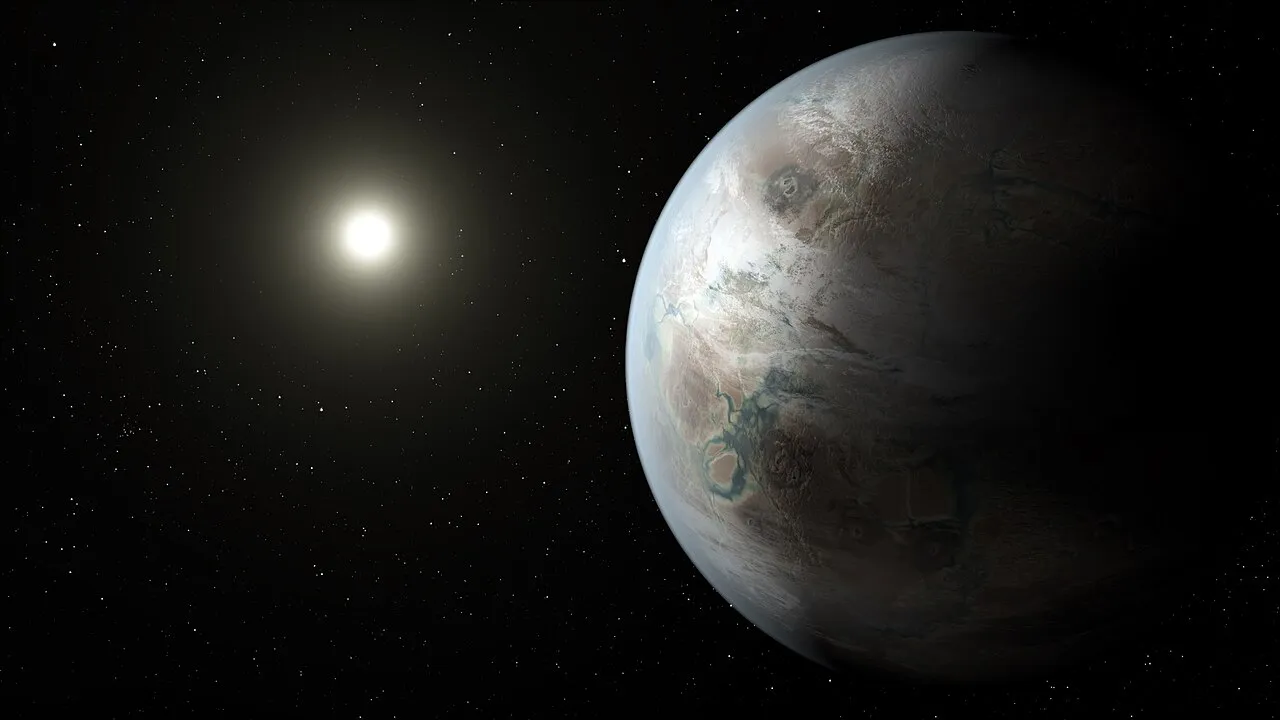
🪐 Scale / Diameter~12,000 mi (19,300 km) wide • ~1.5x Earth's diameter
☄️ Composition & Orbit385-Day Orbit • Sun-Like G2 Host Star
⚡ Cosmic SparkCircles a golden Sun-like star in a 385-day year almost identical to Earth's
🤯 Mind-Blowing Fact • Grade 1
If you weighed 60 pounds on Earth, you would weigh about 120 pounds standing on rocky Kepler-452b!
✨ Word Sparks (Grade 1 Glossary)
Tap 🔊 to hear
cousin
A close relative with shared traits
gravity
Invisible pull holding feet to ground
calendar
Chart tracking days and months
🪝
Could another planet have a year almost just like Earth's?
1
Meet Earth's Big Cousin
Far out in the Swan star pattern orbits a special planet. Scientists call Kepler-452b Earth's older, bigger ! It shines under a warm yellow star just like our Sun.
2
Almost the Same Year
Earth takes 365 days to circle our Sun. Kepler-452b takes 385 days! Its would feel right at home.
3
Heavy Feet on the Ground
Because this planet is wider and heavier than Earth, pulls harder there. Walking around would feel like carrying a heavy backpack!
Plants from Earth taken to Kepler-452b could use its familiar golden sunshine for photosynthesis right away!
✨ Word Sparks (Grade 2 Glossary)
Tap 🔊 to hear
super-Earth
Planet bigger than Earth, smaller than Neptune
photosynthesis
How green plants make food from sunlight
Kepler
NASA space telescope that hunted exoplanets
🪝
Why did NASA cheer when the Kepler telescope spotted a planet with a 385-day year?
1
A Landmark Space Discovery
For years, NASA's Space Telescope stared at over 150,000 stars in Cygnus the Swan, hunting for another Earth. Most planets it found circled dim red stars. Then in 2015, scientists announced Kepler-452b—the first near-Earth-sized world in the habitable zone of a warm, yellow Sun-like star!
2
A Super-Earth World
-452b stretches about one and a half times wider than Earth. Scientists call worlds in this size range . If it has a rocky surface, its strong gravity pulls twice as hard as Earth's.
3
One and a Half Billion Years Older
Its yellow star is six billion years old—making this system 1.5 billion years older than our Solar System!
1. Why did astronomers nickname Kepler-452b 'Earth's older cousin'?
2. What do astronomers call planets that are wider than Earth yet smaller than icy Neptune?
🤯 Mind-Blowing Fact • Grade 3
With five times Earth's mass and a hot interior, Kepler-452b likely erupts with active volcanoes powered by double Earth's surface gravity!
✨ Word Sparks (Grade 3 Glossary)
Tap 🔊 to hear
volcanic
Shaped by melted rock erupting upward
diameter
Distance straight across a circle's center
G2 star
Yellow star class matching our Sun
🪝
How can studying Kepler-452b give scientists a sneak peek at Earth's distant future?
1
Staring Toward Cygnus
Deep in the constellation Cygnus, roughly 1,800 light-years away, shines a with the exact same surface temperature as our Sun! In 2015, NASA's Kepler mission revealed a world crossing that star every 384.8 days, orbiting just five percent farther out than Earth orbits our Sun.
2
Rocky Globe or Thick Skies?
Measuring roughly 1.5 to 1.6 times Earth's , Kepler-452b sits near an exciting planetary boundary. Planetary models suggest a good chance it is a solid, rocky world about five times heavier than Earth, wrapped in thick clouds.
3
An Aging, Brighter Sun
Stars like our Sun slowly swell and grow brighter as they age over billions of years. Because Kepler-452 is six billion years old—1.5 billion years older than our Sun—it shines about twenty percent brighter today.
4
Preview of Future Earth
Receiving about ten percent more sunshine than Earth, Kepler-452b may show how an older planet holds onto its oceans or warms up under an aging sun.
1. Why does the star Kepler-452 shine about twenty percent brighter than our Sun even though both are G2 stars?
2. How much more starlight energy does Kepler-452b receive compared to Earth?
🤯 Mind-Blowing Fact • Grade 4
During a transit of Kepler-452b, its host star dims by only about two parts in ten thousand—like a tiny gnat crawling across a bright car headlight miles away!
✨ Word Sparks (Grade 4 Glossary)
Tap 🔊 to hear
greenhouse
Heat-trapping effect of atmospheric gases
silicate
Rock-forming minerals rich in silicon
orbital period
Exact time needed for one orbit
🪝
Why is spotting a planet with a 385-day orbit thousands of times harder than spotting one with a 3-day orbit?
1
Patience of the Three-Transit Rule
To confirm a genuine exoplanet transit, astronomers must watch a world cross its star at least three times on a steady clockwork schedule. For a close-in planet with a three-day orbit, three transits take a single week. For Kepler-452b, with its 384.8-day , NASA's Kepler Space Telescope had to stare unblinkingly at Cygnus for more than three full years just to catch a handful of tiny dips!
2
A True Solar Twin Host
Announced in July 2015 on the twentieth anniversary year of exoplanet science, Kepler-452b excited researchers because its host star is a G2 main-sequence twin of our Sun with an identical 5,757-kelvin surface temperature. Orbiting at 1.046 astronomical units, the planet bathed inside its habitable zone for billions of years.
3
Straddling the Fulton Radius Gap
Refined parallax data from the European Space Agency's Gaia spacecraft placed the system roughly 1,800 light-years away and pinned Kepler-452b's radius near 1.5 to 1.6 Earth radii. Worlds right along this boundary either retain dense rocky crusts with active volcanism and roughly five Earth masses or cling to thick, steamy hydrogen-water envelopes.
4
Runaway Greenhouse Window
Because its six-billion-year-old yellow star has slowly expanded ten percent wider and grown twenty percent more luminous than our younger Sun, Kepler-452b offers climate scientists a natural test of whether massive super-Earths resist runaway warming hundreds of millions of years longer than smaller one-Earth-mass worlds.
1. Why did the Kepler Space Telescope need more than three years of continuous staring to find Kepler-452b?
2. How closely does the star Kepler-452's surface temperature match our Sun's?
🤯 Mind-Blowing Fact • Grade 5
Over the six billion years Kepler-452b has orbited its star, it spent roughly its first five billion years inside the conservative, cooler heart of the habitable zone!
✨ Word Sparks (Grade 5 Glossary)
Tap 🔊 to hear
radius valley
Size boundary between rocky and gaseous worlds
solar constant
Amount of sunlight reaching Earth's distance
mini-Neptune
Small gas-wrapped planet bigger than super-Earths
🪝
What makes confirming Earth-year planets around distant Sun-like stars one of the toughest detective challenges in astronomy?
1
Hunting Earth Analogs in Kepler Data
NASA designed the Kepler Space Telescope with one overarching scientific dream: measuring eta-Earth, the fraction of Sun-like G-type stars hosting rocky worlds inside their liquid-water habitable zones. In July 2015, mission scientists unveiled Kepler-452b in Cygnus, orbiting at 1.046 astronomical units with a 384.84-day period around a metal-rich G2V star whose 5,757-kelvin effective temperature virtually mirrors our Sun's 5,772 kelvins.
2
Statistical Validation at the Noise Limit
Because Kepler-452 sits roughly 550 parsecs (1,800 light-years) away at apparent magnitude 13.4, radial-velocity wobbles from a five-Earth-mass world at 1 AU are far too minuscule—roughly 40 centimeters per second—for existing ground-based spectrographs to measure cleanly. Furthermore, mechanical failure of Kepler's second reaction wheel after four years halted primary staring after just four shallow 200-parts-per-million transits, sparking valuable scientific scrutiny over subtle detector artifacts versus statistical planet validation.
3
The Rocky-to-Volatile Transition
Spanning roughly 1.5 to 1.63 Earth radii after Gaia satellite parallax updates, Kepler-452b straddles the famous Fulton (~1.5–2.0 Earth radii), the critical evolutionary dividing line where dense iron-silicate super-Earths with solid volcanic crusts and thin skies transition into volatile-shrouded wrapped in deep hydrogen-helium atmospheres.
4
Main-Sequence Brightening and Climate
At an estimated stellar age of six billion years—1.5 billion years older than our Solar System—gradual core hydrogen fusion has expanded Kepler-452's radius by ten percent and boosted its luminosity by twenty percent, bathing Kepler-452b in roughly 1.1 times Earth's after five billion mild years inside the conservative habitable zone.
5
Inspiring Next-Generation Flagships
Climate models indicate five-Earth-mass gravity helps retain surface water longer before moist-greenhouse escape sets in, and Kepler-452b's discovery directly shaped ESA's PLATO mission and NASA's Habitable Worlds Observatory—engineered to find bright, nearby G-star cousins close enough for direct atmospheric spectroscopy.