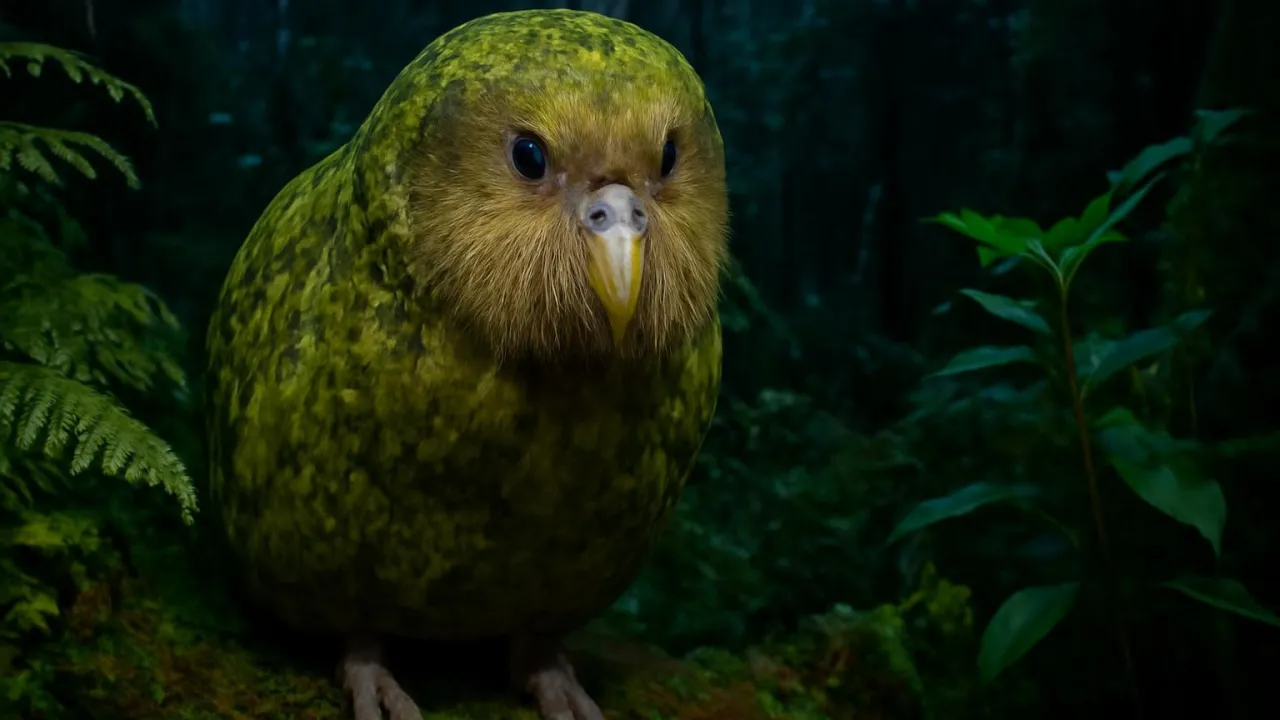
Kakapos can climb trees, even though they cannot fly!
✨ Word Sparks (Grade 2 Glossary)
Tap 🔊 to hear
nest
A bird’s home for eggs or sleeping
climb
To go up using hands or feet
forest
A place with many trees
🪝
Can you picture a parrot that waddles instead of flying?
1
Waddling Wonder
Instead of flying, the kakapo uses its strong legs to walk and . Its wings are too small for flying, but they help it balance as it moves. The kakapo’s green feathers make it look like a patch of moss in the .
2
Nighttime Explorer
Kakapos sleep during the day and come out at night to find food. They eat leaves, fruit, and seeds in the dark . Their soft green feathers help them hide from danger while they search for snacks.
3
A Safe Home in New Zealand
Kakapos live only in the of New Zealand, making under bushes or trees. Because they cannot fly, they need people to protect them from animals like cats and rats. Special islands keep kakapos safe so they can grow and have chicks.
Kakapos freeze like statues when scared, making them hard to spot—even for scientists!
✨ Word Sparks (Grade 3 Glossary)
Tap 🔊 to hear
camouflage
Hiding by looking like your surroundings
predator
An animal that hunts other animals
nocturnal
Active at night, not during the day
🪝
What if you met a parrot that can’t fly and only comes out at night?
1
The Heavyweight Parrot
The kakapo is the world’s heaviest parrot, weighing up to nine pounds. Unlike most parrots, it cannot fly because its wings are too short and weak. Instead, it waddles and climbs around the forest floor. Its green feathers help it blend in with moss and leaves, which is called .
2
Life in the Shadows
Kakapos are , meaning they are active at night and sleep during the day. At night, they search for food like leaves, berries, seeds, and roots. Their strong legs let them walk long distances and even climb trees. Staying hidden in the dark helps them avoid .
3
A Rare Forest Resident
Kakapos live only in the forests of New Zealand, an island country in the Pacific Ocean. They make nests on the ground, usually under bushes or tree roots. Because they can’t fly, they are easy targets for animals like cats and rats, so people protect them on special islands.
4
Strange and Special Features
Kakapos have an owl-like face with whisker-like feathers, helping them sense their surroundings at night. They have a strong, curved beak for chewing tough plants. During breeding season, males make deep booming calls to attract females. Each kakapo has a unique personality, making them extra special among birds.
Kakapos can live more than 60 years—longer than most dogs or cats!
✨ Word Sparks (Grade 4 Glossary)
Tap 🔊 to hear
camouflage
Blending in to hide from danger
ecosystem
A place where plants and animals live together
conservation
Protecting animals and plants from harm
🪝
Can you imagine a parrot so heavy it can’t fly, and only walks at night?
1
A Parrot Unlike Any Other
The kakapo stands out as the only flightless parrot in the world, weighing up to four kilograms. Its short wings can’t lift its heavy body, so it relies on strong legs to walk and climb. The kakapo’s mossy green feathers provide excellent , helping it blend in with the forest floor and avoid predators. Its face is shaped like an owl’s, with whisker-like feathers that help it sense things in the dark.
2
Nocturnal Life in New Zealand
Kakapos are nocturnal, sleeping in hidden burrows or under bushes during the day and emerging at night. They eat a wide variety of plant foods, including leaves, seeds, fruit, and bark from native trees. Their powerful beaks allow them to chew tough plant material, extracting nutrients other birds can’t reach. By moving seeds and eating fruit, kakapos help maintain the balance of their forest .
3
A Struggle for Survival
Kakapos once lived throughout New Zealand, but their numbers dropped sharply after predators like cats, stoats, and rats arrived with humans. Because they nest on the ground and can’t fly, kakapos are especially vulnerable to these new threats. Today, fewer than 250 kakapos remain, and all live on protected predator-free islands managed by scientists. Conservationists carefully monitor each bird and use special technology to help them breed.
4
Why Kakapos Matter
Kakapos play a unique role in their by spreading seeds and shaping the forest. Their story teaches us about the importance of protecting endangered species and restoring habitats. New Zealanders celebrate the kakapo as a national treasure, and people worldwide support efforts to save it. Every surviving kakapo is given a name and closely watched, showing how much people care about this amazing bird.
A kakapo’s booming mating call can echo for miles through the night forest!
✨ Word Sparks (Grade 5 Glossary)
Tap 🔊 to hear
lek
A place where male birds call to attract mates
endangered
At risk of disappearing forever
plumage
A bird’s feathers, especially their color and pattern
🪝
What makes the kakapo the world’s strangest—and rarest—parrot?
1
A Parrot That Walks, Not Flies
The kakapo, or Strigops habroptilus, is the only flightless parrot species on Earth and the heaviest parrot known to science. Adults can weigh between 4 and 9 pounds (2–4 kilograms), making them heavier than some rabbits. Their wings are so short and weak that they can only use them for balance or breaking a fall, never for true flight. Instead, kakapos have evolved robust, muscular legs that allow them to hike long distances and climb trees despite their bulk. This adaptation helps them survive in the dense, uneven forests of New Zealand.
2
Nocturnal Adaptations and Unique Physiology
Kakapos are strictly nocturnal, relying on excellent night vision and a highly developed sense of smell—rare among birds—to find food and avoid danger. Their facial feathers form a disk, much like an owl’s, which helps funnel sound to their ears and enhances their ability to detect subtle noises at night. The beak of the kakapo is strong and curved, designed for crushing tough plant fibers, seeds, and bark. Their green, mottled provides camouflage in the moonlit forest, helping them avoid detection by predators.
3
Endangered Status and Conservation Efforts
Once common throughout New Zealand, kakapo populations plummeted after the introduction of mammalian predators such as stoats, rats, and cats. By the late 20th century, only about 50 individuals remained. Today, fewer than 250 kakapos survive, all of which are intensively managed on predator-free offshore islands. Conservationists use radio transmitters, artificial nests, and even genetic analysis to monitor and support each bird. Every chick is carefully tracked, and scientists sometimes hand-feed young birds to ensure their survival.
4
The Kakapo’s Role in Ecology and Culture
Kakapos are important seed dispersers, helping regenerate native forests by eating fruit and spreading seeds in their droppings. Their decline has affected the balance of New Zealand’s forest ecosystems, making their recovery vital for many plant species. The kakapo is a cultural icon in New Zealand, celebrated in Māori stories and featured on coins and stamps. Conservation programs involve local communities and international supporters, highlighting the global importance of saving this unique bird.
5
Mind-Blowing Numbers and Surprising Science
Kakapos can live more than 60 years, with some individuals reaching 90 years in captivity. During breeding season, males create large bowl-shaped depressions called ‘’ and produce booming calls that can be heard up to 3 miles (5 kilometers) away. Despite their size, kakapos can climb 65 feet (20 meters) up trees to feed. Their population is so closely managed that each bird has a name, a microchip, and a detailed life history. The kakapo recovery story is one of the world’s most remarkable examples of teamwork between people and science.