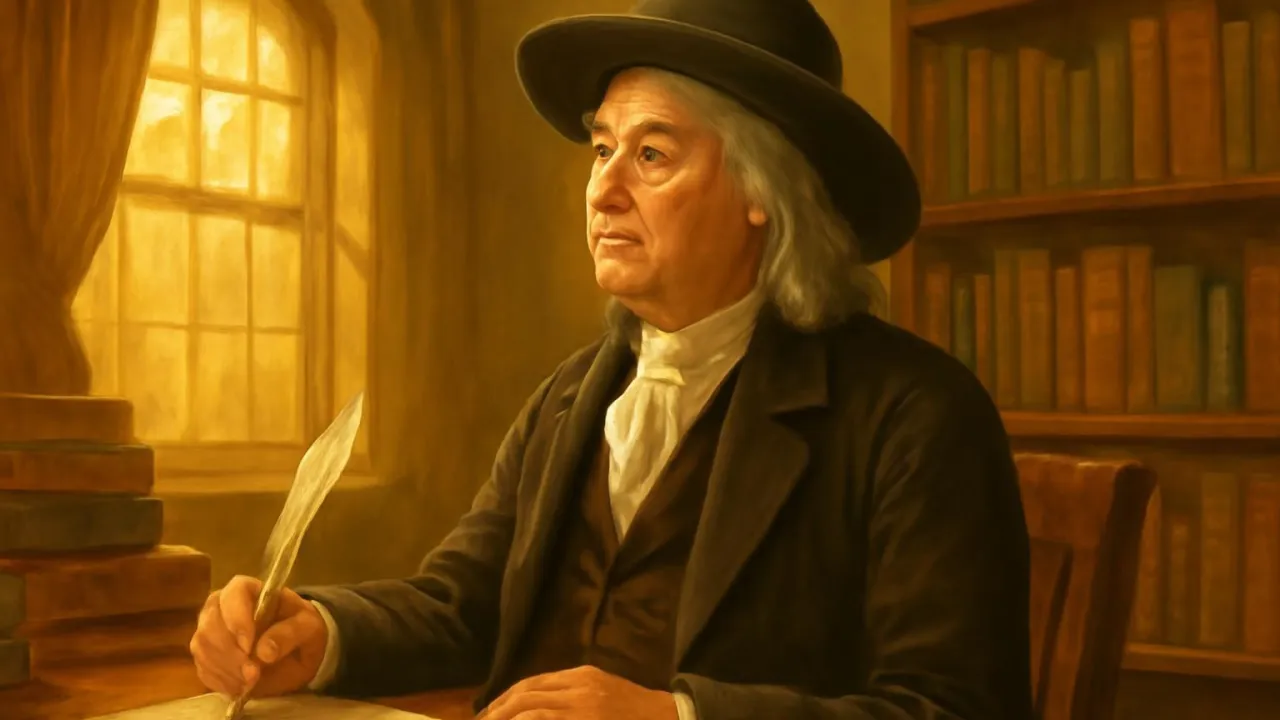
Jeremy’s writing helped create better laws for schools and workers.
✨ Word Sparks (Grade 2 Glossary)
Tap 🔊 to hear
fairness
Treating everyone in a good way.
rule
A guide for how to act.
happiness
A feeling of being glad or joyful.
🪝
Have you ever wondered how to make rules that are fair for everyone?
1
A Curious Boy
Jeremy was a curious child who loved asking questions and reading books. He wanted to know how to make life better for everyone. He often wondered, 'What makes people truly happy?'
2
Hard Work and Big Ideas
Jeremy worked hard and wrote many ideas about . He believed should help the most people. He called this idea 'the greatest .'
3
Changing the World
Jeremy’s ideas helped change how laws were made. People listened and wanted to make things fairer. His thinking still helps people today.
Jeremy once designed a special building called a Panopticon to help people learn and improve.
✨ Word Sparks (Grade 3 Glossary)
Tap 🔊 to hear
utilitarianism
Doing what helps the most people.
perseverance
Keep trying, even when it’s hard.
philosophy
Thinking about life’s big questions.
🪝
Imagine if every rule you made had to help the most people—how would you decide?
1
A Young Thinker
Jeremy Bentham loved to read and ask questions, even as a small child. He wondered why some rules seemed unfair and wanted to change that. His curiosity led him to study law and . He dreamed of making the world a kinder place.
2
Inventing Utilitarianism
Jeremy created a new idea called , which means 'the greatest happiness for the greatest number.' He believed laws should make as many people happy as possible. This was different from old laws that only helped a few. Jeremy wrote many books to share this idea.
3
Overcoming Challenges
Not everyone agreed with Jeremy’s ideas at first, and some people thought he was too different. But Jeremy kept writing and explaining, using clear examples to show why fairness mattered. His helped others see the value of helping all people.
4
A Lasting Impact
Jeremy’s ideas changed the way leaders made laws and rules. His work inspired new ways to think about fairness and happiness. Today, many governments use his ideas when making decisions. Jeremy Bentham’s thinking still shapes our world.
Jeremy asked that his body be preserved and displayed to inspire future thinkers at University College London.
✨ Word Sparks (Grade 4 Glossary)
Tap 🔊 to hear
legacy
What someone leaves behind for others.
debate
A respectful talk about different ideas.
justice
Making sure things are fair for all.
🪝
If you could change the world’s rules, would you choose what helps the most people?
1
A Child with Big Questions
Even as a young boy in London, Jeremy Bentham was fascinated by questions about right and wrong. He read advanced books and asked adults why some rules seemed unfair to certain people. This early curiosity led him to study law, searching for ways to improve society. Jeremy’s family encouraged his love of learning and .
2
The Birth of Utilitarianism
As Jeremy grew older, he developed a groundbreaking idea called utilitarianism, meaning 'the greatest happiness for the greatest number.' He believed laws and actions should be judged by how much happiness or pain they create for everyone. Jeremy wrote detailed books and essays, challenging old traditions that favored only the powerful. His new philosophy sparked across England and Europe.
3
Facing Resistance, Inspiring Change
Many leaders and thinkers at first resisted Jeremy’s ideas, saying they were too radical or strange. Jeremy responded with patience and careful arguments, using examples from real life to show why fairness was important. He even designed a special building, the Panopticon, to help people learn and improve through observation and kindness. Over time, more people began to see the value in his vision.
4
A Legacy of Fairness
Jeremy Bentham’s ideas influenced the creation of modern laws about voting, schools, and workers’ rights. His belief in fairness and happiness for all still shapes government decisions around the world today. Philosophers and lawmakers continue to study his writings, searching for ways to make societies more just. Jeremy’s work reminds us that big questions can lead to lasting change.
Bentham’s preserved body, called his 'auto-icon,' still sits at University College London over 190 years after his death.
✨ Word Sparks (Grade 5 Glossary)
Tap 🔊 to hear
utilitarianism
The idea of helping the most people.
reform
A change made to improve something.
consequences
What happens because of an action.
🪝
What if every lawmaker had to prove their rules would increase happiness for the greatest number of people?
1
Early Curiosity and Education
From a very young age, Jeremy Bentham displayed a remarkable curiosity about fairness and justice, often questioning why certain people suffered while others prospered. He read advanced philosophy books as a child in 18th-century London, astonishing adults with his thoughtful questions. His father recognized Jeremy’s potential and encouraged his studies, enrolling him at Queen’s College, Oxford, when he was just twelve years old. There, Jeremy became fascinated by the law, but he grew frustrated with how many rules seemed to protect only the wealthy and powerful. This early dissatisfaction fueled his lifelong quest to create a better, more just society.
2
Inventing Utilitarianism: A New Way to Judge Actions
Bentham’s most famous contribution was the philosophy of , which he described as 'the greatest happiness for the greatest number.' He argued that laws, policies, and actions should be evaluated based on how much happiness or suffering they produced for all people, not just a privileged few. Bentham’s utilitarian calculus was a radical idea in the late 1700s, challenging centuries of tradition and sparking heated debates among lawmakers and philosophers. He published influential works like 'An Introduction to the Principles of Morals and Legislation,' where he explained how governments could use reason and evidence to create fairer laws.
3
Perseverance in the Face of Resistance
Despite his brilliant ideas, Bentham faced strong opposition from politicians and scholars who preferred old ways of thinking. Many dismissed his theories as unrealistic or dangerous, but Bentham persisted with determination and clarity. He wrote hundreds of essays, letters, and books, using real-life examples to demonstrate how utilitarian principles could improve society. Bentham also designed the Panopticon, an innovative circular building intended to promote learning and good behavior through observation rather than punishment. Although the Panopticon was never fully built, the concept influenced later designs in education and criminal justice.
4
Global Impact and Enduring Legacy
Bentham’s utilitarian philosophy inspired major in British law, including changes to voting rights, education, and the treatment of prisoners and workers. His ideas spread across Europe and the world, shaping the development of modern democracies and human rights movements. Today, remains a powerful tool in ethics, economics, and public policy, guiding leaders as they weigh the of their decisions. Bentham’s preserved body, displayed at University College London, continues to inspire students and visitors to think deeply about fairness and the common good.
5
Lessons from Jeremy Bentham
Jeremy Bentham’s life teaches us the importance of questioning unfairness and working for positive change, even when others disagree. His insistence on evidence, reason, and compassion set new standards for how societies should make decisions. Bentham’s legacy encourages us to consider not just what is traditional, but what truly benefits the most people. By daring to ask, 'What helps everyone?' he changed the way the world thinks about justice, happiness, and responsibility. His ideas remind us that one person’s vision can shape the future for generations.