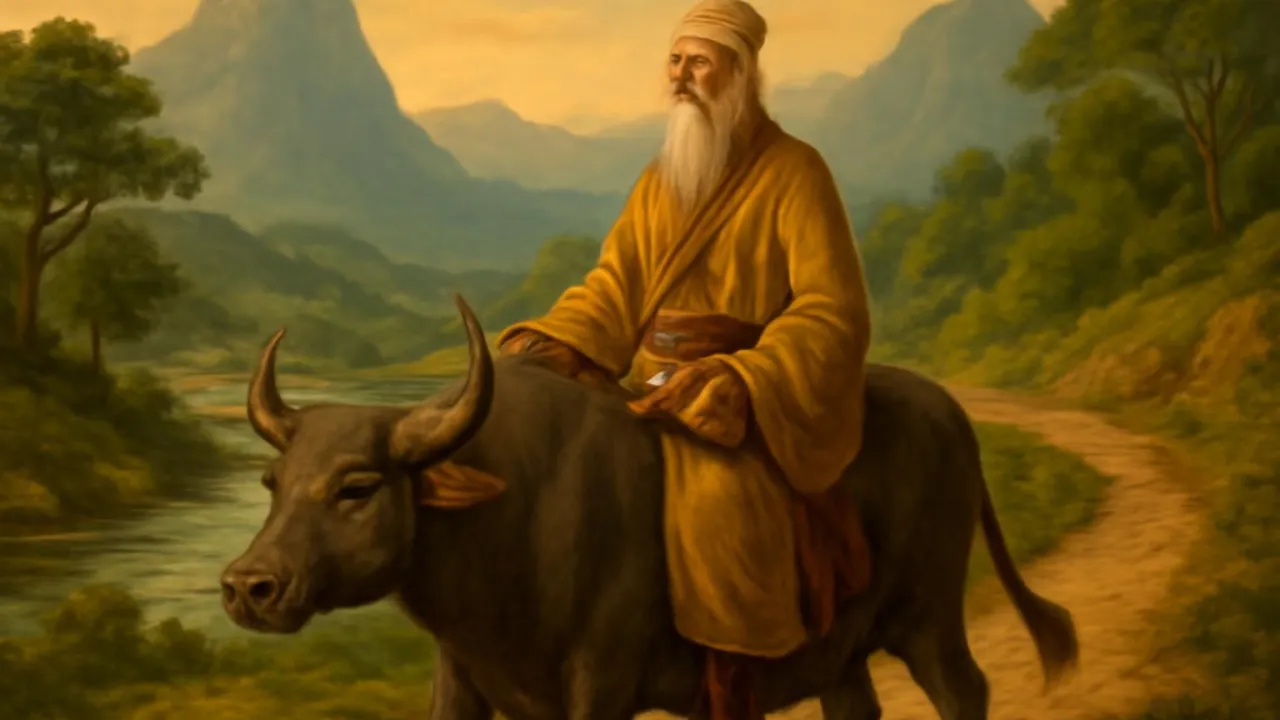
Laozi’s book has been translated into over 250 languages around the world.
✨ Word Sparks (Grade 2 Glossary)
Tap 🔊 to hear
nature
Trees, rivers, and everything outside
peace
When everything is calm and quiet
brush
A tool for writing with ink
🪝
What if you could learn from the wind and water?
1
A Boy With Big Questions
Laozi grew up watching rivers and trees. He wondered why things changed, but the world stayed calm. He liked to think quietly, and he listened to the sounds of .
2
Writing Down His Wisdom
When he grew older, Laozi wrote his thoughts in a book. He used a and ink to share his peaceful ideas. His book became famous, and people wanted to learn from him.
3
A Journey on a Buffalo
One day, Laozi rode away on a water buffalo. He left his book behind for others to read. His ideas about and are still important today.
Some people call Laozi the “Old Master” because of his deep wisdom.
✨ Word Sparks (Grade 3 Glossary)
Tap 🔊 to hear
Tao
The natural way of the world
philosophy
Ideas about life and how to live
legacy
Something important left behind
🪝
Can you imagine learning life’s secrets by watching a river flow?
1
A Curious Child
As a child, Laozi spent hours by the river, watching water move around rocks. He wondered how nature could be so strong yet so gentle. These questions made him curious about the world. He wanted to understand how everything worked together.
2
The Path of Wisdom
Laozi grew up to be a wise philosopher. He believed that people should live simply and follow the natural way, called the . He wrote his thoughts in the Tao Te Ching, a book filled with short poems and advice. His words taught people to be kind, patient, and peaceful.
3
Leaving a Legacy
One famous story tells how Laozi rode a water buffalo to the mountains. Before he left, a guard asked him to write down his wisdom. Laozi agreed, and his book became a treasure for many generations. His ideas spread far beyond his homeland.
4
Why Laozi Matters
Laozi’s teachings helped shape Chinese and culture. He showed that harmony with nature brings happiness and balance. People around the world still read his book today. His gentle way of thinking inspires many to live calmly and wisely.
Some ancient paintings show Laozi with a long beard riding his buffalo.
✨ Word Sparks (Grade 4 Glossary)
Tap 🔊 to hear
Daoism
A way of thinking about harmony
harmony
When things work well together
bamboo
A tall, green plant used for writing
🪝
How can a simple book change how people think for thousands of years?
1
A World of Change
Long ago in ancient China, people searched for ways to live in with nature and each other. Laozi, a quiet thinker, spent his days observing the world’s patterns and listening to the wisdom of rivers and wind. He noticed that nature moved gently but could shape mountains over time. These observations inspired his lifelong search for balance and peace.
2
The Tao Te Ching
Laozi’s most famous work, the Tao Te Ching, was written when he was asked to share his wisdom before leaving his homeland. Using a brush and ink, he wrote about the Tao, or ‘the Way,’ describing how people could live simply and kindly. His book became a guide for rulers, teachers, and ordinary people seeking and understanding.
3
A Journey on a Buffalo
According to legend, Laozi left his city riding a water buffalo, heading toward the mountains to seek peace. At the city gate, a guard recognized his wisdom and asked Laozi to write down his teachings. Laozi agreed, and his words became a treasure for many generations, spreading across China and the world.
4
Lasting Influence
Laozi’s ideas shaped , a major Chinese philosophy that values balance, humility, and living in tune with nature. His teachings have influenced art, politics, and everyday life for over 2,000 years. Even today, people read the Tao Te Ching to find calm and wisdom in a busy world. Laozi’s gentle message continues to inspire people everywhere.
1. What animal is Laozi often shown riding in stories and art?
2. How did Laozi’s teachings spread beyond his homeland?
🤯 Mind-Blowing Fact • Grade 5
Laozi’s Tao Te Ching has inspired leaders, artists, and scientists for over two millennia.
✨ Word Sparks (Grade 5 Glossary)
Tap 🔊 to hear
wu wei
Acting naturally, without forcing things
humility
Being modest and not showing off
legacy
What someone leaves behind for others
🪝
What can we learn from a sage who taught that softness can overcome hardness?
1
A Sage Observing Nature’s Wisdom
Imagine a young Laozi sitting quietly beside a flowing river, watching as water gently moves around every obstacle in its path. He noticed that the soft water could wear down the hardest rocks, teaching him that gentleness and patience could be stronger than force. These early observations shaped Laozi’s lifelong quest to understand the patterns of nature and human life. He believed that true wisdom came from living in harmony with the world around us, not by trying to control it.
2
Writing the Tao Te Ching
As Laozi grew older, his reputation for wisdom spread throughout the Zhou Dynasty. According to legend, when he decided to leave his homeland for a quieter life, a border guard recognized him and asked him to write down his teachings before he departed. Laozi agreed, and in just a few days, he composed the Tao Te Ching—an 81-chapter book filled with poetic verses about the Tao, or ‘the Way.’ This book explores ideas like , simplicity, and the importance of balancing opposites in life.
3
Core Ideas and Influence
Laozi’s philosophy centers on the concept of , which means ‘non-action’ or acting in a natural, effortless way. He encouraged people to let go of pride and ambition, believing that the best leaders were those who governed quietly and led by example. The Tao Te Ching has been translated into over 250 languages and is considered one of the most influential works in world philosophy. Laozi’s teachings have shaped Daoism, Chinese medicine, martial arts, and even modern ideas about ecology and leadership.
4
Legacy Across Millennia
For more than two thousand years, Laozi’s ideas have inspired emperors, artists, writers, and ordinary people seeking peace and balance. His gentle wisdom encouraged people to respect nature, value , and find strength in kindness rather than force. Daoism, the philosophy he founded, remains a major influence in China and around the globe, shaping art, politics, and daily life. Even today, people turn to the Tao Te Ching for guidance in a fast-changing world.
5
Lessons for Today
Laozi’s life reminds us that sometimes the quietest voices can have the greatest impact. His teachings encourage us to pause, observe, and appreciate the natural flow of life. By practicing patience, , and kindness, we can solve problems peacefully and build stronger communities. Laozi’s proves that wisdom from the past can still help us face modern challenges, making his ancient words as meaningful today as they were thousands of years ago.