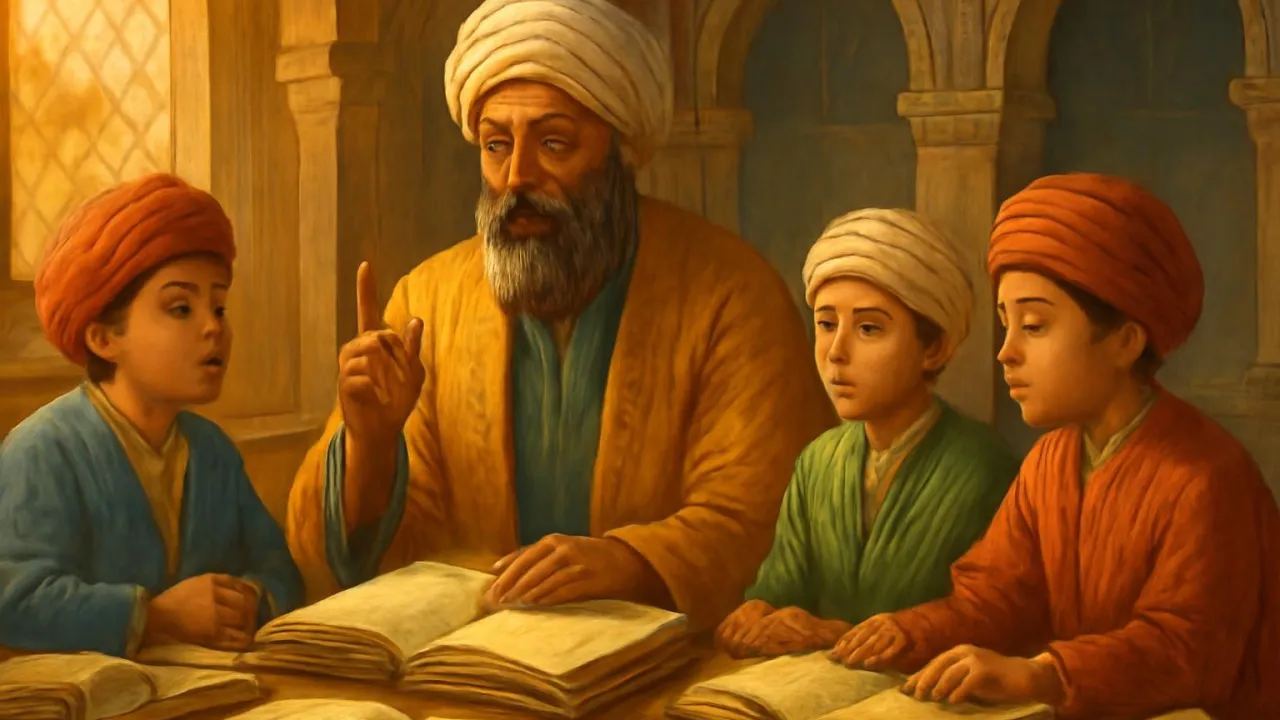
Al-Ghazali’s books are still studied in schools around the world today.
✨ Word Sparks (Grade 2 Glossary)
Tap 🔊 to hear
curious
Wanting to learn new things
teacher
Someone who helps others learn
ideas
Thoughts about how things work
🪝
Have you ever wondered where big ideas come from?
1
A Curious Mind
Young Al-Ghazali was always asking questions about life and the world. He wanted to know why things happened and how people should live. He read every book he could find and listened to wise .
2
Hard Work and Learning
He studied for many years, working hard even when it was difficult. Al-Ghazali wrote down his thoughts in long books to help others understand. He believed that learning could make people kinder and wiser.
3
A Famous Teacher
Al-Ghazali became a famous who helped students think deeply. He taught that asking questions is important for everyone. His are still read in many countries today.
Al-Ghazali’s work helped shape both Islamic and Western philosophy for hundreds of years.
✨ Word Sparks (Grade 3 Glossary)
Tap 🔊 to hear
legacy
What someone leaves behind for others
philosophy
The study of big life questions
perseverance
Not giving up, even when it’s hard
🪝
Imagine a world where every question leads to a new adventure.
1
A Boy Full of Questions
As a child, Al-Ghazali was always asking questions about life, people, and the universe. He wanted to know why the sky was blue and how people could tell right from wrong. His curiosity made him read many books and listen to great teachers. This love for learning shaped his whole life.
2
Learning and Perseverance
Al-Ghazali faced many challenges, like traveling far from home to study. He spent years in schools called madrasas, where he learned about , religion, and science. Even when lessons were hard, he showed and never gave up. His hard work made him a respected scholar.
3
Changing How People Think
Al-Ghazali wrote important books, such as 'The Revival of Religious Sciences.' He asked deep questions about faith, reason, and happiness. By combining and religion, he helped people see that asking questions could lead to wisdom. His ideas changed how people thought about learning and belief.
4
A Lasting Legacy
Al-Ghazali became a famous teacher whose students spread his ideas far and wide. He taught that kindness, honesty, and curiosity were keys to a good life. Today, his books are still read by students all over the world. His shows us the power of asking questions and seeking knowledge.
Al-Ghazali’s books were translated into Latin and influenced European philosophers like Thomas Aquinas.
✨ Word Sparks (Grade 4 Glossary)
Tap 🔊 to hear
theology
The study of religious beliefs
madrasas
Schools for learning in the Islamic world
legacy
What someone leaves for the future
🪝
What if searching for answers could change the world forever?
1
A Childhood of Curiosity
From a young age, Al-Ghazali was fascinated by the mysteries of life and the universe. Growing up in Persia during the Islamic Golden Age, he spent hours reading, questioning, and seeking wisdom from every teacher he met. His early curiosity led him to study philosophy, science, and religion with remarkable dedication. This thirst for knowledge would guide his journey as a thinker and writer.
2
A Scholar’s Journey
Al-Ghazali traveled far from home to attend famous , where he learned from leading scholars of his time. He worked tirelessly, mastering philosophy, law, and , even when faced with doubts and challenges. His perseverance helped him become a respected professor in Baghdad, where students from many lands came to learn. Al-Ghazali’s commitment to learning inspired others to ask questions and seek understanding.
3
Transforming Philosophy and Faith
Al-Ghazali’s most famous book, 'The Revival of Religious Sciences,' explored how faith and reason could work together. He argued that true wisdom comes from both questioning and believing, which was a new idea for many people. His writings challenged scholars to think deeply about the meaning of life, happiness, and truth. By blending philosophy and religion, he changed how people studied and understood the world.
4
A Timeless Influence
Al-Ghazali’s teachings spread across continents, shaping both Islamic and Western thought for centuries. His students carried his ideas to new lands, making his truly global. Today, his books are still read in universities and schools, inspiring new generations to be curious and wise. Al-Ghazali’s life reminds us that asking questions can lead to lasting discoveries and positive change.
Al-Ghazali’s books have been read and debated for nearly a thousand years, shaping philosophy worldwide.
✨ Word Sparks (Grade 5 Glossary)
Tap 🔊 to hear
logic
Thinking carefully to find the truth
ethics
Rules about what is right and wrong
crisis
A time when someone feels unsure or worried
🪝
Can one thinker’s search for truth reshape the way people understand the world for centuries?
1
A Childhood Driven by Wonder
In the bustling city of Tus, young Al-Ghazali was captivated by the mysteries of life and the universe. He eagerly questioned his teachers, read every book he could find, and debated with friends about right and wrong. Growing up during the Islamic Golden Age, he was surrounded by scholars, scientists, and poets, which fueled his curiosity even more. His early experiences taught him that wisdom comes from asking questions and seeking understanding. This passion for knowledge would become the foundation of his life's work.
2
The Scholar’s Path: Perseverance and Mastery
Al-Ghazali’s journey to becoming a renowned philosopher was filled with challenges and perseverance. He left home to study at the best madrasas, traveling across Persia and beyond to learn from the greatest minds of his era. He mastered disciplines like philosophy, Islamic law, theology, and , often studying late into the night. Despite facing personal doubts and periods of spiritual , he remained committed to both reason and faith. His reputation grew, and he was invited to teach at the prestigious Nizamiyya University in Baghdad, where students from many regions gathered to hear his lectures. His tireless dedication made him a respected scholar and teacher.
3
Revolutionizing Philosophy and Religious Thought
Al-Ghazali’s most influential work, 'The Revival of Religious Sciences,' became a turning point in both Islamic and Western philosophy. He argued that true wisdom could only be reached by blending rational thought with sincere faith, challenging the idea that science and religion must be separate. His method involved careful questioning, logical analysis, and deep reflection on spiritual matters. Al-Ghazali also critiqued earlier philosophers, urging people not to accept ideas blindly but to seek evidence and understanding. His writings inspired debates, new schools of thought, and a lasting respect for the balance between reason and belief.
4
A Global Legacy Across Centuries
Al-Ghazali’s influence quickly spread beyond Persia, as his students and books traveled across the Islamic world and into Europe. His works were translated into Latin and studied by Christian scholars, including Thomas Aquinas, who admired his approach to philosophy and theology. Al-Ghazali’s ideas about , happiness, and the search for truth shaped universities and religious schools for hundreds of years. Even today, his books are read by students, philosophers, and theologians who seek to understand the connection between mind and spirit. His legacy is a testament to the power of asking questions and seeking knowledge.
5
Inspiration for Future Generations
Al-Ghazali’s life story encourages us to be curious, resilient, and open-minded in our own search for truth. He showed that wisdom grows from honest questions, careful study, and a willingness to learn from others. His ability to unite reason and faith helped bridge gaps between different cultures and beliefs, making him a true pioneer of philosophical thought. By teaching kindness, critical thinking, and the importance of lifelong learning, he changed how people view education and personal growth. Al-Ghazali’s journey reminds us that every question can lead to a new discovery, and that seeking understanding is a lifelong adventure.