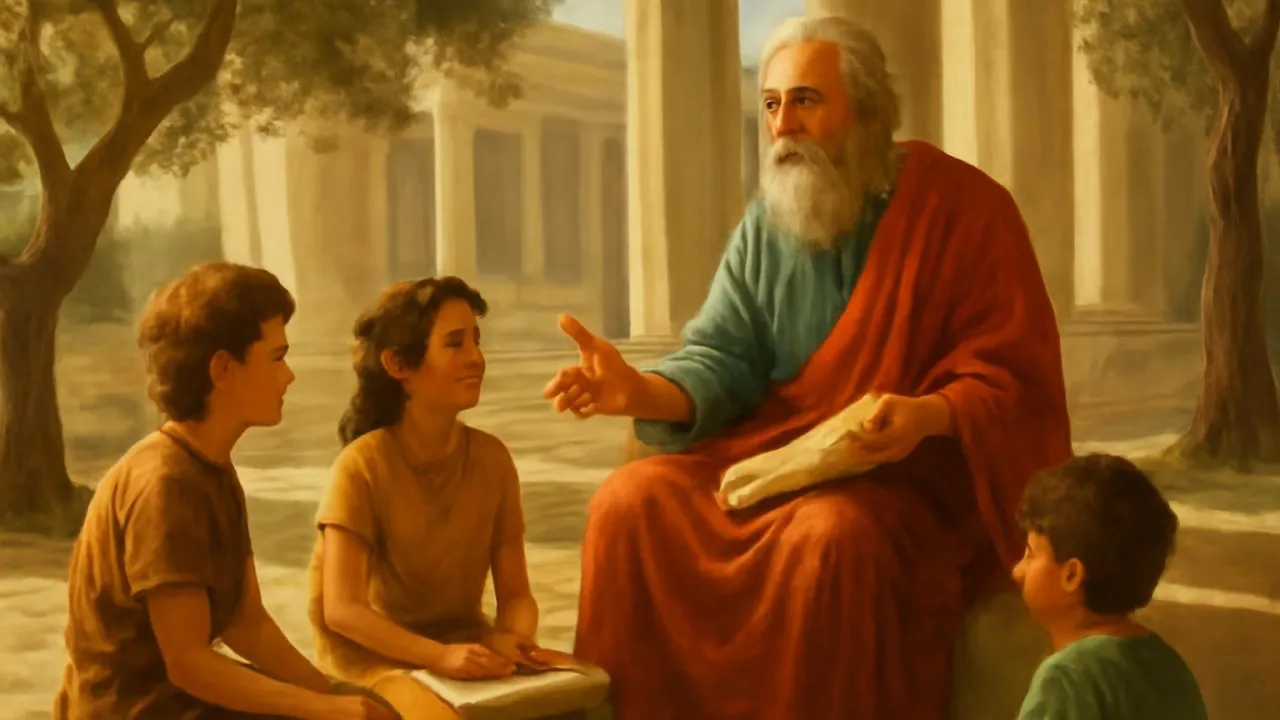
Plato’s real name was Aristocles, but everyone called him Plato!
✨ Word Sparks (Grade 2 Glossary)
Tap 🔊 to hear
dialogue
A talk between two or more people
justice
Doing what is fair and right
student
Someone who learns from a teacher
🪝
Have you ever wondered what makes something right or fair?
1
A Boy Full of Questions
One day, young Plato sat under a shady tree, thinking about big ideas. He liked to ask his teachers questions and listen closely to their answers. He wondered why people do good things and what makes something fair.
2
Learning in a Garden
When Plato grew up, he started a special school called the Academy. He taught outside in a garden, where learned by talking and thinking together. They shared ideas about fairness and friendship.
3
Writing Down Ideas
Plato wrote his ideas in books called . These books show people talking and asking questions. Even today, people read his books to learn about thinking and .
Plato’s teacher, Socrates, never wrote anything down—Plato wrote their talks for him!
✨ Word Sparks (Grade 3 Glossary)
Tap 🔊 to hear
Socratic method
Learning by asking and answering questions
The Republic
A famous book about justice by Plato
philosophy
The study of big ideas and life
🪝
Have you ever wondered what makes something truly good or fair?
1
A Curious Mind in Ancient Athens
As a young boy in Athens, Plato was always curious about the world. He loved to ask questions about what makes a good person or a fair city. His teachers noticed his sharp mind and encouraged him to think deeply.
2
Learning from Socrates
Plato became a student of the famous philosopher Socrates, who taught by asking questions. Socrates showed Plato the power of dialogue and encouraged him to seek the truth. This way of learning is called the .
3
The Academy and New Ideas
Plato started the Academy, the first school for in Europe. Students gathered in gardens to talk about justice, friendship, and the meaning of life. Plato believed that asking questions helped people grow wise.
4
Writing Dialogues for the Future
Plato wrote many dialogues, using characters to explore big ideas. His most famous book, , asks what makes a just society. Today, people all over the world still read his works and learn from his questions.
Plato’s Academy lasted for almost 900 years after he started it!
✨ Word Sparks (Grade 4 Glossary)
Tap 🔊 to hear
ethics
Deciding what is right and wrong
legacy
Something important left for the future
democracy
A way people share power to rule
🪝
What if you could build a school where everyone learns by asking questions?
1
A Young Thinker in Athens
Growing up in ancient Athens, Plato was surrounded by art, music, and lively debates. He was born into a wealthy family during a time when Athens was a center of learning and . From a young age, Plato was fascinated by questions about truth, courage, and what makes a good life. His early curiosity set him on a path to become one of history’s most important philosophers.
2
Learning with Socrates
Plato became a devoted student of Socrates, who taught by challenging students with tough questions. This style, known as the Socratic method, helped people discover answers through discussion rather than memorization. Socrates inspired Plato to value wisdom above riches or power, and their conversations shaped Plato’s ideas about justice and knowledge.
3
The Academy: A New Kind of School
After Socrates died, Plato founded the Academy, the first school of philosophy in Europe. The Academy was held in a peaceful garden where students explored ideas about government, science, and . Plato believed that real learning happened when people asked questions together, and he encouraged debate and curiosity.
4
Plato’s Legacy Lives On
Plato wrote many dialogues, including The Republic, which explores how to build a fair society. His writings introduced important concepts like justice, equality, and the search for truth. Today, people around the world study Plato’s works, using his questions to guide their own thinking about life and society.
Plato’s Academy educated students for almost 900 years—even after the Roman Empire began!
✨ Word Sparks (Grade 5 Glossary)
Tap 🔊 to hear
theory of Forms
Plato’s idea that perfect things exist in thought
critical thinking
Carefully examining ideas and reasons
dialogue
A deep conversation to explore ideas
🪝
Imagine a world where every lesson begins with a question—how would you learn differently?
1
Curiosity in the Heart of Athens
In the bustling city of Athens, young Plato grew up surrounded by artists, thinkers, and lively public debates. His wealthy family gave him access to the best teachers, but what truly set Plato apart was his relentless curiosity about the world. He questioned everything—from the meaning of friendship to the nature of justice—setting the stage for his lifelong journey as a philosopher.
2
The Socratic Influence and a New Way to Learn
Plato’s most important mentor was Socrates, a philosopher famous for challenging people to think deeply by asking tough questions. This approach, called the Socratic method, transformed Plato’s understanding of learning. Instead of memorizing facts, Plato learned to seek wisdom by engaging in thoughtful , always searching for the underlying reasons behind beliefs and actions.
3
Founding the Academy and Shaping Minds
After witnessing the trial and death of Socrates, Plato was inspired to create the Academy in 387 BCE, often considered the first university in Western history. Students from across Greece gathered in its open gardens to study philosophy, mathematics, science, and government. The Academy became a center for , where Plato encouraged students to question, debate, and pursue knowledge together.
4
Dialogues, The Republic, and Enduring Ideas
Plato wrote more than thirty philosophical , using characters and conversations to explore complex ideas. His most famous work, The Republic, examines what makes a society just and how leaders should be chosen. Plato’s writing introduced influential concepts such as the , the importance of reason, and the value of a just government—ideas that continue to shape philosophy and politics today.
5
Legacy: The Philosopher’s Lasting Impact
Plato’s Academy remained active for nearly nine centuries, influencing countless thinkers, including his student Aristotle. His method of questioning laid the foundation for modern education and scientific inquiry. Plato’s vision of a world guided by wisdom, justice, and open discussion inspires teachers, leaders, and students around the globe, reminding us that every great discovery begins with a single, thoughtful question.