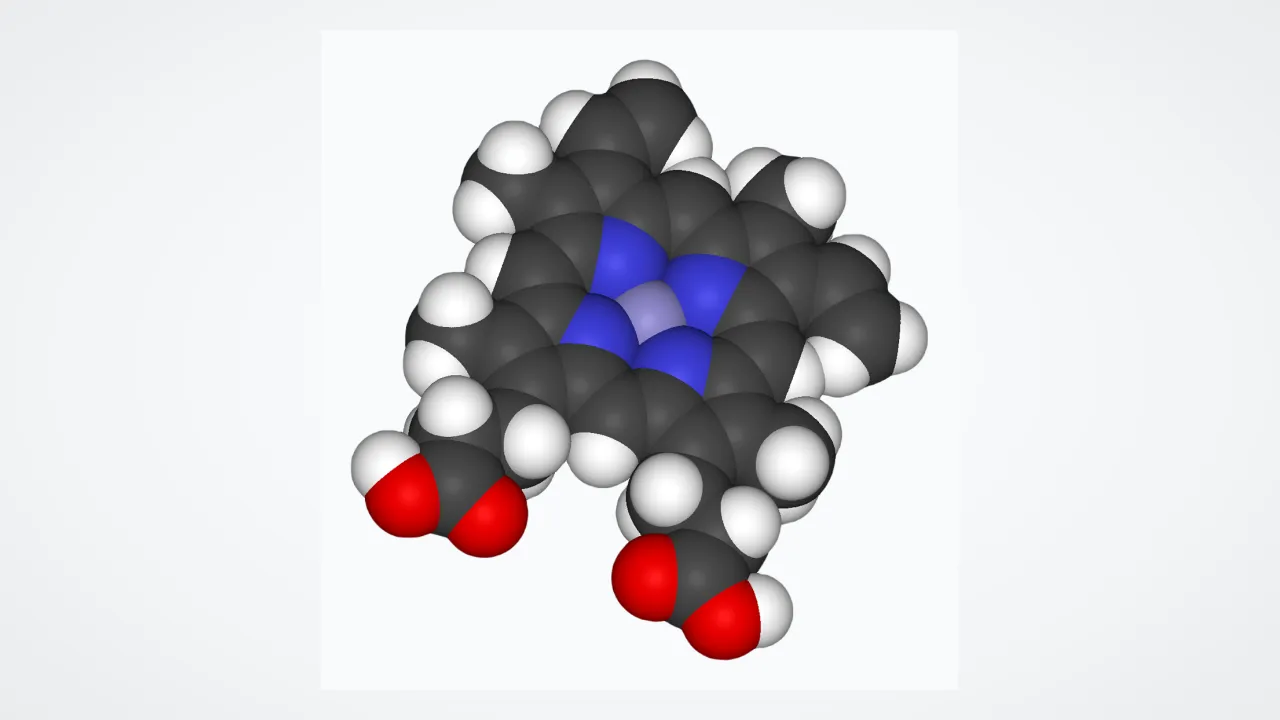
1. What gives human blood its bright ruby-red color?
2. Where do red blood cells pick up fresh oxygen first?
🤯 Mind-Blowing Fact • Grade 2
Horseshoe crabs and octopuses use copper instead of iron to carry oxygen, which makes their blood bright blue instead of red!
✨ Word Sparks (Grade 2 Glossary)
Tap 🔊 to hear
Hemoglobin
Iron-rich protein carrying oxygen in blood
Anemia
Feeling tired from having too little iron
Atom
Smallest tiny building unit of an element
🪝
Why won't a refrigerator magnet stick to your arm even though there is real iron in your blood?
1
Packed Inside Hemoglobin
Hold a magnet near your wrist—nothing pulls! That is because blood iron does not float around as solid metal chunks. Instead, single iron tuck neatly inside special red-blood-cell proteins called .
2
Catch and Release
Every red blood cell carries millions of proteins. In your lungs, iron snaps up fresh oxygen molecules. Seconds later, down in hard-working leg or brain cells, iron gently lets that oxygen go so cells can make energy!
3
Refilling Your Iron Tank
Low iron makes kids feel tired because cells get less oxygen—a condition doctors call . Eating lentils, lean beef, turkey, pumpkin seeds, tofu, and iron-fortified oatmeal keeps your oxygen trucks rolling strong!
1. Why doesn't a magnet stick to the iron flowing through your veins?
2. Why do octopuses and horseshoe crabs have blue blood instead of red?
🤯 Mind-Blowing Fact • Grade 3
Science teachers can actually use a strong magnet to pull tiny flecks of real elemental iron right out of crushed iron-fortified breakfast cereal mixed with water!
✨ Word Sparks (Grade 3 Glossary)
Tap 🔊 to hear
Heme
Ring-shaped pocket holding one iron atom
Myoglobin
Iron protein storing oxygen inside muscle cells
Scarlet
Bright glowing red color of oxygen-rich blood
🪝
How can one single red blood cell carry a billion molecules of oxygen at the exact same time?
1
Four Seats Per Hemoglobin
Zoom inside one doughnut-shaped red blood cell, and you will find about two hundred seventy million hemoglobin molecules! Each hemoglobin protein holds four tiny iron rings called groups, so every hemoglobin can carry four oxygen molecules at once.
2
Color Shift: Bright Red vs. Dark Cherry
Have you ever heard someone claim blood inside veins is blue? Actually, human blood is always red—skin just bends light so veins look bluish! Oxygen-packed blood leaving your lungs shines bright red, while oxygen-poor blood returning to your heart turns deep dark cherry red.
3
Muscle Reserve Tanks
Red blood cells hold about seventy percent of your body's iron, while hard-working muscles keep a cousin protein called . Myoglobin uses iron to store an emergency oxygen stash right inside muscle fibers for quick sprints!
4
The Vitamin C Boost
Meat and fish offer easy-to-absorb iron, while beans, spinach, and grains offer plant iron. Eating vitamin C—like strawberries or bell peppers—alongside beans helps your gut absorb way more plant iron!
1. Is human blood inside your veins ever truly blue?
2. Which iron-rich cousin protein stores an extra stash of oxygen right inside muscle cells?
🤯 Mind-Blowing Fact • Grade 4
Deep-diving sperm whales pack so much iron-rich myoglobin into their muscles for hour-long ocean dives that their muscle tissue looks almost pitch black!
✨ Word Sparks (Grade 4 Glossary)
Tap 🔊 to hear
Reversible
Able to attach and let go cleanly
Transferrin
Blood protein ferrying recycled iron to marrow
Spleen
Organ recycling worn-out red blood cells
🪝
Why does iron rust permanently on an old bicycle left in the rain, yet let go of oxygen cleanly inside your cells?
1
Preventing Permanent Rust
Leave an unpainted iron bike frame outdoors in damp air, and oxygen locks onto the metal permanently as flaky orange rust. Inside your bloodstream, permanent bonding would be a disaster—oxygen could never hop off at hungry cells! Hemoglobin solves this problem by tucking each iron atom inside a protective ring called heme, cushioned within folded protein chains that allow binding: iron grabs O2 tightly in air-rich lungs, then releases it smoothly in warm, active tissues.
2
Cooperative Teamwork
Each hemoglobin molecule links four protein subunits, each cradling one iron-containing heme group. Remarkably, the four subunits cooperate! As soon as the first iron atom catches an oxygen molecule inside lung capillaries, hemoglobin flexes slightly, making it much easier for the other three iron atoms to snap up oxygen too.
3
Master Recyclers in the Spleen
Red blood cells wear out after roughly one hundred twenty days of squeezing through narrow capillaries. Rather than wasting precious iron, cleanup cells in your and liver dismantle old hemoglobin, load the rescued iron onto a blood shuttle protein called , and ship it straight back to bone marrow to build fresh red blood cells!
4
Heme vs. Non-Heme Nutrition
Poultry, fish, and red meats supply heme iron (15–35% absorbed), while lentils, chickpeas, tofu, pumpkin seeds, and greens supply non-heme iron (2–20% absorbed)—easily boosted by pairing with vitamin C foods.
1. How does hemoglobin prevent its iron atoms from permanently 'rusting' onto oxygen?
2. What happens to the iron inside red blood cells when they retire after 120 days?
🤯 Mind-Blowing Fact • Grade 5
Every second, your red bone marrow packs freshly recycled iron into two million brand-new red blood cells—installing over half a quadrillion hemoglobin molecules per minute!
✨ Word Sparks (Grade 5 Glossary)
Tap 🔊 to hear
Bohr Effect
Hemoglobin releasing extra oxygen near active muscles
Ferritin
Hollow sphere protein safely storing spare iron
Hepcidin
Liver hormone regulating gut iron absorption
🪝
How did twenty-five years of X-ray photographs unlock hemoglobin's 'molecular lung'—and connect every breath you take to exploding supernovae?
1
Stardust Forged for Cellular Respiration
Every one of the roughly three to four grams of iron (Fe, atomic number 26) circulating through your body originated billions of years ago inside massive dying stars and supernova explosions! On Earth, aerobic cells harness iron's ability to shift smoothly between ferrous (Fe2+) and ferric (Fe3+) oxidation states, deploying it both to transport diatomic oxygen in blood and to shuttle electrons inside mitochondrial cytochrome enzymes that generate ATP fuel.
2
Max Perutz and Cooperative Binding
Austrian-British molecular biologist Max Perutz spent twenty-five years firing X-rays through hemoglobin crystals before unveiling its 3D atomic structure and sharing the 1962 Nobel Prize in Chemistry. Perutz called hemoglobin a 'molecular lung': four globin polypeptide chains (two alpha, two beta) each cradle a porphyrin heme ring centered on one ferrous Fe2+ ion. Binding the first O2 molecule tugs the iron atom fractions of a nanometer into the heme plane, shifting the entire tetramer from a 'tense' state to a 'relaxed' state that raises oxygen affinity three-hundredfold!
3
The Bohr Effect at Working Muscles
How does hemoglobin know exactly where to unload its cargo? Sprinting muscles release carbon dioxide and mild lactic acid, lowering local blood pH. Discovered by Christian Bohr in 1904, this slight acidity alters hemoglobin's shape so it releases extra oxygen precisely where cells work hardest!
4
Hepcidin, Ferritin, and Closed-Loop Recycling
Because humans lack an active excretion pathway for excess iron—and free unbound iron sparks damaging radicals—the liver releases a master hormone called to throttle intestinal absorption whenever storage vaults inside liver cells are full. Meanwhile, macrophages recycle twenty-plus milligrams of iron daily from senescent erythrocytes.
5
Combating Global Iron-Deficiency Anemia
Rapid childhood growth expands blood volume swiftly, making iron deficiency the world's most common nutritional shortfall—preventable by combining bioavailable heme sources or vitamin-C-paired legumes, seeds, and fortified grains.