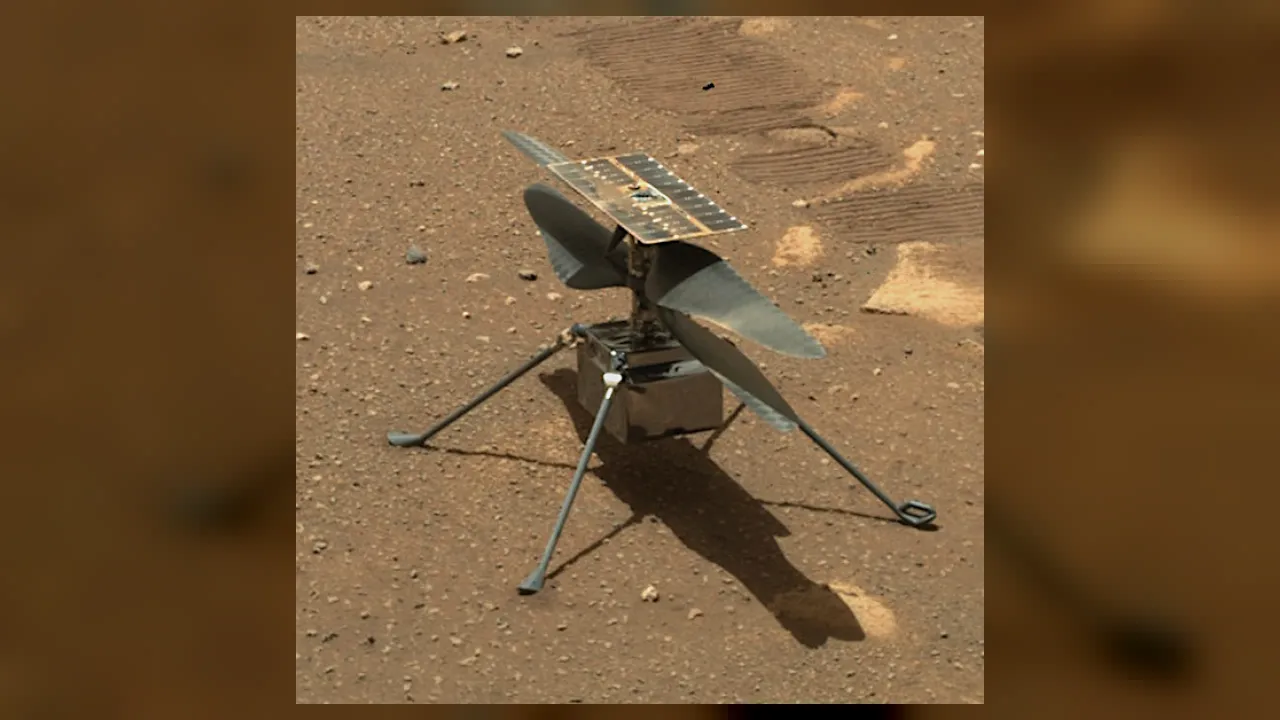
1. Why did Ingenuity have to be super light with fast-spinning blades?
2. How many times did the brave little helicopter end up flying on Mars?
🤯 Mind-Blowing Fact • Grade 2
An Alabama high school student named Vaneeza Rupani gave Ingenuity its inspiring name in a nationwide NASA essay contest!
✨ Word Sparks (Grade 2 Glossary)
Tap 🔊 to hear
carbon fiber
Super-strong, featherlight woven material for aircraft
lift
Upward force pushing wings or blades skyward
solar panel
Flat plate turning sunlight into electric power
🪝
How do you fly a helicopter when the air feels as thin as 100,000 feet above Earth?
1
A Wright Brothers Moment
Imagine watching four skinny legs off another planet for the very first time! On April 19, 2021, this tissue-box-sized rotorcraft climbed ten feet above Jezero Crater, hovered smoothly, and landed right back on target.
2
Spinning Five Times Faster
Because Martian air has only one percent of Earth's thickness, ordinary helicopter blades would barely push anything. Engineers built two four-foot carbon-fiber rotors that spin in opposite directions more than 2,400 times every minute!
3
Surviving Freezing Nights
A small on top charges six batteries each day, using most of its power just to stay warm through freezing nights.
1. What uses up most of Ingenuity's battery power every Martian night?
2. Why does the helicopter have two rotors spinning in opposite directions?
🤯 Mind-Blowing Fact • Grade 3
On Earth, Ingenuity weighs four pounds—about as much as a gallon of milk—but in Mars's gentler gravity it weighs less than eleven ounces!
✨ Word Sparks (Grade 3 Glossary)
Tap 🔊 to hear
aerodynamics
How air moves around wings and spinning blades
chassis
The main frame supporting a vehicle's body
navigation
Figuring out position and steering along a route
🪝
How can a four-pound robot fly all by itself when its human pilots are 170 million miles away?
1
Unfolding From a Rover's Belly
Clamped sideways under Perseverance's during the seven-month trip from Earth, NASA's Mars Helicopter unfolded like origami onto rusty gravel in April 2021. Once the rover rolled safely back, the four-pound craft stood ready at Wright Brothers Field.
2
No Joystick Allowed
Radio commands take between five and twenty minutes to travel from Earth to Mars, making live joystick steering impossible! Instead, Ingenuity's smartphone-style computer snapped thirty black-and-white ground photos per second, tracking rocks below to balance itself automatically against sudden wind gusts.
3
From Demo to Aerial Scout
Engineers originally designed it for just thirty days and five short hops. Instead, it soared for nearly three years, scouting sand ripples and cliffs from forty to eighty feet up so Perseverance could pick faster, safer routes.
4
Final Landing in Sand Ripples
In January 2024, smooth sand dunes confused its ground-tracking camera during Flight 72, chipping a rotor tip on landing and ending its legendary flying career.
1. Why couldn't engineers on Earth steer Ingenuity live with a remote joystick?
2. How did Ingenuity keep track of its movement while flying?
🤯 Mind-Blowing Fact • Grade 4
Even after rotor damage grounded it forever on Flight 72, Ingenuity stayed awake as a stationary weather and avionics test station on Jezero's dunes!
✨ Word Sparks (Grade 4 Glossary)
Tap 🔊 to hear
altimeter
Sensor measuring height above the ground below
drag
Air resistance pushing back against moving objects
inertial
Measuring motion changes using internal gyroscopes and accelerometers
🪝
Why does spinning a helicopter blade too fast on Mars actually make it lose lift instead of climb higher?
1
Solving the Martian Lift Equation
Designing the first interplanetary aircraft forced JPL engineers into an aerodynamic tightrope walk. Mars possesses roughly one-third of Earth's surface gravity, which helps, yet its carbon-dioxide atmosphere exerts barely one percent of Earth's sea-level pressure—equivalent to flying seventeen miles above Earth, more than twice as high as jetliners cruise! To generate enough lift, Ingenuity paired ultra-stiff foam-filled carbon-fiber blades spanning four feet with a featherweight 1.8-kilogram body.
2
Dodging the Speed of Sound
Why couldn't engineers simply spin the rotors ten thousand times a minute? Because cold carbon dioxide carries sound slower than Earth air, blade tips spinning much past 2,600 revolutions per minute approach Mach 0.7, triggering shockwaves and that ruin stability. Ingenuity operated right inside that narrow sweet spot at roughly 2,400 to 2,537 RPM.
3
Off-the-Shelf Brains in Brutal Cold
Rather than slow, bulky radiation-hardened chips, Ingenuity relied on a fast commercial smartphone processor paired with laser and sensors making five hundred adjustments per second. When dust dimmed winter sunlight in 2022, engineers cleverly let it freeze overnight and reboot each sunny morning!
4
Inspiring Future Sky Explorers
Across 17 kilometers of total flight distance, Ingenuity proved aerial robots can reach cliffs no wheeled rover can climb, inspiring next-generation Mars choppers and NASA's Dragonfly rotorcraft bound for Saturn's moon Titan.
1. What happens if rotor blade tips spin too close to the Martian speed of sound?
2. Which future NASA rotorcraft mission to Saturn's moon Titan builds upon lessons of alien flight?
🤯 Mind-Blowing Fact • Grade 5
The UN's International Civil Aviation Organization granted Ingenuity an official aircraft designator—IGY—and named its first takeoff spot JZRO, the first airport code on another planet!
✨ Word Sparks (Grade 5 Glossary)
Tap 🔊 to hear
coaxial
Two rotors mounted one above another sharing one shaft
millibar
Metric unit used to measure atmospheric gas pressure
odometry
Estimating travel distance and position using motion sensors
🪝
How did a technology demonstration built with smartphone electronics rewrite the textbook on planetary exploration?
1
Simulating Mars Inside a Vacuum Chamber
Before anything could fly in Jezero Crater, engineers at NASA's Jet Propulsion Laboratory had to recreate Mars on Earth. Inside a twenty-five-foot space simulator, technicians pumped out nearly all air, backfilled thin carbon dioxide to six of pressure, and hung early prototypes from motorized fishing line to fake Mars's 38-percent gravity. Early test models thrashed wildly until custom-contoured carbon-fiber blades and ultra-fast control loops tamed the thin atmosphere's sluggish aerodynamic damping.
2
Coaxial Engineering and Mass Discipline
Every gram counted inside Ingenuity's 1,800-gram budget. Six Sony lithium-ion cells, a Qualcomm Snapdragon 801 processor running Linux, a Garmin laser rangefinder, a color horizon camera, and a downward black-and-white navigation camera all nestled inside a foil-insulated fuselage no bigger than a grapefruit box, insulated by carbon-dioxide gas gaps to trap daytime warmth.
3
Visual-Inertial Odometry in Real Time
During flight, an inertial measurement unit sampled tilt and acceleration five hundred times per second while optical-flow algorithms tracked surface rocks across thirty frames per second, communicating status back to Earth through a Zigbee radio relay on Perseverance up to a kilometer away.
4
Shattering Every Record Across 72 Flights
Following its historic 39.1-second maiden flight on April 19, 2021—officially logged by the International Civil Aviation Organization with callsign IGY—Ingenuity transitioned into an operational scout. Over 1,000 Martian days, it reached altitudes of 24 meters (78.7 feet), ground speeds of 10 meters per second (22.4 mph), and cumulative airtime exceeding 128 minutes.
5
Legacy at Valinor Hills
When featureless sand ripples starved its optical-flow tracker on January 18, 2024, causing a hard touchdown that snapped a rotor tip at 'Valinor Hills,' Ingenuity had already proven that planetary science now owns a third dimension: the skies of alien worlds.