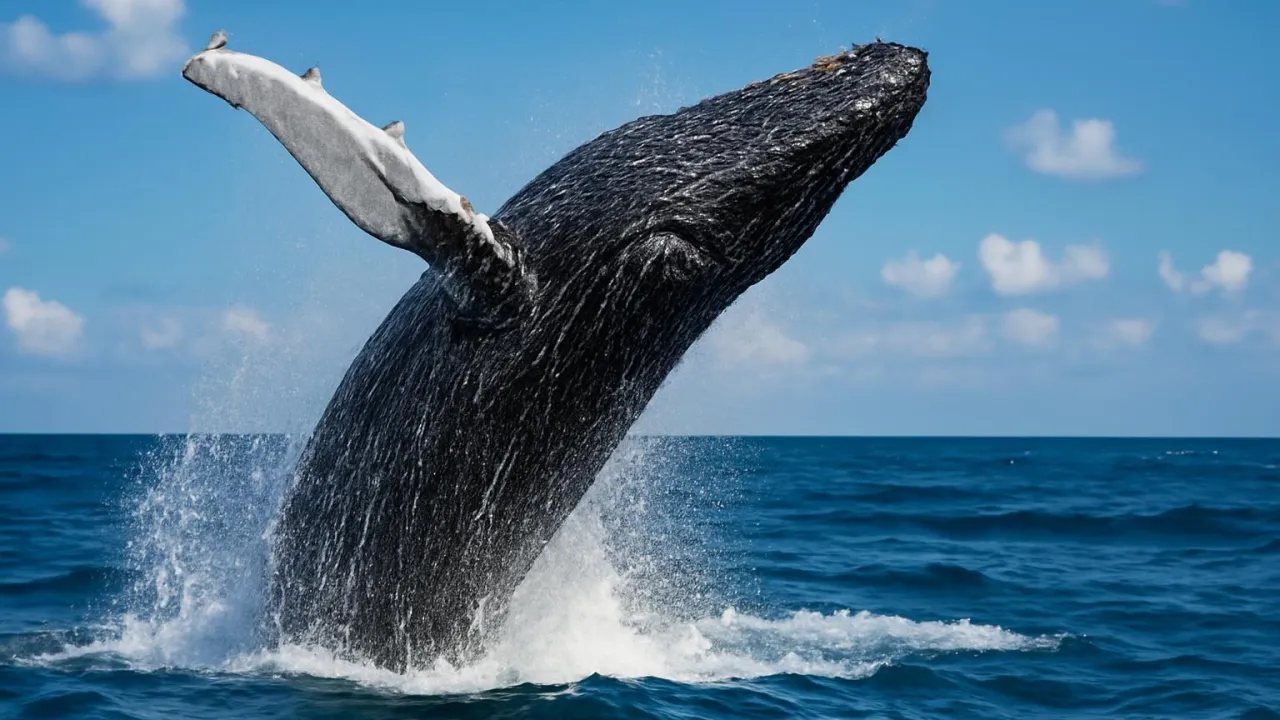
Humpback whale songs can be heard over 20 miles away underwater!
✨ Word Sparks (Grade 2 Glossary)
Tap 🔊 to hear
krill
Tiny sea creatures that whales eat
ocean
A big body of saltwater on Earth
song
A special sound animals make to communicate
🪝
Have you heard that humpback whales sing songs underwater?
1
Humpback Whales Live in Oceans
Humpback whales live in all around the world. They swim in cold and warm waters. They travel long distances every year to find food and mates.
2
Their Food and Size
They eat small fish and by opening their big mouths wide. Humpbacks can grow up to 52 feet long. They are very heavy and strong animals.
3
Amazing Whale Songs
Humpback whales sing long and loud underwater. Their songs can last many minutes and travel far. Scientists think whales use songs to find each other and communicate.
Humpback whale songs can change over time, creating new melodies each year!
✨ Word Sparks (Grade 3 Glossary)
Tap 🔊 to hear
baleen
Filter plates whales use to catch tiny food
migration
Long travel to different places for food or safety
communication
Sharing information using sounds or signals
🪝
Did you know humpback whales use songs to communicate across oceans?
1
Humpback Whales’ Ocean Home
Humpback whales live in oceans worldwide, migrating between cold and warm waters. They travel thousands of miles each year to find food and mate. Their large size helps them swim long distances efficiently. These whales are mammals and breathe air through blowholes on top of their heads.
2
Feeding and Adaptations
Humpbacks feed on tiny krill and small fish by using plates to filter water. Their huge mouths open wide to scoop in water and food, then push water out. This adaptation helps them gather many tiny creatures quickly. Their strong muscles help them swim and dive deep to find food.
3
The Power of Whale Songs
Male humpbacks produce complex songs that can last up to 20 minutes and repeat for hours. These songs help whales communicate and may attract mates or warn rivals. Sound travels far underwater, so songs can reach whales miles away. Singing is a key adaptation for social interaction in the ocean.
4
Protecting the Giants
Humpback whales face threats like ship strikes and pollution in oceans. Conservation efforts help protect their habitats and reduce human dangers. Many countries have laws to keep whales safe during . Understanding their behavior helps scientists create better protection plans.
Humpback whales’ bubble-net feeding is a rare example of cooperative hunting in marine mammals!
✨ Word Sparks (Grade 4 Glossary)
Tap 🔊 to hear
bubble-net feeding
Whales make bubbles to trap fish together
ecosystem
All living things and their environment together
conservation
Protecting animals and nature from harm
🪝
How do humpback whale songs shape ocean life and their survival?
1
Migrating Giants of the Ocean
Humpback whales migrate thousands of miles between feeding grounds in cold polar waters and breeding areas in warm tropical seas. This seasonal movement allows them to take advantage of rich food supplies and safe places to raise calves. Their large bodies store energy needed for these long journeys. Migration also helps maintain ocean by balancing predator-prey relationships.
2
Feeding Strategies and Adaptations
Using baleen plates, humpbacks filter vast amounts of krill and small fish from seawater during feeding. They often use , a cooperative hunting technique where whales create bubbles to herd prey into tight groups. This behavior shows complex social interaction and adaptation to their environment. Their feeding impacts ocean food webs by controlling prey populations.
3
Songs and Social Communication
Male humpback whales produce intricate songs that change yearly, serving as communication signals during breeding seasons. These songs can travel over 20 miles underwater, allowing whales to locate mates and establish territory. Singing also plays a role in social bonding and competition among males. The evolution of these songs reflects adaptation to acoustic properties of ocean habitats.
4
Human Impact and Conservation
Human activities like ship traffic, fishing gear entanglement, and ocean noise pollution threaten humpback whales’ survival. programs have reduced hunting and established marine protected areas to safeguard habitats. International cooperation is vital to monitor populations and enforce regulations. Protecting humpbacks supports biodiversity and healthy ocean .
Humpback whale songs change yearly, showing cultural learning similar to human music evolution!
✨ Word Sparks (Grade 5 Glossary)
Tap 🔊 to hear
baleen plates
Filter structures whales use instead of teeth
migration
Seasonal long-distance travel to feed and breed
acoustic communication
Using sound to send messages underwater
🪝
What makes the humpback whale a marvel of marine biology and acoustic communication?
1
Taxonomy and Global Distribution
The humpback whale, scientifically named Megaptera novaeangliae, belongs to the family Balaenopteridae. It is found in all major oceans, migrating annually between polar feeding grounds and tropical breeding areas. This species exhibits complex migratory behavior that spans thousands of kilometers. Its global presence plays a significant role in marine biodiversity and ecosystem dynamics.
2
Physiological Adaptations and Mechanics
Humpbacks possess instead of teeth, allowing them to filter-feed on small prey like krill and fish efficiently. Their massive pectoral fins, up to one-third their body length, aid in agile maneuvering and breaching behaviors. The whales’ lungs and circulatory system support deep dives lasting up to 30 minutes. Specialized muscles and blubber layers provide insulation in cold waters.
3
Complex Acoustic Communication
Male humpback whales produce elaborate songs composed of repeated themes lasting up to 20 minutes, which can be heard over 20 miles underwater. These songs evolve annually, reflecting cultural transmission and adaptation within populations. Acoustic signals serve multiple functions, including mate attraction, social cohesion, and territorial displays. Sound propagation is enhanced by oceanic conditions that favor long-distance transmission.
4
Conservation History and Challenges
Once severely depleted by commercial whaling, humpback whale populations have rebounded due to international protection under the International Whaling Commission. Despite recovery, threats such as ship strikes, entanglement in fishing gear, and noise pollution persist. Ongoing research and marine protected areas contribute to effective conservation strategies. Public awareness campaigns support global efforts to safeguard these marine giants.
5
Quantitative Comparisons and Ecological Role
Adult humpbacks can reach lengths of 52 feet and weigh up to 40 tons, making them among the largest baleen whales. Their feeding behavior influences krill populations, which are crucial to ocean food webs. Breaching speeds can exceed 15 miles per hour, showcasing remarkable power. By cycling nutrients through their , humpbacks contribute to ocean health and productivity.