🧬 HUMAN BODY
🧬 Community Epidemiological Threshold • Immune System & Public Health
VA Science & Health SOL 1.1, 3.1, 4.2, 5.1 (Cells, Organs & Body Systems)
Herd Immunity
How Protected Neighbors Build an Invisible Community Shield
Grade 5 • Advanced • 316 words
🩺 Body System & LocationImmune System & Population Epidemiology • Schools, Towns, and Global Communities
🔬 Size / Cell CountThresholds vary by germ • ~95% immunity needed to block ultra-contagious measles
⚙️ Core JobBreaks chains of germ transmission when enough people carry trained immune defenses
⚡ Body SuperpowerProtects vulnerable newborn babies and sick neighbors who cannot get certain vaccines
🤯 Mind-Blowing Fact • Grade 1
Teamwork vaccines helped wipe out a terrible ancient disease called smallpox across the entire planet in 1980!
✨ Word Sparks (Grade 1 Glossary)
Tap 🔊 to hear
immune
Protected by body defenses against a germ
shield
Protective barrier blocking something from passing
community
Group of neighbors living and sharing together
🪝
How can your strong immune system act like a superhero shield for a tiny newborn baby?
1
Stopping Germs From Jumping
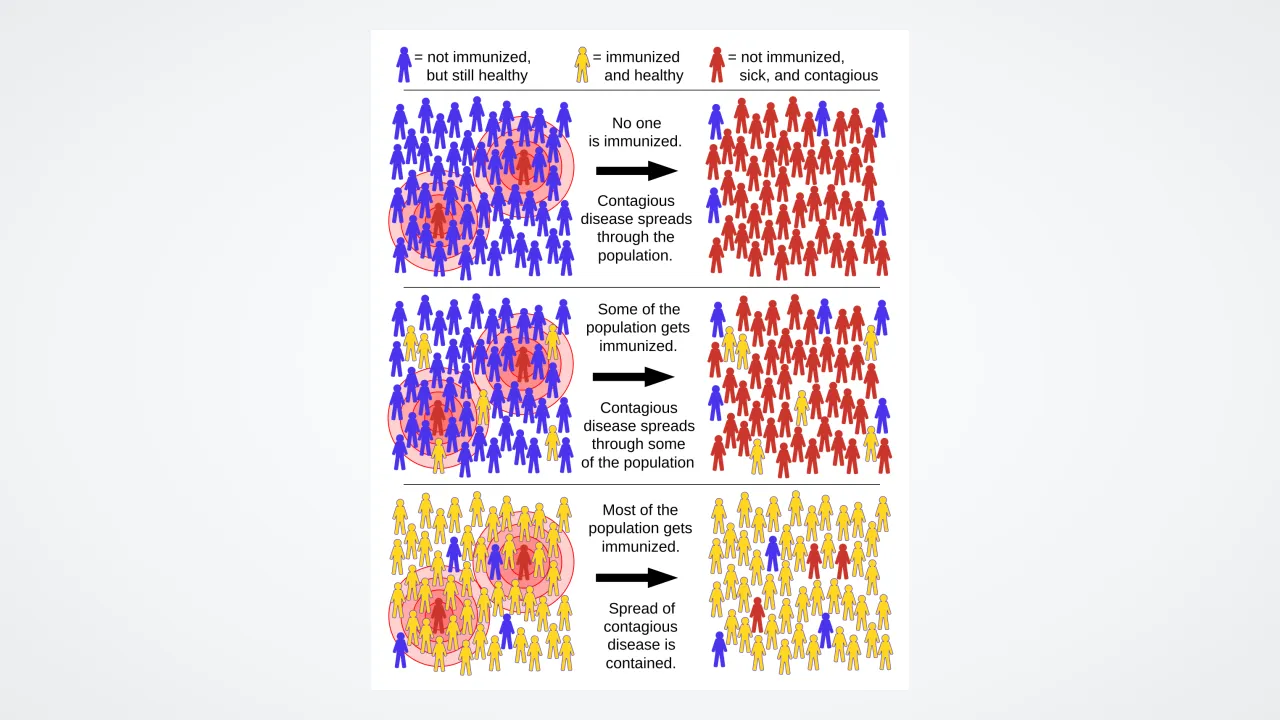
Pop, bounce, stop! Imagine a sneaky cold germ trying to hop from person to person! If nobody has germ , it jumps everywhere fast.
2
A Circle of Umbrellas
When almost everyone in town has trained , the germ hits a wall! It cannot find new bodies to jump into, so it stops.
3
Helping Tiny Neighbors
Newborn babies are too young for some shots. When big kids and grown-ups stay protected, our circle keeps tiny babies safe too!
1. What happens to a contagious germ when almost everyone around it is already immune?
2. Who gets extra protection from community herd immunity?
🤯 Mind-Blowing Fact • Grade 2
Veterinarians first coined the phrase 'herd immunity' over 100 years ago while studying how cattle herds stayed safe from farm sicknesses!
✨ Word Sparks (Grade 2 Glossary)
Tap 🔊 to hear
vaccine
Safe medicine training white blood cells early
outbreak
Sudden spread of sickness through a group
vulnerable
Needing extra care and protection from harm
🪝
How is stopping a germ outbreak just like spacing out dominoes so the whole row won't topple?
1
Pulling Out Dominoes!
Line up twenty dominoes and tap the first one—clack-clack-clack, every single domino falls! Now take out most of the middle dominoes and tap the first one again. Clack—stop! The rest of the row stays standing safe and tall.
2
Vaccines Train Your Guards
Scientists call this teamwork protection herd immunity or community immunity. Safe show your white blood cells a harmless wanted poster of a germ, training your body to block it before it can spread.
3
Why No Germ Works Alone
Note that herd immunity only works against contagious germs that pass from person to person, like measles or polio! If someone steps on a rusty nail outdoors, tetanus bacteria come from dirt, so each person needs their own tetanus booster.
1. In the domino example, what do the removed middle dominoes represent?
2. Why doesn't herd immunity protect you against tetanus germs hidden in garden soil?
🤯 Mind-Blowing Fact • Grade 3
Polio once paralyzed hundreds of thousands of children each year, yet global community vaccination has eliminated over 99.9 percent of polio cases worldwide!
✨ Word Sparks (Grade 3 Glossary)
Tap 🔊 to hear
epidemiologist
Scientist tracking how diseases spread and stop
threshold
Minimum percentage needed to stop outbreaks
memory cells
Long-living immune cells remembering past germ clues
🪝
Why does stopping measles take 95% of a town being immune, while less-catchy germs take a smaller percentage?
1
Counting How Fast Germs Jump
Picture dry pine needles on a forest floor: if wet green grass surrounds one tiny spark, a campfire cannot turn into a wildfire! Disease detectives—called —measure how easily different germs jump from one sick person to unprotected neighbors.
2
The Threshold Number
Every contagious germ has a tipping point called the herd immunity . Once community immunity climbs above that percentage, each case infects fewer than one new person on average, causing outbreaks to fizzle out!
3
Super-Catchy Measles
Some viruses are champion jumpers! Measles particles can hang in room air for two hours, so one sick person could infect twelve to eighteen unprotected people. Blocking measles requires roughly 95 percent of a community to be immunized!
4
Safe Memory Cells Without Sickness
Vaccines build memory B and T cells safely without making people suffer dangerous illnesses first—protecting cancer patients, elders, and infants across the whole neighborhood.
1. Why does measles require a very high (~95%) herd immunity threshold compared to many other viruses?
2. Why is building herd immunity through vaccines safer than letting everyone catch a dangerous disease naturally?
🤯 Mind-Blowing Fact • Grade 4
Ring vaccination plus global herd immunity vanquished variola (smallpox) in 1980 and rinderpest cattle plague in 2011—the first two diseases humanity completely erased from nature!
✨ Word Sparks (Grade 4 Glossary)
Tap 🔊 to hear
R-naught (R0)
Average new infections sparked by one case
transmission
Passing of a pathogen between living hosts
mutation
Tiny change in a virus's genetic code
🪝
How do disease detectives use one simple math number—R-naught—to calculate the exact shield a city needs?
1
Meet R0: The Basic Reproduction Number
Step into a public-health command center, and you will spot the symbol R0 (pronounced 'R-naught') written on whiteboards! R0 represents the average number of people one contagious patient will infect in a completely unprotected population. Seasonal flu typically has an R0 near 1.3 to 2, polio sits around 5 to 7, and airborne measles towers between 12 and 18!
2
The Elegant Threshold Formula
Epidemiologists calculate the herd immunity threshold using a neat fraction: 1 minus (1 divided by R0). If a virus has an R0 of 4, then 1 - (1/4) = 3/4, meaning at least 75 percent of the community must be immune so at least three out of every four paths hit a dead end! That shrinks the effective reproduction number below 1.0, starving the outbreak.
3
Pockets of Vulnerability
Even if a whole country averages 95 percent vaccination, herd immunity works locally! If immunity drops to 70 percent inside one neighborhood or school, a single traveler carrying measles can still ignite a local cluster there.
4
When Viruses Mutate or Immunity Fades
Fast-changing respiratory viruses like influenza or coronaviruses mutate their outer coat proteins over time, and antibody levels gradually dip—which is why updated seasonal boosters keep community shields strong.
1. Using the epidemiologist formula 1 - (1 / R0), what immunity threshold blocks outbreaks of a virus with R0 = 5?
2. Why can a local outbreak still happen even when a nation's overall average vaccination rate looks high?
🤯 Mind-Blowing Fact • Grade 5
Mathematicians Kermack and McKendrick proved in 1927 with their SIR equations that epidemics naturally extinguish not when susceptible hosts hit zero, but the exact moment susceptible density drops below 1 / R0!
✨ Word Sparks (Grade 5 Glossary)
Tap 🔊 to hear
SIR model
Mathematical framework tracking Susceptible, Infectious, Immune groups
Animal population naturally harboring a transmissible pathogen
🪝
How do SIR differential equations, antigenic drift, and network clustering govern when population immunity can—and cannot—eradicate a human pathogen?
1
Historical Origins from Veterinary Medicine to SIR Models
In 1923, bacteriologists W.W.C. Topley and G.S. Wilson coined the phrase 'herd immunity' while tracking bacterial epidemics across laboratory mouse colonies, soon joined by Arthur Hedley's observations that childhood measles epidemics in Baltimore mysteriously collapsed whenever immune child cohorts crossed a critical density. Simultaneously in 1927, William Ogilvy Kermack and Anderson Gray McKendrick formulated the foundational SIR compartmental differential equations—partitioning populations into Susceptible (S), Infectious (I), and Recovered/Immune (R) compartments—proving mathematically that epidemics terminate long before every susceptible individual is infected!
2
Deriving Re, R0, and Vaccine Efficacy Adjustments
Epidemiological stability hinges on driving the effective reproduction number, Re = R0 × (S / N), strictly below 1.0, where R0 denotes the basic reproduction number in a naive population of size N. Setting Re = 1 yields the classic critical immunity threshold: Pc = 1 - (1 / R0). For hyper-infectious airborne morbilliviruses like measles (R0 ≈ 15), Pc reaches ~93–95%. Moreover, if a vaccine prevents onward transmission with imperfect efficacy E (where E < 1.0), the required vaccination coverage Vc climbs higher via Vc = [1 - (1 / R0)] / E—meaning a pathogen with R0 = 4 and an 85%-blocking vaccine requires ~88% population uptake!
3
Immunocompromised Cocoons and Global Eradication Criteria
Indirect protection shields neonates whose maternal IgG antibodies are waning, organ-transplant recipients on immunosuppressive therapy, and children undergoing B-cell-depleting leukemia chemotherapy. True global disease eradication—achieved for human variola virus (smallpox) in 1980 under D.A. Henderson's WHO campaign and bovine rinderpest in 2011—requires three strict biological conditions: no non-human wildlife or environmental reservoir, sterilizing lifelong immunity, and recognizable clinical cases.
4
Why Antigenic Drift and Zoonoses Complicate Thresholds
Pathogens that harbor animal reservoirs (such as yellow fever in monkeys or influenza A in waterfowl), wane in mucosal IgA sterilizing immunity, or undergo rapid RNA polymerase continuously replenish the Susceptible (S) compartment—shifting public health goals from permanent eradication to seasonal endemic suppression and severe-disease prevention.
5
Spatial Assortativity in Contact Networks
Real human societies are not homogeneously mixed test tubes: social assortativity—where unvaccinated individuals cluster geographically or socially—elevates local Re above 1.0 despite high national averages, explaining why spatial epidemiology maps school-district coverage block by block.
1. Why could humanity permanently eradicate smallpox in 1980, whereas seasonal influenza A cannot be eradicated the same way?
2. According to the adjusted vaccine coverage formula Vc = (1 - 1/R0) / E, what happens if a vaccine is 80% effective at blocking transmission instead of 100%?