1. Why is Haumea shaped like a stretched football instead of a round ball?
2. What surprising feature circles around football-shaped Haumea alongside its two moons?
🤯 Mind-Blowing Fact • Grade 2
Haumea's longest side is more than twice as long as its shortest pole-to-pole height—like a smooth white skipping stone flying through space!
✨ Word Sparks (Grade 2 Glossary)
Tap 🔊 to hear
Sideswipe
A glancing crash hitting along an outer edge.
Mythology
Traditional stories about gods and heroes from cultures.
Skipping stone
A flat oval pebble skimmed across pond water.
🪝
What cosmic crash turned Haumea into the fastest-spinning big object in our Solar System?
1
A Glancing Cosmic Crash
Billions of years ago, another big Kuiper Belt world sideswiped Haumea like a trick pool shot! That glancing crash set Haumea whirling once every 3.9 hours—stretching its longest end to 1,440 miles while squishing its poles to just 665 miles!
2
Daughters of Haumea
Named after the Hawaiian goddess of childbirth, Haumea travels with two icy moons chipped off in that ancient crash: larger Hi'iaka and smaller inner Namaka.
3
Surprise Ring Discovery
In 2017, twelve telescopes watched Haumea pass in front of a star and discovered a 43-mile-wide icy ring circling its middle!
1. Which culture's mythology gave Haumea and its moons Hi'iaka and Namaka their names?
2. How did astronomers discover Haumea's narrow ring in 2017?
🤯 Mind-Blowing Fact • Grade 3
Haumea is the only object in the entire Kuiper Belt with a confirmed 'collisional family'—dozens of sparkling white ice siblings chipped off its own crust!
✨ Word Sparks (Grade 3 Glossary)
Tap 🔊 to hear
Crystalline ice
Water ice with atoms arranged in tidy patterns.
Collisional family
Group of space objects chipped from one crash.
Light curve
Graph tracking how brightness rises and falls.
🪝
How did astronomers track down Haumea's 'lost family' scattered all across the Kuiper Belt?
1
Blinking Bright and Dim
Even from four billion miles away, telescopes notice Haumea brightening and dimming every two hours! As its stretched football body tumbles end over end, we alternately see its wide 1,440-mile side and its narrow end—plus one mysterious dark red spot rotating past.
2
Pure Sparkling Water Ice
Unlike reddish Pluto or Makemake, Haumea's thin outer shell gleams with pure crystalline water ice as bright as fresh snow. Even stranger, space radiation usually scrambles ice crystals within ten million years, meaning internal warmth keeps Haumea's ice neat!
3
The Only Kuiper Collisional Family
Astronomers found over a dozen smaller Kuiper Belt ice chunks sharing similar orbits and identical pure water-ice spectra—fragments blasted off Haumea during its ancient spin-up crash!
4
A Synchronized Ring
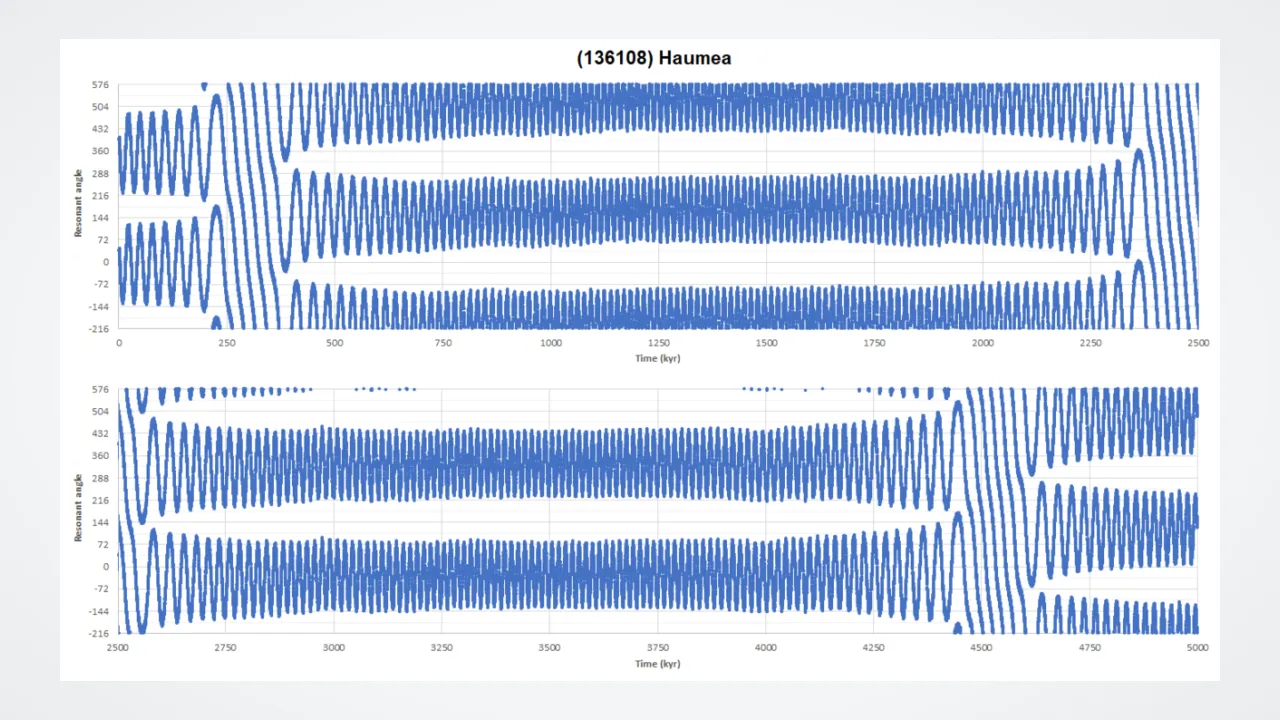
Haumea's ring orbits in a tidy 3:1 rhythm: Haumea spins exactly three times for every single lap its ring particles make!
1. Why does Haumea's brightness rise and fall twice during every 3.9-hour rotation?
2. How many times does Haumea spin for every one orbit of its ring particles?
🤯 Mind-Blowing Fact • Grade 4
If you walked from Haumea's short north pole out to its pointy football tip, your weight would drop by two-thirds thanks to distance and dizzying centrifugal spin!
✨ Word Sparks (Grade 4 Glossary)
Tap 🔊 to hear
Jacobi ellipsoid
Three-axis football shape of an ultra-fast-spinning fluid body.
Amorphous ice
Jumbled non-crystal ice scrambled by cold space radiation.
Effective gravity
Net downward pull after subtracting outward spin force.
🪝
Why would you weigh three times LESS standing on Haumea's pointy ends than at its flat poles?
1
Extreme Jacobi Ellipsoid Physics
In classical physics, a fluid or deformable world spinning slowly forms a slightly squashed sphere like Earth or Saturn. Spin it past a critical speed, however, and hydrostatic equilibrium snaps into a three-axis ''—a stretched cigar or rugby ball! Whirling in 3.915 hours with a dense rocky core (overall density near 1.88 grams per cubic centimeter), Haumea stretches to 2,322 by 1,704 by 1,074 kilometers.
2
Wild Gravity Differences Across One World
Imagine hiking from Haumea's flat north pole down to the tip of its longest equator end! At the pole, you stand close to the heavy rocky core with zero outward spin force. Out at the 1,160-kilometer equatorial tip, you stand twice as far from the center while rapid centrifugal force flings you outward—making roughly three times weaker!
3
Crystalline Ice Puzzle
At minus 390 degrees Fahrenheit (38 K), cosmic rays normally disorder crystalline ice into messy '.' Yet Keck and JWST spectra show over 75 percent of Haumea's crust—and 100 percent of moon Hi'iaka—remains crystalline, warmed from within by radioactive potassium, uranium, and thorium!
4
Non-Coplanar Moons
Strangely, inner moon Namaka's 18-day orbit tilts thirteen degrees away from outer Hi'iaka's 49-day orbit and Haumea's equator ring, stirred by past orbital resonances.
1. Why is effective surface gravity weakest at the pointy equatorial tips of Haumea?
2. Why does Haumea still fit the definition of a dwarf planet even though it isn't a sphere?
🤯 Mind-Blowing Fact • Grade 5
Supercomputer simulations suggest Haumea spun so close to its speed limit after its core formed that chunks of clean surface snow literally flung off its pointy football tips like mud off a spinning bicycle tire to form its moons, ring, and icy family!
✨ Word Sparks (Grade 5 Glossary)
Tap 🔊 to hear
Rotational fission
Flinging material off equatorial tips by spinning ultra-fast.
Opacity
Measure of how much starlight a ring blocks.
Chord
Straight path a background star traces behind Haumea.
🪝
How did a gentle core-merging collision and rotational fission create Haumea's pure-ice family without scattering debris at high speed?
1
Occultation Revision of Density and Core Structure
Prior to the landmark January 21, 2017 stellar occultation across twelve European observatories, astronomers estimated Haumea's density above 2.6 grams per cubic centimeter. Precise timings expanded Haumea's longest axis to 2,322 kilometers—virtually matching Pluto's diameter!—lowering its bulk density to roughly 1.885 grams per cubic centimeter and revealing a differentiated hydrated-silicate core (~85 percent of total mass) wrapped inside a bright, volatile-free pure water-ice crust constituting just three to fifteen percent of its mass.
2
Rotational Fission and Low-Velocity Family Ejection
For years, dynamicists puzzled over Haumea's collisional family: fragmented pure-ice siblings scatter with remarkably slow relative velocities (under 150 meters per second), far gentler than a catastrophic high-speed smash! NASA Goddard simulations in 2022 resolved the paradox: two proto-Kuiper worlds collided obliquely, merged their rocky cores into a single super-fast spinner, and flung slushy surface ice plus moons Hi'iaka and Namaka gently off Haumea's equatorial tips via as core hydration swelled and altered its moment of inertia!
3
Spin-Orbit Resonance of the 2,287-Kilometer Ring
Orbiting precisely at a radius of 2,287 kilometers with an optical near 0.5 and width of 70 kilometers, Haumea's coplanar ring locks near the 3:1 spin-orbit resonance—where gravitational lumps from Haumea's elongated football body shepherd icy particles outside the classical spherical Roche zone.
4
JWST Thermal and Crystalline-Amorphous Mixture
James Webb Space Telescope near-infrared spectra collected in 2022–2023 resolved both sharp 1.65-micrometer crystalline water-ice bands and subtle amorphous water-ice signatures across Haumea's 50-kelvin surface, confirming zero detectable methane or nitrogen volatiles—long since boiled away by its primordial spin-up!
5
Laboratory for Exo-Ring and Non-Spherical Worlds
Alongside ringed centaurs Chariklo and Chiron plus trans-Neptunian Quaoar, Haumea demonstrates how triaxial gravitational harmonics sculpt stable rings around small icy worlds across the outer Solar System.