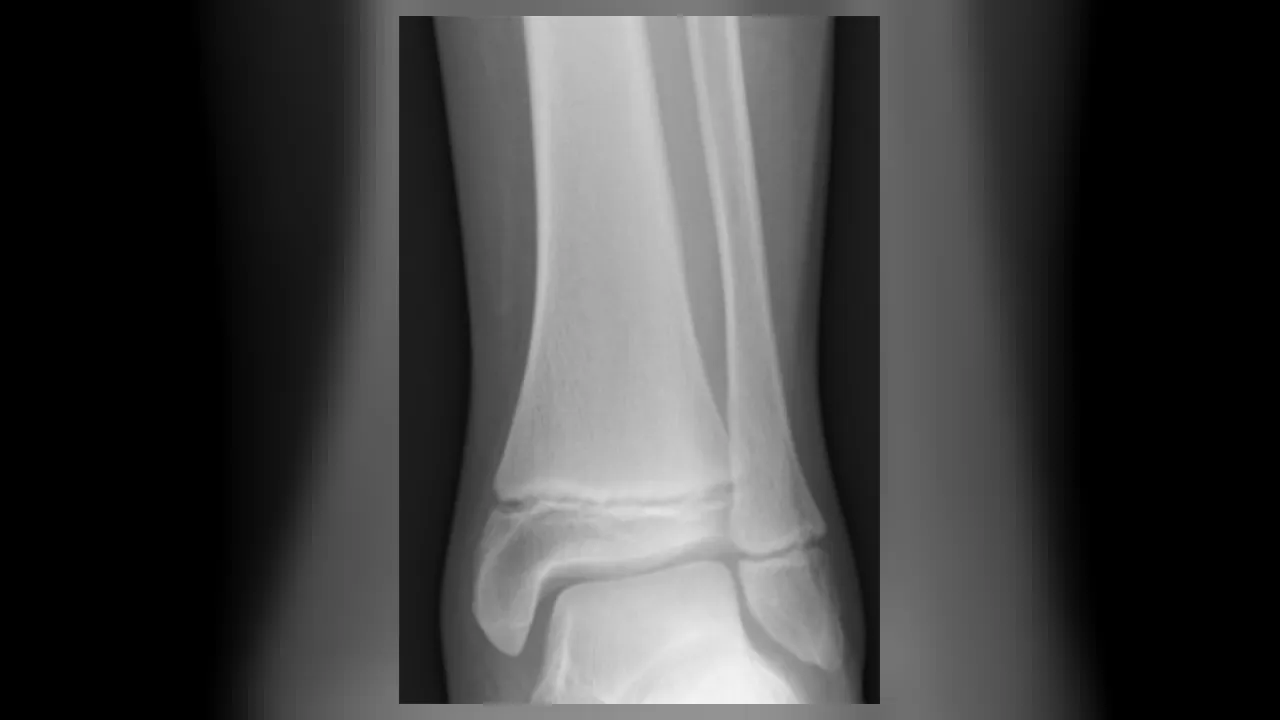
1. Where are growth plates located inside your arm and leg bones?
2. When do your growth plates do most of their bone-lengthening work?
🤯 Mind-Blowing Fact • Grade 2
Doctors can estimate how much taller a child will grow just by checking how wide their wrist and hand growth plates look on a quick X-ray!
✨ Word Sparks (Grade 2 Glossary)
Tap 🔊 to hear
X-ray
Special light camera showing hard bones inside
calcium
Mineral from food that makes bones strong
flexible
Able to bend gently without snapping
🪝
Why do growth plates look like empty dark stripes on a kid's X-ray picture?
1
Bendy Like Your Nose Tip
Gently wiggle the tip of your nose or your outer ear! That smooth, material is called cartilage. Before you were born, most of your skeleton started out as soft cartilage before turning into strong bone.
2
Dark Stripes on X-Rays
Kids keep thin discs of cartilage near the ends of long bones in their arms, legs, and fingers. Because beams pass right through soft cartilage, growth plates look like neat dark gaps on a doctor's X-ray screen!
3
Closing Up as Grown-Ups
Inside each plate, cartilage cells stack up like pancakes and harden into solid bone behind them. Once teenagers finish growing, growth plates turn completely into solid bone, locking in adult height!
1. Why do growth plates show up as dark lines between bright white bone parts on a child's X-ray?
2. Why don't adults keep growing taller in their thirties and forties?
🤯 Mind-Blowing Fact • Grade 3
The growth plates around your knee—at the bottom of your thighbone and top of your shinbone—do the heaviest lifting, adding almost two-thirds of your entire leg length!
✨ Word Sparks (Grade 3 Glossary)
Tap 🔊 to hear
epiphyseal plate
Scientific name for a bone's growth plate
chondrocytes
Cells building and stacking fresh cartilage layers
osteoblasts
Builder cells laying down hard mineral bone
🪝
How does a tiny cartilage disc push a solid leg bone longer without breaking it?
1
Conveyor Belt Inside Your Bones
Imagine jacking up a tall brick tower from the middle while people still walk around inside! Long bones like your femur (thighbone) and tibia (shinbone) face that exact challenge. Near each rounded end sits an —the scientific name for a growth plate.
2
Stacking Up Like Coins
Inside the plate, special cartilage cells called divide rapidly, stacking into neat vertical columns like rolls of coins. Each new layer pushes the rounded end of the bone a tiny fraction of a millimeter farther outward!
3
Osteoblasts Turn Cartilage to Bone
On the trailing edge facing the bone shaft, blood vessels bring bone-building cells called . They coat the older cartilage framework with calcium and phosphate minerals—transforming flexible cartilage into rock-solid bone!
4
Protecting Growing Joints
Because cartilage growth plates are softer than surrounding bone or tough ligaments, pediatric doctors check twists near a child's wrist or ankle carefully with protective splints so growth plates heal straight and strong.
1. Which two cell teams work like a relay race inside a growth plate?
2. Which growth plates contribute the biggest share of your leg length?
🤯 Mind-Blowing Fact • Grade 4
Precision sensors attached to growing mammal legs proved that over 90 percent of bone elongation happens while lying down resting or sleeping, when gravity isn't pressing on the soft growth plate!
✨ Word Sparks (Grade 4 Glossary)
Tap 🔊 to hear
epiphysis
Rounded end cap of a long bone
ossification
Biological transformation of cartilage into hard bone
Do kids grow smoothly every single day, or in secret overnight mini-jumps?
1
Four Microscopic Assembly Zones
Zoom in 200 times with a microscope on a child's tibia—between the rounded (end cap) and long diaphysis (shaft) hums a four-zone assembly line called endochondral ! Closest to the joint sits the resting reserve zone. Beneath it, the proliferative zone divides chondrocytes into tidy columns; next, the hypertrophic zone swells those cells up to ten times larger to push bone length apart; finally, the ossification zone mineralizes the matrix into sturdy trabecular bone.
2
Hormones Conducting the Orchestra
During deep slow-wave sleep, your pulses out human growth hormone (GH), prompting your liver and bones to make IGF-1, which tells chondrocytes to multiply! Thyroid hormone keeps the assembly line humming, and during puberty a surge of estrogen and testosterone triggers a dramatic teenage growth spurt of 3 to 4 inches a year!
3
Saltatory Mini-Jumps Overnight
Precision leg-measuring sensors on sleeping lambs and children revealed a cool surprise: bones barely lengthen while standing or running because gravity compresses the plate, then spring outward in sudden micro-bursts during rest and sleep!
4
Epiphyseal Fusion
Toward late adolescence—typically around ages 14 to 16 in girls and 16 to 19 in boys—rising estrogen levels signal osteoblasts to overtake the last cartilage layer, leaving a faint 'epiphyseal line' of solid bone.
1. Why does almost all bone lengthening happen while you are lying down resting or sleeping?
2. What happens inside the 'hypertrophic zone' of a growth plate?
🤯 Mind-Blowing Fact • Grade 5
Clinical endocrinology discoveries proved that in both teenage boys and girls, it is actually estrogen—converted locally from testosterone in males via aromatase enzymes—that signals growth plates to fuse at adult height!
✨ Word Sparks (Grade 5 Glossary)
Tap 🔊 to hear
endochondral ossification
Replacing a growing cartilage model with bone
hypertrophic
Enlarging dramatically in individual cell volume
metaphysis
Flared bone neck where cartilage becomes bone
🪝
How does a 3-millimeter cartilage physis withstand running forces several times your body weight while simultaneously manufacturing five centimeters of solid bone a year?
1
Cytoarchitecture of Endochondral Ossification
Every long bone in your appendicular skeleton—from the femur and humerus down to individual phalanges—achieves longitudinal growth through a marvel of tissue engineering called . Sandwiched between the secondary ossification center of the epiphysis and the primary metaphyseal shaft lies the epiphyseal plate (physis), a 2-to-5-millimeter disc of hyaline cartilage organized into four histological strata. Slow-cycling stem-like cells in the resting zone feed rapidly dividing clones in the proliferative zone, which align into vertical stacks braced by type II collagen and aggrecan proteoglycans.
2
Hypertrophic Expansion and Vascular Invasion
Biophysical measurements reveal that cell division alone accounts for less than a quarter of bone elongation; the real mechanical engine is the zone! Terminally differentiating chondrocytes switch to synthesizing type X collagen and swell five-to-tenfold in volume via osmotic fluid uptake, jacking the epiphysis away from the shaft. Simultaneously, hypertrophic cells secrete vascular endothelial growth factor (VEGF), inviting metaphyseal capillary loops, chondroclasts, and osteoblasts to invade calcified cartilage struts and remodel them into woven, then lamellar, cortical and trabecular bone.
3
The GH–IGF-1 Axis and Estrogen's Biphasic Paradox
Neuroendocrine regulation flows from pulsatile nocturnal somatotropin (growth hormone) secreted by the anterior pituitary during Stage 3 slow-wave sleep, stimulating systemic and local insulin-like growth factor-1 (IGF-1) alongside thyroid hormone (T3). Intriguingly, endocrinologists discovered in the 1990s that estrogen—synthesized directly in ovaries or converted from testosterone via aromatase enzymes in boys—drives both the adolescent growth spurt AND eventual epiphyseal fusion across BOTH sexes by exhausting resting-zone stem-cell senescence!
4
Hueter-Volkmann Biomechanics and Salter-Harris Care
Described in the nineteenth century, the Hueter-Volkmann law states that sustained excessive compression slows physeal growth whereas unloading permits expansion—confirmed in 2004 by Norman Wilsman's implanted micro-transducer telemetry showing 90% of elongation occurs during recumbency. Because hyaline cartilage resists shear forces less than mineralized bone or collateral ligaments, pediatric orthopedists classify childhood physeal fractures using the Salter-Harris I–V system to prevent premature bony bridges from tethering asymmetric growth.
5
Forensic and Clinical Bone-Age Atlases
Because hand and wrist ossification centers fuse in a predictable chronological cascade from infancy to age nineteen, clinicians compare single left-wrist radiographs against the Greulich-Pyle atlas to evaluate endocrine health and adult stature potential.