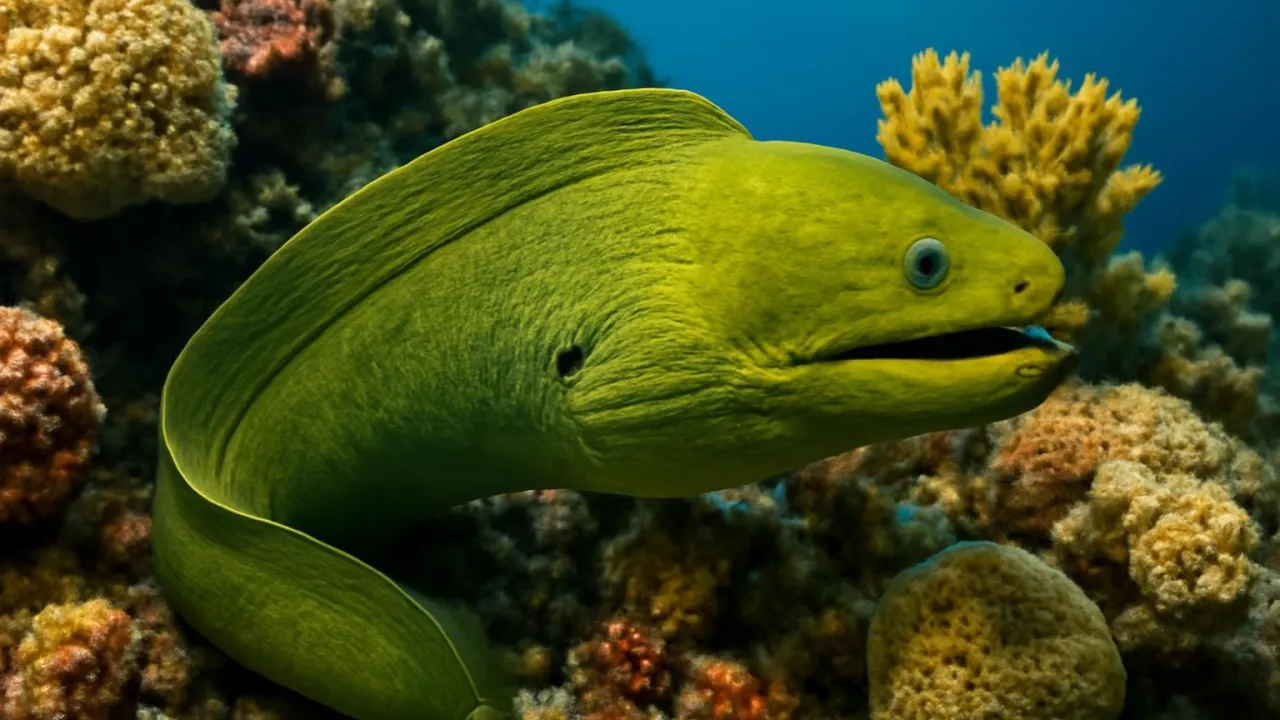
Green moray eels can bite with a force strong enough to catch fast fish!
✨ Word Sparks (Grade 2 Glossary)
Tap 🔊 to hear
camouflage
Colors that help animals hide in their homes
predator
An animal that hunts other animals for food
prey
An animal that is hunted and eaten by others
🪝
Have you ever seen a fish that looks like a snake in the sea?
1
The Green Moray’s Home
Green moray eels live in coral reefs near the ocean shore. They hide in dark holes and rocky places. These spots keep them safe from bigger fish. The reefs also have lots of food for the eel.
2
How It Grows
Green moray eels start very small and grow longer over time. They can reach up to eight feet in length. When young, they stay hidden more often. As they grow, they explore more to find food.
3
A Special Body Feature
The eel has sharp teeth that help it catch slippery fish. It uses its strong jaws to bite and hold . Its green skin helps it blend in with the coral. This keeps it safe from .
1. Why does the green moray eel hide in coral reefs?
2. What helps the eel catch slippery fish?
🤯 Mind-Blowing Fact • Grade 3
Green moray eels use camouflage to sneak up on prey and avoid bigger predators.
✨ Word Sparks (Grade 3 Glossary)
Tap 🔊 to hear
camouflage
Colors that help animals hide in their homes
predator
An animal that hunts other animals for food
ecosystem
A community of plants and animals living together
🪝
How does the green moray eel sneak up on its prey in coral reefs?
1
Living in Coral Reefs
The green moray eel lives in warm coral reefs where it can hide easily. Its green skin provides excellent among the rocks and seaweed. This helps it avoid and surprise prey. The reef environment offers plenty of nutrients for many sea creatures.
2
Body Adaptations for Hunting
This eel has long, slender bodies that allow it to slip through narrow reef crevices. Its sharp teeth are perfect for gripping slippery fish and crustaceans. The strong jaws can bite quickly to capture fast-moving prey. These adaptations make it a skilled in its habitat.
3
Life Cycle and Growth
Green moray eels begin life as tiny larvae floating in open water. As they grow, they settle into reef habitats and develop their green coloring. They can reach lengths of up to eight feet as adults. Their long life helps maintain balance in the reef food web.
4
Role in the Ecosystem
As , green moray eels help control fish and crustacean populations. This balance supports coral reef health by preventing overgrazing on coral. They also serve as prey for larger sharks and groupers. Their presence is vital for a thriving reef .
1. What helps the green moray eel hide in coral reefs?
2. Why is the green moray eel important in its ecosystem?
🤯 Mind-Blowing Fact • Grade 4
Green moray eels’ camouflage and hunting skills make them vital to coral reef health.
✨ Word Sparks (Grade 4 Glossary)
Tap 🔊 to hear
predator
An animal that hunts other animals for food
ecosystem
A community of living things in one place
conservation
Protecting nature and animals from harm
🪝
What makes the green moray eel a key hunter in coral reef food webs?
1
Habitat and Camouflage
Green moray eels inhabit coral reefs in the western Atlantic Ocean, where their green coloration provides effective camouflage among algae and rocks. This camouflage allows them to avoid and ambush prey with surprising speed. The reefs offer complex structures that protect the eel and support a diverse community of animals. Without such habitats, green moray eels would struggle to survive.
2
Hunting and Physical Adaptations
These eels have powerful jaws equipped with sharp teeth that enable them to catch fish and crustaceans efficiently. Their elongated, flexible bodies allow them to navigate narrow reef crevices to surprise prey. The eel’s nocturnal hunting behavior reduces competition and predation risks. Such adaptations increase their success as in a competitive .
3
Role in Coral Reef Ecosystems
As mid-level , green moray eels help regulate populations of smaller fish and invertebrates, maintaining ecological balance. Their predation prevents overpopulation that could damage coral reefs by excessive grazing. Additionally, they serve as prey for larger species like sharks, creating a complex food web. Human activities such as overfishing and reef damage threaten these delicate relationships.
4
Geographic Distribution and Conservation
Green moray eels are found primarily in the western Atlantic, from Florida to Brazil, favoring shallow reef environments. Coral reef degradation due to climate change and pollution poses risks to their habitat. efforts focus on protecting reef to ensure eel populations remain stable. Understanding their ecological role helps promote sustainable marine practices.
1. How does the green moray eel’s camouflage help it?
2. Why is protecting coral reefs important for green moray eels?
🤯 Mind-Blowing Fact • Grade 5
Green moray eels can grow up to 8 feet long and weigh over 30 pounds, making them powerful reef hunters.
✨ Word Sparks (Grade 5 Glossary)
Tap 🔊 to hear
taxonomy
How scientists group animals by their traits
predator
An animal that hunts other animals for food
conservation
Protecting nature and animals from harm
🪝
How do the green moray eel’s unique features support its role in Atlantic coral reef ecosystems?
1
Taxonomy and Scientific Classification
The green moray eel, scientifically named Gymnothorax funebris, belongs to the family Muraenidae, which includes many eel species. It is classified within the order Anguilliformes, characterized by elongated, snake-like bodies. This taxonomic placement highlights its evolutionary adaptations for a predatory lifestyle in marine environments. Understanding its classification helps scientists study its behavior and ecological role.
2
Physiological Mechanics and Hunting Strategies
Green moray eels possess highly flexible bodies that allow them to maneuver through narrow reef crevices with ease. Their powerful jaws contain sharp, backward-pointing teeth that prevent prey from escaping once caught. They rely on excellent olfactory senses to detect prey in low-visibility conditions. Nocturnal hunting reduces competition and increases their chances of successful predation.
3
Conservation and Environmental Challenges
Coral reef degradation caused by climate change, pollution, and overfishing threatens green moray eel populations by reducing available habitat. efforts focus on protecting reef ecosystems through marine protected areas and sustainable fishing practices. Monitoring eel populations helps assess reef health and biodiversity. Public education about reef importance supports ongoing conservation initiatives.
4
Ecological Role and Food Web Dynamics
Green moray eels act as mid-level , regulating populations of fish and crustaceans within coral reef food webs. Their predation helps maintain species diversity and prevents overgrazing on coral by herbivorous fish. They also serve as prey for larger predators like sharks, contributing to energy transfer in the ecosystem. These interactions highlight their integral role in reef stability.
5
Quantitative Comparisons and Habitat Range
Adult green moray eels can reach lengths up to 8 feet (2.4 meters) and weigh as much as 30 pounds (13.6 kilograms). They inhabit shallow waters typically less than 100 feet (30 meters) deep. Their hunting speed and bite force allow them to capture prey quickly in complex reef environments. Compared to other moray species, they are among the largest and most powerful reef .