🧬 HUMAN BODY
🧬 Piloerection (Cutis Anserina) • Integumentary & Sympathetic Systems
VA Science & Health SOL 1.1, 3.1, 4.2, 5.1 (Cells, Organs & Body Systems)
Goosebumps
Tiny Hair-Lifting Muscles Left Over From Furry Ancestors
Grade 5 • Advanced • 297 words
🩺 Body System & LocationIntegumentary & Nervous Systems • Dermis Layer of Human Skin
🔬 Size / Cell Count~5 million hair follicles • Tiny arrector pili muscles 1–2 mm long
⚙️ Core JobContracts microscopic skin muscles when you feel cold, startled, or awestruck
⚡ Body SuperpowerFluffs thick fur on mammals for warmth and stimulates hair-follicle stem cells
🤯 Mind-Blowing Fact • Grade 1
You cannot get goosebumps on the palms of your hands or the soles of your feet because no hair grows there!
✨ Word Sparks (Grade 1 Glossary)
Tap 🔊 to hear
follicle
Tiny skin pocket where one hair grows
muscle
Body tissue that pulls to create movement
chilly
Cool enough to make your skin feel cold
🪝
Why do tiny bumps pop up on your arms when a cold breeze blows by?
1
Brrr! Tiny Skin Bumps
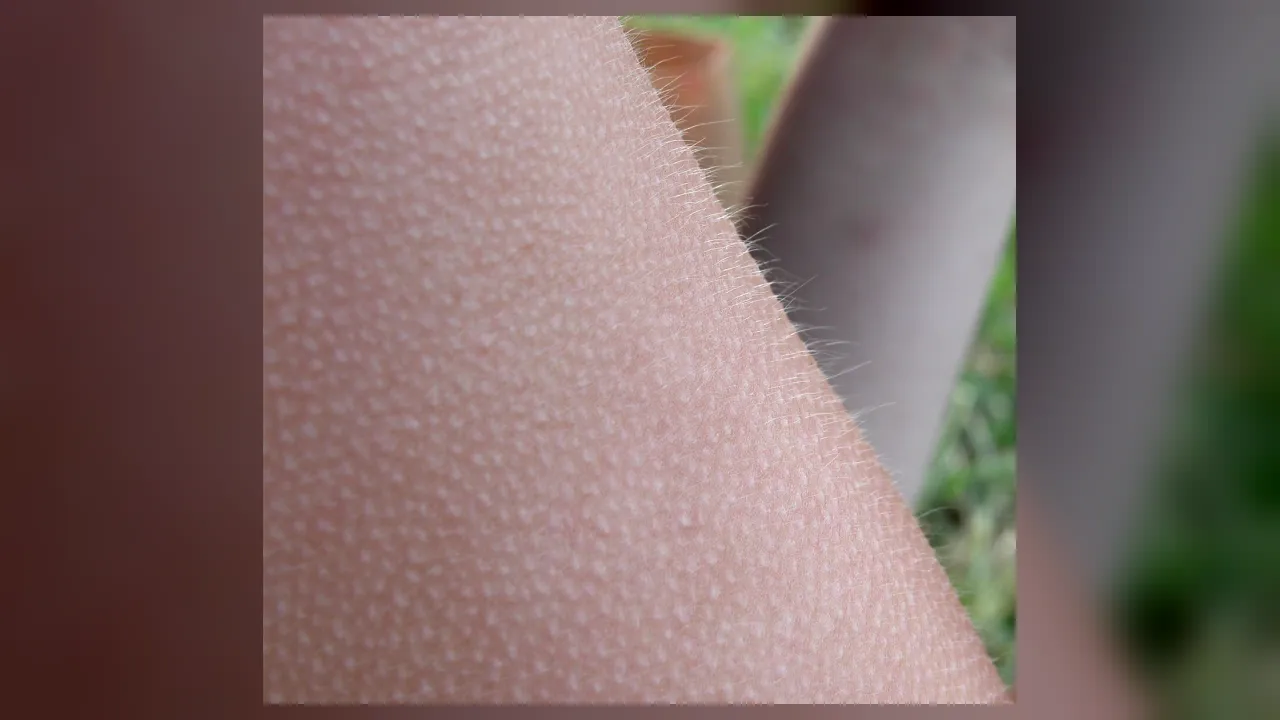
Brrr! Step out of a warm bath into cool air. Look closely at your arm! Dozens of tiny bumps pop up fast, and little hairs stand straight up.
2
Mini Muscles Pull
Under your skin, each little hair has a tiny . Cold air makes that muscle pull tight. Each pull lifts a hair and makes a bump!
3
Just Like Fluffy Pets
Furry cats and dogs puff up their coats to stay warm. We do not have thick fur, so we just get cute goosebumps!
1. What pulls each tiny arm hair upright during goosebumps?
2. Where on your body can goosebumps NEVER appear?
🤯 Mind-Blowing Fact • Grade 2
In different countries around the world, people call goosebumps 'chicken skin,' 'ant skin,' or even 'duck bumps'!
✨ Word Sparks (Grade 2 Glossary)
Tap 🔊 to hear
adrenaline
Fast body chemical released during excitement or chill
insulation
Trapped layer that keeps cozy warmth inside
mammal
Warm-blooded animal with hair or fur
🪝
Why can hearing your favorite song give you the exact same skin bumps as a snowy day?
1
Cold Air or Big Feelings
Imagine stepping into an icy swimming pool—or listening to a thrilling drumroll at a concert! Suddenly, bumpy dots ripple across your arms. People call them goosebumps because plucked geese have bumpy skin that looks very similar.
2
Automatic Nerve Signals
You cannot wiggle these tiny skin muscles on purpose. Instead, your brain's automatic nervous system sends out a quick burst of when you feel cold, startled, or amazed by awesome music.
3
How Fur Coats Work
On furry animals, standing hairs trap a cozy blanket of warm air against the skin or make a startled cat look twice as big! On humans, our thin arm hairs mostly leave behind a fun reminder of our cousins.
1. How do puffed-up hairs help a furry mammal in winter?
2. Besides cold weather, what else can trigger goosebumps?
🤯 Mind-Blowing Fact • Grade 3
Porcupines raise their defensive quills using oversized versions of the exact same arrector pili muscles that give you goosebumps!
✨ Word Sparks (Grade 3 Glossary)
Tap 🔊 to hear
arrector pili
Microscopic smooth muscle that pulls hair upright
piloerection
Scientific term for hairs standing straight up
dermis
Middle skin layer holding nerves and follicles
🪝
What are the tiny hidden muscles inside your skin called, and how do they create dimples and bumps?
1
Meet the Arrector Pili
Run your fingers across your forearm the next time a sudden chill hits. Beneath your outer skin lies the , home to millions of hair follicles. Anchored to each follicle is a ribbon-thin smooth muscle called the , Latin for 'hair raiser.'
2
The Piloerection Reflex
Scientists call goosebumps . When temperature sensors in your skin detect cold—or your emotional brain center senses surprise or musical awe—sympathetic nerves release chemical messengers that make thousands of muscles contract together.
3
Pulling Up a Tiny Tent
Normally, each hair slants at an angle inside your skin. When the shortens, it pulls the base of the follicle upright like raising a tent pole, depressing the skin slightly on one side and pushing up a tiny mound around the hair shaft.
4
Mammalian Survival Clues
Porcupines use this exact same muscle reflex to raise their sharp quills, chimpanzees bristle their shoulders to look fierce, and sea otters fluff dense fur. Humans kept the wiring even after evolving much thinner body hair!
1. What does the Latin name 'arrector pili' literally mean?
2. Which animal uses super-sized arrector pili muscles to lift its protective quills?
🤯 Mind-Blowing Fact • Grade 4
Scientists call musical goosebumps 'frisson,' and brain scans show people who get them have extra nerve fibers linking their hearing cortex to emotion centers!
✨ Word Sparks (Grade 4 Glossary)
Tap 🔊 to hear
vestigial
Inherited trait left over from ancient ancestors
frisson
Pleasant wave of chills from moving music
stem cells
Special cells able to grow fresh tissue
🪝
Why did humans keep the goosebump reflex for millions of years after losing thick body fur?
1
Sympathetic Fight-or-Flight Wiring
Hear an orchestra swell to a soaring crescendo, and a wave of electric tingles sweeps down your neck and arms! Whether sparked by a winter gust or emotional chills—which psychologists call —goosebumps belong to your sympathetic nervous system. When the hypothalamus or amygdala detects cold stress or intense emotion, sympathetic nerve fibers release norepinephrine onto smooth muscle receptors in the dermis.
2
Vestigial Insulation, Active Biology
For most mammals, piloerection serves two vital purposes: expanding the boundary layer of still air trapped in fur to slash heat loss, and inflating body silhouette during territorial encounters. Because human body hair is sparse, doctors long considered cutis anserina (Latin for 'goose skin') a purely trait—an evolutionary leftover like a tiny historical footprint.
3
A Surprising Stem-Cell Discovery
In 2020, Harvard biologists uncovered a hidden job that explains why evolution preserved goosebumps! Using high-resolution electron microscopy, they found that sympathetic nerves wrap around hair-follicle while arrector pili muscles form a physical bridge holding those nerves in place.
4
Short-Term Bump, Long-Term Coat
When cold weather persists, those same sympathetic nerves nudge hair-follicle to wake up and grow thicker new hair over weeks. So goosebumps are the fast first step of a two-speed system connecting skin, muscles, nerves, and regeneration!
1. What surprising hidden job of the goosebump system did Harvard scientists discover in 2020?
2. What does the medical Latin phrase 'cutis anserina' mean?
🤯 Mind-Blowing Fact • Grade 5
Charles Darwin studied goosebumps across dozens of mammal and bird species in 1872 to show how physical reflexes and emotional expressions evolved from shared survival circuits!
Sensory nerve channel detecting skin temperature shifts
🪝
How do a one-millimeter smooth muscle, a sympathetic nerve, and a cluster of stem cells form a microscopic triad beneath your skin?
1
Micro-Anatomy of Cutis Anserina
Step out onto a frosty porch at dawn and watch thousands of pinpoint elevations ripple across your forearms in less than two seconds. Known clinically as or piloerection, this phenomenon recruits millions of microscopic smooth-muscle bundles called arrector pili. Spanning roughly 1 to 2 millimeters inside the papillary and reticular dermis, each muscle anchors obliquely between the hair-follicle bulge and the upper dermal connective tissue, cradling a sebaceous gland in the angle between.
2
Thermoregulatory and Limbic Neural Pathways
Cutaneous cold —specifically TRPM8 ion channels—relay drops in skin temperature to the preoptic area of the hypothalamus. Simultaneously, intense acoustic beauty, awe, or sudden startle activates the amygdala and nucleus accumbens. Both pathways converge on preganglionic neurons of the sympathetic nervous system, prompting postganglionic adrenergic fibers to release onto alpha-1 adrenergic receptors on arrector pili cells, triggering synchronized calcium-driven contraction.
3
Charles Darwin and Comparative Ethology
In his 1872 classic The Expression of the Emotions in Man and Animals, Charles Darwin marveled that hair erection spans mammals, birds fluffing contour feathers, and horned creatures bristling crests. By rotating hair shafts perpendicular to the epidermis, furry mammals deepen their insulating air boundary layer by up to 50 percent while projecting formidable size to predators.
4
The 2020 Neuro-Mesenchymal Stem-Cell Triad
For over a century, physiologists dismissed human piloerection as a purely vestigial relic. Then in 2020, Ya-Chieh Hsu and Shwartz at Harvard University demonstrated that arrector pili muscles, sympathetic nerves, and hair-follicle stem cells form an essential three-part niche. Without the muscle serving as a structural scaffold, sympathetic axons retract; during sustained cold, elevated activates beta-2 receptors on stem cells, accelerating hair regeneration.
5
Aesthetic Chills and Cortical Connectivity
Diffusion tensor brain imaging by Matthew Sachs revealed that roughly half to two-thirds of people regularly experience musical frisson because denser white-matter tracts connect their auditory cortex directly to the anterior insula and medial prefrontal cortex—turning sound waves into full-body physiological wonder.