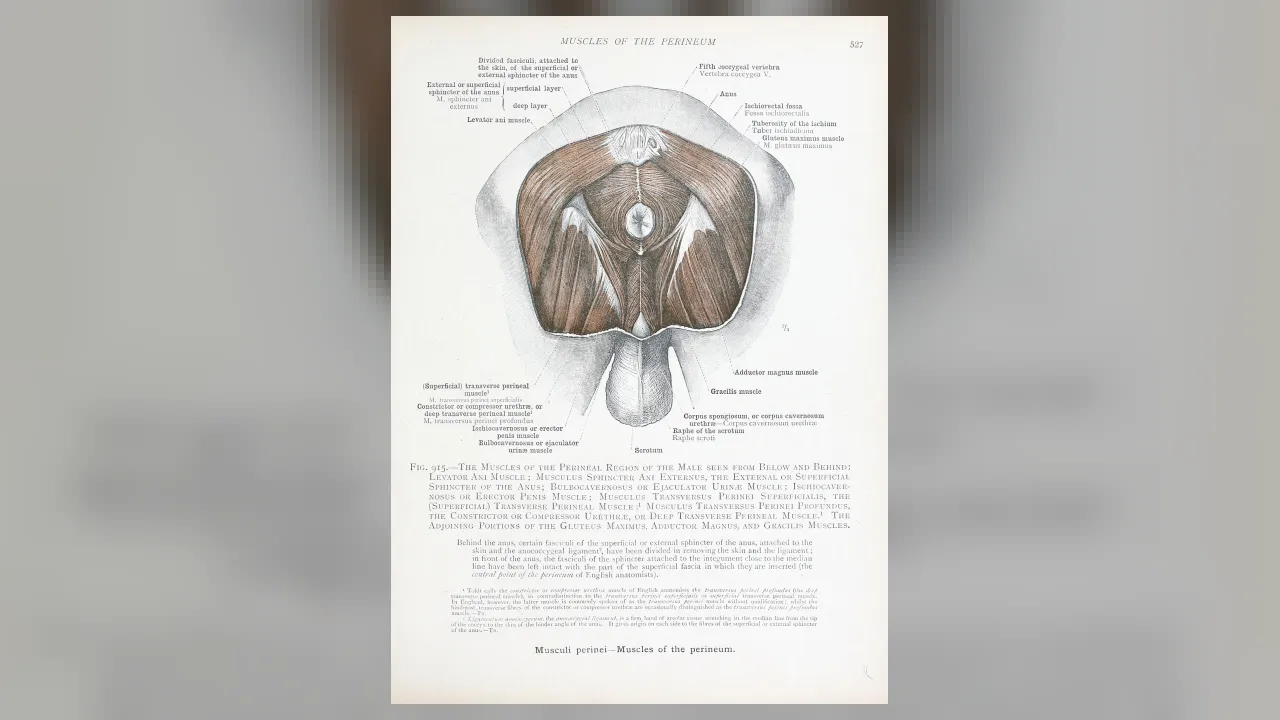
1. Why does the gluteus maximus have 'maximus' in its name?
2. When does your gluteus maximus work super hard?
🤯 Mind-Blowing Fact • Grade 2
When you stroll slowly on flat ground, your giant gluteus maximus mostly relaxes and saves its huge power for running, jumping, and climbing!
✨ Word Sparks (Grade 2 Glossary)
Tap 🔊 to hear
Torso
Main trunk of your body above hips
Gluteus Medius
Medium-sized side hip muscle steadying one-foot balance
Gravity
Earth's downward pull on everything with weight
🪝
Why is the gluteus maximus way bigger in humans than in horses, dogs, or chimpanzees?
1
Built for Two-Legged Balance
Watch a dog or chimpanzee walk on all fours, then watch a human jog upright! Because humans balance a tall upper body on just two legs, we need an extra-giant hip muscle on the back to keep our from tipping forward onto our noses.
2
Quiet on Walks, Mighty on Hills
Here is a neat surprise: when you stroll slowly across a flat hallway, your gluteus maximus barely has to work! The instant you break into a run, hop over a puddle, or hike uphill, it wakes up with massive strength.
3
Three Gluteal Brothers
Two smaller helper muscles— and gluteus minimus—tuck underneath to keep your hips level whenever you balance on one foot!
1. Why do humans have a much larger gluteus maximus relative to body size than chimpanzees?
2. What happens to your gluteus maximus during a slow, easy walk across a flat room?
🤯 Mind-Blowing Fact • Grade 3
Three-quarters of your gluteus maximus fibers actually pull on a tough side-thigh ribbon called the IT band that reaches all the way below your knee!
✨ Word Sparks (Grade 3 Glossary)
Tap 🔊 to hear
Iliotibial Band
Tough outer-thigh ribbon linking hip to shin
Hip Extension
Driving your thigh backward or standing tall
Core
Central trunk muscles linking hips and shoulders
🪝
How does your gluteus maximus connect all the way down past your knee using a famous side-thigh strap?
1
Largest Solo Muscle Champion
Wait—earlier you may have heard the four-part quadriceps is the heaviest muscle group. When you measure single individual muscles one on one, the thick, coarse-fibered gluteus maximus wins gold easily, weighing around two pounds on each side of an adult's hips!
2
Connecting Into the IT Band
Only about one-quarter of your gluteus maximus attaches directly onto the back of your thighbone! The other three-quarters blend into a long, super-tough white ribbon running all the way down the outer side of your thigh called the iliotibial (IT) band, helping steady your knee as well as your hip.
3
Throwing Baseballs Starts Here!
Ask any pitching coach or tennis pro where a fast throw begins: not in the hand, but in the hips! Rotating your hips powerfully with your gluteus maximus whips energy up through your and out your arm.
4
The Glute Family Trio
Named by size—maximus (largest), medius (middle), and minimus (smallest)—your three gluteal muscles team up to power and steady every step!
1. Where do roughly three-quarters of the fibers of your gluteus maximus attach?
2. How does the gluteus maximus help a baseball pitcher throw a fastball?
🤯 Mind-Blowing Fact • Grade 4
Harvard sensor experiments proved your gluteus maximus fires up to ten times harder during sprinting and uphill climbing than during a casual flat walk!
✨ Word Sparks (Grade 4 Glossary)
Tap 🔊 to hear
Electromyography
Sensor test measuring electrical activity inside muscles
Sacrum
Shield-shaped bone at your spine's bottom base
External Rotation
Turning the thigh outward away from center
🪝
What electrical sensor experiments proved the gluteus maximus evolved specifically to make humans great runners?
1
Testing the Running Hypothesis
For decades, anthropologists assumed our enormous gluteus maximus evolved simply for walking on two feet. Then, in 2006, Harvard evolutionary biologist Daniel Lieberman and colleagues taped harmless (EMG) muscle sensors onto volunteers walking and running on treadmills. During level walking, the gluteus maximus barely whispered—firing weakly! The split second volunteers broke into a run, EMG charts lit up with massive bursts of electrical activity on every single stride.
2
Catching a Falling Trunk
Why does running demand so much gluteus maximus power? Every time your front foot strikes the ground at high speed, momentum tries to pitch your heavy upper torso forward at the hip. Firing right before and during foot-strike, the gluteus maximus acts like a giant guy-wire cable anchoring your pelvis and backward, keeping your spine tall while simultaneously decelerating the swinging leg.
3
Dual Insertion Biomechanics
Originating broadly across the posterior ilium, lower , coccyx, and sacrotuberous ligament, its thick fascicles sweep downward at forty-five degrees. Deep lower fibers insert onto the gluteal tuberosity of the femur to drive hip extension and , while superficial fibers tension the fascia lata and iliotibial tract across the lateral knee.
4
Sitting All Day vs. Active Play
Spending long hours slumped in desk chairs leaves hip flexors tight and glutes sleepy—so standing up to stretch, climb, and play tag keeps your body's largest muscle energized and protects your lower back!
1. What did Daniel Lieberman's 2006 treadmill EMG sensor experiments reveal about the gluteus maximus?
2. How does firing your gluteus maximus on foot-strike protect your posture while sprinting?
🤯 Mind-Blowing Fact • Grade 5
Through a tough diamond-shaped sheet of lower-back tissue, your right gluteus maximus connects diagonally to your left back-and-shoulder muscle—forming a giant X-spring across your spine when you run and throw!
✨ Word Sparks (Grade 5 Glossary)
Tap 🔊 to hear
Thoracolumbar Fascia
Diamond-shaped back sheet linking hips and shoulders
Inferior Gluteal Nerve
Dedicated spinal nerve commanding the gluteus maximus
Abductor
Muscle moving a limb outward from center
🪝
How does diagonal myofascial cross-wiring link your right gluteus maximus directly to your left shoulder when you sprint or throw?
1
Gross Morphology of the Largest Skeletal Muscle
Averaging roughly 800 to 1,000 grams per side and boasting a cross-sectional area exceeding forty-five square centimeters, the musculus gluteus maximus is the single largest individual muscle in the human body. Characterized by unusually coarse muscle fascicles separated by fibrous septa and innervated exclusively by the (spinal roots L5, S1, S2), it forms the superficial contour of the posterior pelvis.
2
Bipedal Remodeling of the Hominin Pelvis
In quadrupedal great apes, the iliac blades sit flat against the back, orienting gluteal muscles primarily as hip rather than extensors. During hominin evolution from Australopithecus to Homo erectus, the pelvis broadened and curved into a bowl while the posterior iliac crest expanded backward—repositioning the gluteus maximus behind the hip axis to generate tremendous sagittal extension torque against gravity.
3
The Posterior Oblique Sling: Hip-to-Shoulder Transfer
Sports biomechanists marvel at how the gluteus maximus anchors the body's 'posterior oblique myofascial sling.' Through the diamond-shaped of your lower back, collagen fibers from the right gluteus maximus interweave directly with the left latissimus dorsi shoulder muscle! When you sprint, kick, or hurl a javelin, firing opposite-side glutes and lats tensions this X-shaped elastic sheet across your spine, transferring lower-body ground reaction force straight into upper-body velocity.
4
Iliotibial Tract Tensioning and Knee Control
Because roughly seventy-five percent of gluteus maximus fibers insert into the iliotibial tract alongside the anterior tensor fasciae latae, gluteal contraction tensions this lateral fascial strut—resisting internal femoral rotation and shielding the knee from inward valgus collapse during athletic landings.
5
Balanced Fiber Composition for Power and Posture
Histologically blending roughly equal proportions of oxidative Type I slow-twitch fibers and glycolytic Type II fast-twitch fibers, the gluteus maximus seamlessly transitions from stabilizing upright stance on steep slopes to generating explosive vertical jump power.