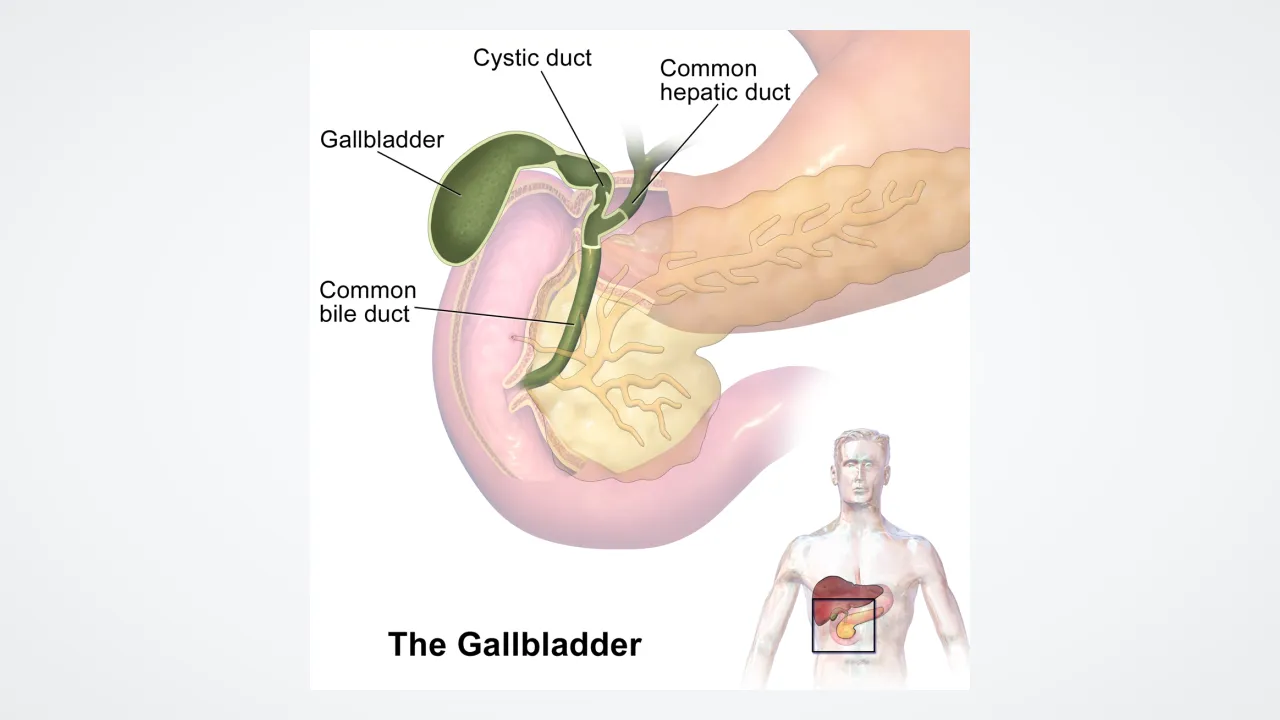
1. Which organ actually makes the bile that your gallbladder holds?
2. What kind of food makes your gallbladder squeeze out bile?
🤯 Mind-Blowing Fact • Grade 2
Although your gallbladder holds only about three tablespoons of liquid, it concentrates bile so much that it packs up to ten times the fat-splitting power!
✨ Word Sparks (Grade 2 Glossary)
Tap 🔊 to hear
Concentrate
Make liquid stronger by removing extra water
Duct
Small tube that carries liquid inside bodies
Fats
Energy-rich nutrients in oils, nuts, and butter
🪝
Why don't oil and water mix in a cup—and how does your tummy solve that puzzle?
1
Oil and Water Puzzle
Try stirring a spoonful of cooking oil into a glass of water, and watch the oil clump into big floating blobs! Inside your watery digestive tract, from avocados, nuts, and ice cream clump together the exact same way.
2
Super-Strong Storage
Your liver makes golden-green bile all day, sending it into the pear-shaped gallbladder underneath. While waiting between meals, the gallbladder pulls out extra water so the stored bile grows much stronger.
3
Time to Squeeze!
As soon as fatty food enters your small intestine, a signal tells the gallbladder to squeeze. Bile rushes down a tiny tube and breaks big fat blobs into millions of microscopic droplets!
1. How does the gallbladder make stored bile up to ten times stronger between meals?
2. Where does bile travel right when your gallbladder squeezes?
🤯 Mind-Blowing Fact • Grade 3
Your thrifty body recycles about ninety-five percent of its bile salts at the end of the small intestine, sending them back to the liver to use again and again!
✨ Word Sparks (Grade 3 Glossary)
Tap 🔊 to hear
Emulsification
Breaking large fat globs into tiny droplets
Duodenum
First curved section of the small intestine
Bilirubin
Yellowish-green pigment recycled from old blood cells
🪝
How does a tiny pear-shaped pouch know the exact moment you take a bite of cheesy pizza?
1
Why Enzymes Need Help With Fats
Picture trying to paint a whole wall using a tiny brush when all the paint is frozen into one giant ball! Digestive enzymes in your small intestine are water-loving molecules, so when greasy fats clump into big oily globes, enzymes can only nibble at the outside edge. That is where your gallbladder and bile save the day.
2
What Is Inside Bile?
Made continuously by liver cells, bile is a greenish-yellow fluid blended from water, bile salts, cholesterol, electrolytes, and a pigment called recycled from old red blood cells. Between meals, a muscular valve at the bottom of the bile duct stays shut, backing bile up into the gallbladder for safekeeping.
3
The Hormone Wake-Up Call
The moment rich, fatty chyme leaves your stomach and touches the —the first curve of the small intestine—intestinal cells release a messenger hormone into your blood. That hormone signals the gallbladder's muscular wall to contract and the doorway valve to open wide!
4
Emulsifying for Easy Digestion
Bile salts surround fat globs and shatter them into tiny droplets—a process called —giving enzymes huge surface area to finish digestion and unlock vitamins A, D, E, and K.
1. What does 'emulsification' do to fats inside your small intestine?
2. Which four vitamins need bile's fat-splitting teamwork so your body can absorb them?
🤯 Mind-Blowing Fact • Grade 4
The hormone cholecystokinin gets its name from Greek roots meaning 'to move the bile sac,' describing its exact job inside your digestive system!
✨ Word Sparks (Grade 4 Glossary)
Tap 🔊 to hear
Amphipathic
Having both water-loving and fat-loving molecular sides
Micelles
Tiny spheres ferrying digested fats to gut cells
Gallstones
Hardened crystals that sometimes form inside gallbladders
🪝
How can one tiny bile salt molecule grab onto greasy oil and watery intestinal juice at the exact same time?
1
Two-Sided Molecular Bridges
Zoom down to the molecular level inside a drop of bile, and you will spot bile salts performing clever chemistry. Each bile salt molecule is —meaning one face is hydrophobic (fat-loving and water-fearing) while the opposite face is hydrophilic (water-loving). When bile mixes with dietary oils, the fat-loving sides cling tightly to tiny lipid droplets while the water-loving sides face outward, keeping droplets suspended so they cannot merge back into giant slicks!
2
Plumbing of the Biliary Tree
Every day, hepatocytes produce between 600 and 1,000 milliliters of dilute golden bile. Tiny channels merge into the common hepatic duct. When you are fasting, a circular muscle ring called the sphincter of Oddi stays closed, steering bile up the cystic duct into the three-inch gallbladder, whose folded mucosa absorbs water and sodium to concentrate bile five- to tenfold.
3
Cholecystokinin Triggers Action
When fatty acids and amino acids enter the duodenum, specialized sensory cells secrete the hormone cholecystokinin (CCK)—a Greek name that literally means 'bile-sac mover.' CCK stimulates smooth muscle in the gallbladder wall to squeeze while simultaneously relaxing the sphincter of Oddi, delivering concentrated bile down the common bile duct.
4
Micelles and Life Without a Gallbladder
After pancreatic lipase snips fats apart, bile salts ferry fatty acids to intestinal villi in tiny spheres called . Surprisingly, if crystal buildup called ever requires gallbladder removal, people still live healthy lives because liver bile trickles steadily directly into the gut!
1. Why don't tiny emulsified fat droplets immediately clump back together into one big oily blob?
2. Why can a person still digest food if doctors safely remove their gallbladder?
🤯 Mind-Blowing Fact • Grade 5
Even though bile is famous for fat digestion, it contains zero enzymes—its magic is pure physical chemistry that boosts fat surface area a thousandfold!
✨ Word Sparks (Grade 5 Glossary)
Tap 🔊 to hear
Conjugating
Chemically linking molecules together for better solubility
Enterohepatic
Recycling loop connecting intestines back to liver
Hydrolyze
Split chemical bonds apart using water molecules
🪝
How does your hepatobiliary system recycle a tiny three-gram pool of bile salts up to ten times a day to digest every gram of dietary lipid?
1
Anatomy of the Biliary Tract
Tucked into a shallow fossa beneath the right hepatic lobe, the gallbladder (vesica biliaris) is a muscular, fibromuscular sac measuring 7 to 10 centimeters in length with a resting capacity of roughly 30 to 50 milliliters. Internally, unlike the stomach or small intestine, the gallbladder lacks a submucosa and instead features velvety mucosal folds (rugae) carpeted with tall columnar epithelial cells rich in microvilli and ATP-powered sodium pumps.
2
Biochemistry of Bile Synthesis and Pigments
Hepatocytes secrete roughly 800 milliliters of hepatic bile daily, synthesizing primary bile acids—cholic acid and chenodeoxycholic acid—directly from cholesterol, then them with the amino acids glycine or taurine to form ionized bile salts. Bile also serves as the body's primary excretory route for excess cholesterol and conjugated bilirubin, a breakdown product of hemoglobin heme whose chemical transformations give bile its emerald hue.
3
Neurohormonal Coordination at the Duodenum
During interdigestive fasting, tonic contraction of the hepatopancreatic sphincter—described by Italian anatomist Ruggero Oddi in 1887—diverts hepatic bile through spiral valves of Heister in the cystic duct into the gallbladder, where active ion absorption concentrates bile salts up to tenfold. Upon arrival of dietary lipids in the duodenum, enteroendocrine I-cells secrete cholecystokinin (CCK) into the bloodstream while vagal nerve fibers fire, contracting gallbladder smooth muscle and relaxing Oddi's sphincter so bile joins pancreatic juice at the ampulla of Vater.
4
Emulsification, Lipolysis, and Micellar Transport
Note a crucial distinction: bile contains zero digestive enzymes! Instead, physical emulsification expands lipid surface area a thousandfold so pancreatic lipase and colipase can triglycerides into monoglycerides and free fatty acids, which then pack into 5-nanometer mixed micelles to cross the watery unstirred layer along enterocyte brush borders.
5
Enterohepatic Circulation
Remarkably, the entire human body holds only about 3 grams of bile salts, yet active transporters in the terminal ileum reclaim 95 percent of them per meal, returning them via the portal vein to the liver two to three times during a single dinner!