🌌 COSMOS
🔭 NASA Jet Propulsion Laboratory • First Jupiter Orbiter & Atmospheric Probe
VA Science SOL 1.6, 4.5, 4.6 (Solar System, Stars & Space Exploration)
Galileo Probe
First Jupiter Orbiter and Cloud-Diving Explorer
Grade 3 • Fluent • 153 words
🌌 Cosmic Location & DistanceJupiter System Orbit & Jovian Cloud Deck • ~484 Million Miles from Sun
🪐 Scale / Diameter17.4 ft (5.3 m) Orbiter + 747 lb (339 kg) Cone Atmospheric Probe
☄️ Composition & OrbitPlutonium RTG Power • First Asteroid Flybys, Jupiter Orbit (1995–2003) & Ocean Discovery
⚡ Cosmic SparkUncovered Europa's hidden saltwater ocean and dove straight into Jupiter's clouds at 106,000 mph
🤯 Mind-Blowing Fact • Grade 1
Icy moon Europa is smaller than Earth's Moon, yet Galileo discovered its hidden underground ocean holds twice as much water as all of Earth's oceans combined!
✨ Word Sparks (Grade 1 Glossary)
Tap 🔊 to hear
Space Shuttle
winged NASA spaceship carrying crews and cargo
Europa
icy Jupiter moon hiding a deep ocean
crust
hard outer shell of a world
🪝
What happened when a brave little robot parachuted straight into giant planet Jupiter?
1
Launched from a Space Shuttle
Astronauts opened Atlantis's big doors in 1989! Out floated the Galileo spacecraft, bound for giant planet Jupiter!
2
Diving into Giant Clouds
Galileo dropped a cone-shaped probe right into Jupiter's stormy sky! On a parachute, it sniffed wild winds for nearly an hour.
3
A Secret Moon Ocean
Meanwhile, the main Galileo craft circled Jupiter for eight years. Beneath moon 's icy shell, it found a giant ocean!
1. How did the Galileo spacecraft begin its journey in 1989?
2. What thrilling secret did Galileo discover hiding under Jupiter's icy moon Europa?
🤯 Mind-Blowing Fact • Grade 2
While still cruising toward Jupiter in July 1994, Galileo had a front-row seat from space to photograph pieces of broken Comet Shoemaker-Levy 9 slamming into Jupiter's nightside!
✨ Word Sparks (Grade 2 Glossary)
Tap 🔊 to hear
comet
icy snowball rock orbiting the Sun
backup antenna
smaller spare radio aerial on spacecraft
lava fountain
glowing melted rock spraying from volcano
🪝
How did Galileo visit the very first asteroids ever photographed—and watch a comet crash into Jupiter?
1
First Asteroid Moon!
Named after Italian astronomer Galileo Galilei—who discovered Jupiter's four big moons in 1610—NASA's Galileo spacecraft made history before even reaching Jupiter! Crossing the Asteroid Belt, it snapped the first close photos of asteroids Gaspra and Ida, spotting tiny moon Dactyl orbiting Ida!
2
106,000-Mile-Per-Hour Plunge
On December 7, 1995, Galileo became the first spacecraft ever to orbit Jupiter, while its 747-pound cone probe slammed into Jupiter's clouds at 106,000 miles per hour—the fastest atmospheric entry ever survived by a human machine!
3
Volcanoes and Icy Oceans
Even though its big umbrella antenna jammed shut, clever software updates let Galileo send thousands of crisp photos via a tiny —revealing towering on moon Io and Europa's buried ocean!
1. What surprise did Galileo spot orbiting space rock Ida in the Asteroid Belt?
2. How did engineers save the Galileo mission when its main umbrella-shaped antenna got stuck closed?
🤯 Mind-Blowing Fact • Grade 3
Jupiter's moon Ganymede is the ONLY moon in the entire Solar System known to generate its own permanent magnetic field—creating shimmering auroras around its poles, discovered thanks to Galileo!
✨ Word Sparks (Grade 3 Glossary)
Tap 🔊 to hear
Ganymede
Jupiter's biggest moon, larger than Mercury
electric current
flow of electric charge through saltwater
aurora
glowing polar lights from magnetic particles
🪝
How do you survive slamming into a giant planet's sky twice as hot as the surface of the Sun?
1
Surviving 230 Gs of Braking
Imagine racing faster than thirty miles every second and slamming on the brakes in two minutes flat! When Galileo's cone-shaped Atmospheric Probe hit Jupiter's upper sky in December 1995, friction created a glowing fireball twice as hot as the Sun's surface and 230 times Earth's gravity! More than half of its thick carbon heat shield vaporized away to protect the instruments inside.
2
Fifty-Eight Minutes Under a Parachute
Popping open an eight-foot parachute, the probe drifted 95 miles down through howling 400-mile-per-hour winds! Surprise—it had landed inside a freak 'hot spot,' a dry, cloud-free patch like a desert in Jupiter's stormy sky, before crushing pressure finally melted it.
3
Magnetic Clues Inside Europa
Up in orbit, Galileo's magnetometer noticed Jupiter's tilted magnetic field inducing inside icy moon Europa—proof that an electrically conducting global ocean of salty liquid water sloshes beneath Europa's cracked ice shell!
4
Ganymede's Magnetic Surprise
Galileo also discovered that giant moon —bigger than planet Mercury—generates its very own permanent magnetic field!
1. Why did Galileo's Atmospheric Probe detect much less water cloud vapor than scientists expected during its parachute drop?
2. How did Galileo prove a salty liquid ocean hides miles beneath Europa's solid ice crust without drilling through the ice?
🤯 Mind-Blowing Fact • Grade 4
During its fiery two-minute braking slam into Jupiter's upper atmosphere, Galileo's cone probe slowed from 106,000 miles per hour to under 1,000 miles per hour while losing 180 pounds—over half of its entire heat shield—into glowing vapor!
✨ Word Sparks (Grade 4 Glossary)
Tap 🔊 to hear
data compression
shrinking computer files without losing details
magnetic induction
changing magnetism sparking electric currents nearby
noble gases
unreactive gases like helium and neon
🪝
How did three stuck umbrella ribs 100 million miles out force engineers to reinvent deep-space data compression?
1
The Stuck High-Gain Antenna Crisis
Deployed from Space Shuttle Atlantis in October 1989 on a six-year Venus-Earth-Earth gravity-assist route, Galileo folded its 16-foot gold-mesh umbrella antenna neatly against sun glare during inner-planet flybys. When controllers commanded the umbrella to open in April 1991, three of its eighteen graphite ribs stayed stubbornly snagged on central pins—cutting planned radio speed from 134,000 bits per second down to a trickle of 10 bits per second on the tiny backup low-gain antenna!
2
Software Genius Rescues the Mission
Refusing defeat, Jet Propulsion Laboratory engineers uploaded revolutionary image-compression algorithms right to Galileo's vintage computers and linked giant Deep Space Network antennas across California, Spain, and Australia into one virtual ear—boosting data speeds a hundredfold and capturing 14,000 stunning images across 35 Jupiter orbits!
3
Record Atmospheric Entry Physics
Released five months ahead of arrival with no thrusters of its own, the 339-kilogram Atmospheric Entry Probe hit Jupiter at 47.4 kilometers per second on December 7, 1995. Shedding 82 kilograms of carbon-phenolic shield in seconds under 15,500-degree-Celsius shock plasma, it measured Jovian helium, , and howling winds down to 22 bars of pressure.
4
Ocean Worlds and Safeguarded Farewell
After unveiling subsurface oceans inside Europa, Ganymede, and Callisto, low-fuel Galileo plunged deliberately into Jupiter on September 21, 2003—ensuring unsterilized Earth microbes could never contaminate Europa's ocean!
1. Why did Galileo travel inward past Venus and twice past Earth before heading outward to Jupiter?
2. Why did NASA steer Galileo into Jupiter's atmosphere in 2003 at the end of its eight-year tour?
🤯 Mind-Blowing Fact • Grade 5
Galileo was engineered with a unique 'dual-spin' body—half the spacecraft spun steadily three times a minute to measure 360-degree magnetic fields and particles while a motorized joint held the bottom camera section rock-still to snap sharp photos!
✨ Word Sparks (Grade 5 Glossary)
Tap 🔊 to hear
dual-spin
half spacecraft spinning while cameras stay still
chaos terrain
jumbled ice rafts refrozen over slush
ultramafic lava
ultra-hot magnesium-rich molten volcanic rock
🪝
How did Galileo's dual-spin architecture, electromagnetic induction physics, and extreme hypersonic entry transform outer-planet exploration?
1
Dual-Spin Orbiter and VEEGA Astrodynamics
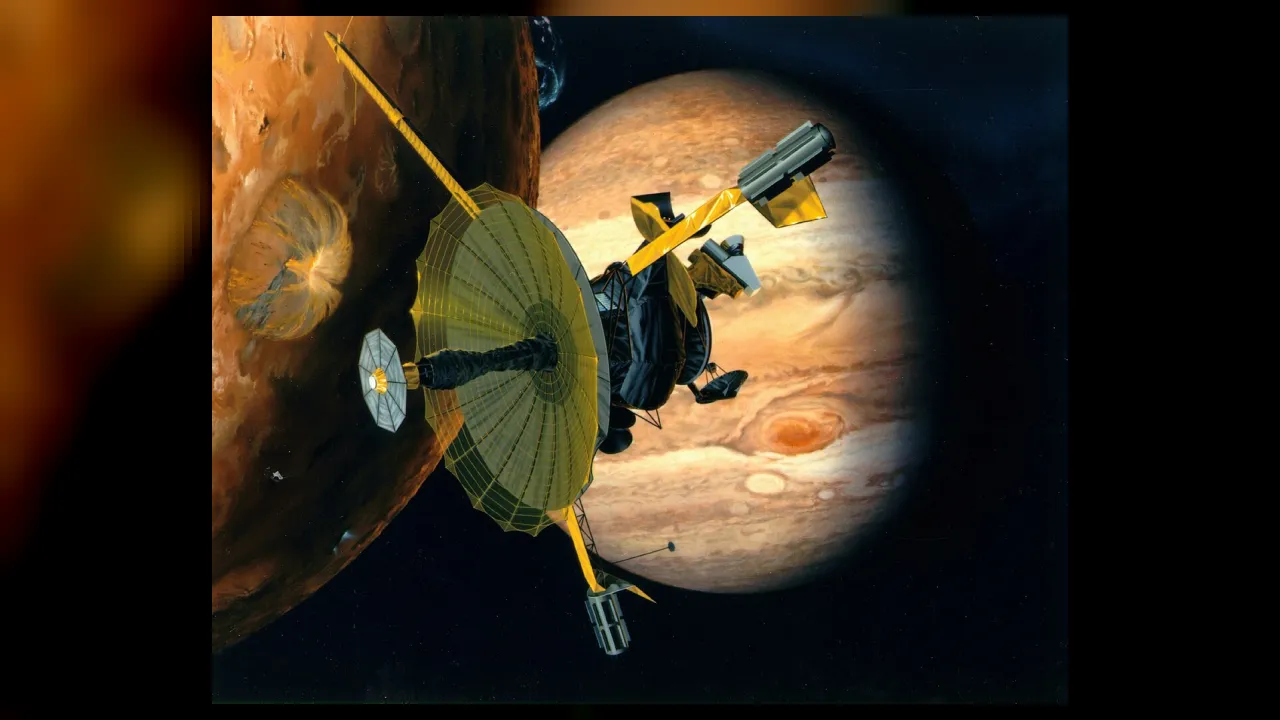
Engineered at NASA's Jet Propulsion Laboratory as humanity's first outer-planet orbiter, the 2,223-kilogram Galileo spacecraft pioneered a clever '' configuration: its magnetometer and plasma-particle section rotated at 3 RPM to sweep full-sky fields, while a motorized bearing held its solid-state CCD camera and near-infrared mapping spectrometer steady on a despun section! Launched from Space Shuttle Atlantis on an Inertial Upper Stage via a Venus-Earth-Earth Gravity Assist trajectory, Galileo achieved first-ever asteroid encounters at S-type 951 Gaspra and binary 243 Ida/Dactyl while surviving stuck molybdenum-disulfide dry-lubricant pins on its 4.8-meter X-band mesh antenna through onboard ICT/JPEG packet compression and arrayed 70-meter DSN apertures.
2
Hypersonic Entry at 47.4 km/s
On December 7, 1995, Galileo's 339-kilogram, 45-degree-blunt-cone Atmospheric Probe executed the most extreme planetary entry in aerospace history—slamming into Jupiter's hydrogen-helium atmosphere at 47.4 kilometers per second and decelerating at 228 Gs! Radiative and convective shock heating topped 15,500 kelvins, ablating 82 kilograms of its 152-kilogram carbon-phenolic forebody shield. Transmitting via L-band relay to the overhead orbiter for 57.6 minutes down to 22 bars—156 kilometers below the 1-bar reference level—its mass spectrometer measured helium matching protosolar ratios while heavy noble gases argon, krypton, and xenon proved enriched threefold over solar values.
3
Electromagnetic Induction and Subsurface Oceans
Across 35 Jovian orbits, Margaret Kivelson's UCLA magnetometer team unlocked Galileo's crowning astrobiological triumph! Because Jupiter's dipole tilts 10 degrees relative to its spin axis, Europa experiences an 11-hour oscillating magnetic field; Galileo detected induced dipole fields opposing that variation at near-100-percent efficiency—proving an electrically conducting brine ocean tens of kilometers deep underlies Europa's fractured , alongside deeper salty oceans inside Callisto and dynamo-bearing Ganymede!
4
Ultramafic Volcanism on Io and Ring Dust Origins
Surviving more than four times its design radiation dose inside Jupiter's inner magnetosphere, Galileo clocked 1,600-kelvin silicate lava curtains on Io hotter than modern terrestrial basalts and proved Jupiter's gossamer rings consist of impact dust kicked off tiny inner moons Amalthea, Thebe, Adrastea, and Metis.
5
Paving the Way for Europa Clipper and JUICE
Vaporizing cleanly into Jupiter on September 21, 2003 for planetary protection, Galileo birthed ocean-world astrobiology—directly inspiring NASA's Europa Clipper and ESA's Jupiter Icy Moons Explorer (JUICE).