🧬 HUMAN BODY
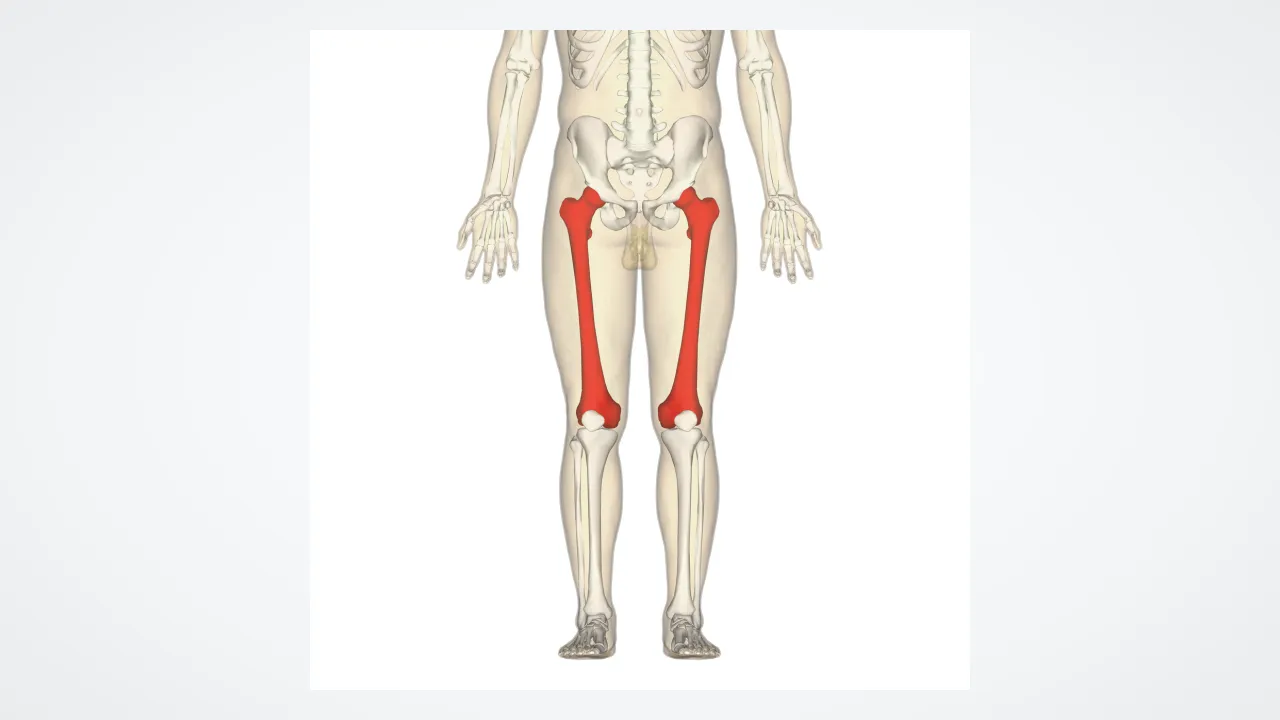
🧬 Os Femoris • Appendicular Skeletal System
VA Science & Health SOL 1.1, 3.1, 4.2, 5.1 (Cells, Organs & Body Systems)
Femur (Thighbone)
Longest, Heaviest, and Strongest Bone in You
Grade 5 • Advanced • 271 words
🩺 Body System & LocationUpper Leg (Thigh) • Bridging Hip Socket to Knee Joint
🔬 Size / Cell Count~18–19 in (46–48 cm) in adults • ~1/4 of your total standing height!
⚙️ Core JobBears full upper-body weight, powers running/jumping, and houses marrow
⚡ Body SuperpowerPound for pound stronger than solid concrete under vertical compression
🤯 Mind-Blowing Fact • Grade 1
Your thighbone is so long that it measures about one-fourth of how tall you are from head to toe!
✨ Word Sparks (Grade 1 Glossary)
Tap 🔊 to hear
Femur
Science name for your super-strong upper leg bone
Thigh
Upper part of your leg above knee
Joint
Place where two bones meet and move
🪝
Pat the top of your leg above your knee—did you just touch your biggest bone?
1
Champion of All Bones
Stand up tall and pat your upper leg! Hidden under strong muscles sits your , or thighbone. Out of all 206 bones in you, this one wins biggest and longest!
2
Ball at the Top
At the top end, your has a smooth round ball. That ball fits into your hip cup so your leg swings in big circles!
3
Super Strong Pillar
Every time you leap off a swing, your two catch your whole body weight without bending or breaking.
1. Which bone wins the prize for longest and strongest bone in the human body?
2. About what fraction of your standing height comes from the length of one femur?
🤯 Mind-Blowing Fact • Grade 2
Scientists tested bone strength and discovered a healthy adult femur can support the weight of a small family car before cracking!
✨ Word Sparks (Grade 2 Glossary)
Tap 🔊 to hear
Hollow
Having an open space down the middle
Concrete
Hard rocky building material used in sidewalks
Socket
Cup-shaped bone hollow holding a round joint
🪝
How can a bone inside your leg be stronger than concrete without making you too heavy to jump?
1
Hollow Like a Bike Frame
Lift a sturdy bicycle frame, and notice how light it feels because its metal tubes are inside! Your femur uses that exact same trick. A rock-hard outer cylinder of bone surrounds a softer central tunnel filled with marrow, giving you -beating strength without heavy solid weight.
2
Swinging Hip, Bending Knee
Up top, the rounded head of the femur plugs into your pelvis like a joystick so you can kick forward, backward, or sideways. Down below, twin rounded knuckles form the top half of your hinge-like knee.
3
Growing Longer Every Year
Special growth zones near both ends add fresh bone all through childhood until you reach your grown-up height!
1. Why is the middle shaft of your femur shaped like a hollow tube instead of a solid rock?
2. What kind of joint forms where the round top ball of your femur meets your hip?
🤯 Mind-Blowing Fact • Grade 3
When you sprint and jump, each femur effortlessly handles impact forces up to five times your entire body weight with every single stride!
✨ Word Sparks (Grade 3 Glossary)
Tap 🔊 to hear
Diaphysis
Long, sturdy tubular shaft of a bone
Epiphyses
Rounded joint ends of a long bone
Quadriceps
Four powerful front thigh muscles straightening knees
🪝
How can scientists estimate how tall a prehistoric human stood just by finding a single thighbone?
1
Nature's Built-In Ruler
Imagine uncovering a single fossilized leg bone in an ancient cave! Because the human femur consistently grows to roughly 26.7 percent—just over one-quarter—of a person's standing height, paleontologists and detectives can multiply a femur's length by nearly four to estimate stature within an inch or two!
2
Built for Giant Landing Forces
Whenever you sprint across a soccer field or hop off playground steps, landing forces equal three to five times your body weight! Thick compact bone along the femur's shaft—the —absorbs those jolts, while giant muscle groups like your in front and hamstrings in back pull on ridges along the bone.
3
Spongy Arches at Both Ends
Inside the rounded ends—the —crisscrossing beams of spongy bone arrange themselves like tiny cathedral arches to spread hip and knee loads evenly.
4
Growth Plates in Action
Near each end sits an epiphyseal growth plate of living cartilage that builds new bone cells all through elementary and high school!
1. If an adult fossil femur measures 18 inches long, roughly how tall was that person?
2. Where does a child's femur add new length as they grow taller?
🤯 Mind-Blowing Fact • Grade 4
The sweeping iron arches of the Eiffel Tower in Paris were inspired by the microscopic bone struts inside the top of the human femur!
✨ Word Sparks (Grade 4 Glossary)
Tap 🔊 to hear
Trabeculae
Crisscrossing microscopic arches inside spongy bone ends
Trochanters
Bony knobs near top femur anchoring muscles
Osteoblasts
Builder cells depositing fresh mineral bone tissue
🪝
Why did the Eiffel Tower's engineer study the microscopic arches inside the top of the human femur?
1
The Eiffel Tower Inside Your Hip!
In the 1860s, Swiss engineer Karl Culmann visited an anatomy lab and gasped when he saw a sliced human femur! Inside the angled femoral neck, tiny struts of spongy bone called curved in sweeping crisscrossing arcs that matched his own mathematical crane diagrams line for line. Soon after, Gustave Eiffel's team used those exact load-bearing curves to design the iron lattice of the Eiffel Tower in Paris!
2
Why Femurs Angle Inward
Notice that your hips are wider apart than your knees! Instead of dropping straight down like vertical table legs, human femurs slant inward from the deep hip socket (acetabulum) to center your knees and feet directly beneath your body's center of gravity. Without this clever ten-degree inward slant, you would have to sway your whole upper body side to side with every step just to stay balanced!
3
Trochanters: Giant Muscle Handles
Near the angled femoral neck jut two rugged bony knobs called the greater and lesser , while a long rough ridge runs down the back of the shaft. Powerful gluteal, quadriceps, hamstring, and hip-flexor muscles anchor onto these levers, pulling with hundreds of pounds of force to propel you uphill, across a field, or up flights of stairs.
4
Wolff's Law: Use It to Strengthen It!
Far from being dead dry rock, your femur is living tissue wired with star-shaped sensor cells called osteocytes that feel every jump and sprint! Following a principle discovered in 1892 called Wolff's law, active weight-bearing play and calcium-rich foods signal bone-building to deposit extra calcium phosphate crystals right along lines of stress—making active bones denser and tougher!
1. Why do human femurs slant inward from the hips toward the knees instead of going straight down?
2. According to Wolff's law, what happens to your femurs when you run, jump, and play sports regularly?
🤯 Mind-Blowing Fact • Grade 5
Because bone needs gravity's pull to stay dense, astronauts aboard the International Space Station exercise two hours daily with vacuum-cylinder resistance machines to keep their femurs strong!
✨ Word Sparks (Grade 5 Glossary)
Tap 🔊 to hear
Hydroxyapatite
Hard calcium-phosphate crystal giving bone rock-like strength
Osteoclasts
Cells that dissolve old bone during remodeling
Condyles
Rounded knuckle-like projections forming the knee joint
🪝
How does a composite matrix of flexible collagen cables and ceramic hydroxyapatite crystals let one thighbone withstand over a metric ton of force?
1
Composite Materials Engineering
Measuring roughly 46 to 48 centimeters in an average adult, the femur (os femoris) owes its legendary toughness to hierarchical composite chemistry. Pure mineral crystal alone would shatter like a porcelain plate; pure protein alone would bend like a rubber hose. By mineralizing triple-helical type I collagen fibers (tensile strength) with microscopic plates of calcium (`Ca10(PO4)6(OH)2`, compressive stiffness), cortical bone along the femoral diaphysis achieves an axial compressive breaking threshold exceeding 1,500 to 2,000 kilograms of force!
2
Proximal, Shaft, and Distal Architecture
Proximally, the spherical femoral head—tethered inside the acetabulum by the ligamentum teres and coated in glass-smooth articular cartilage—joins the shaft via an angled neck (~125-degree angle of inclination) flanked by the greater and lesser trochanters. Posteriorly along the shaft runs a raised ridge, the linea aspera, anchoring adductor and vastus muscles. Distally, the bone flares into medial and lateral separated anteriorly by the patellar trochlear groove.
3
Wolff's Law and Mechanotransduction
Inspired by Karl Culmann and anatomist Georg Hermann von Meyer's 1867 femoral trabecular drawings, German surgeon Julius Wolff published his landmark 1892 law of bone remodeling. Within tiny fluid-filled canals (canaliculi), spider-shaped osteocytes detect microscopic fluid shear during running, signaling bone-building osteoblasts and bone-sculpting to align trabecular arches strictly along principal tensile and compressive trajectories.
4
The Bicondylar Carrying Angle and Medullary Marrow
Whereas chimpanzees possess vertical femurs requiring side-to-side trunk swaying on two legs, hominins evolved a 9-to-11-degree valgus bicondylar angle—verified in the 3.2-million-year-old fossil 'Lucy' (Australopithecus afarensis)! Internally, the adult medullary cavity stores energy-rich yellow marrow while the proximal epiphysis retains hematopoietic red marrow.
5
Spaceflight Bone Science
Because astronauts lose up to 1.5 percent of femoral neck density per month in microgravity, NASA equips space stations with resistive exercise machines to mimic Earth's bone-strengthening gravity!