🧬 HUMAN BODY
🧬 Epiglottis • Respiratory & Digestive Crossroads
VA Science & Health SOL 1.1, 3.1, 4.2, 5.1 (Cells, Organs & Body Systems)
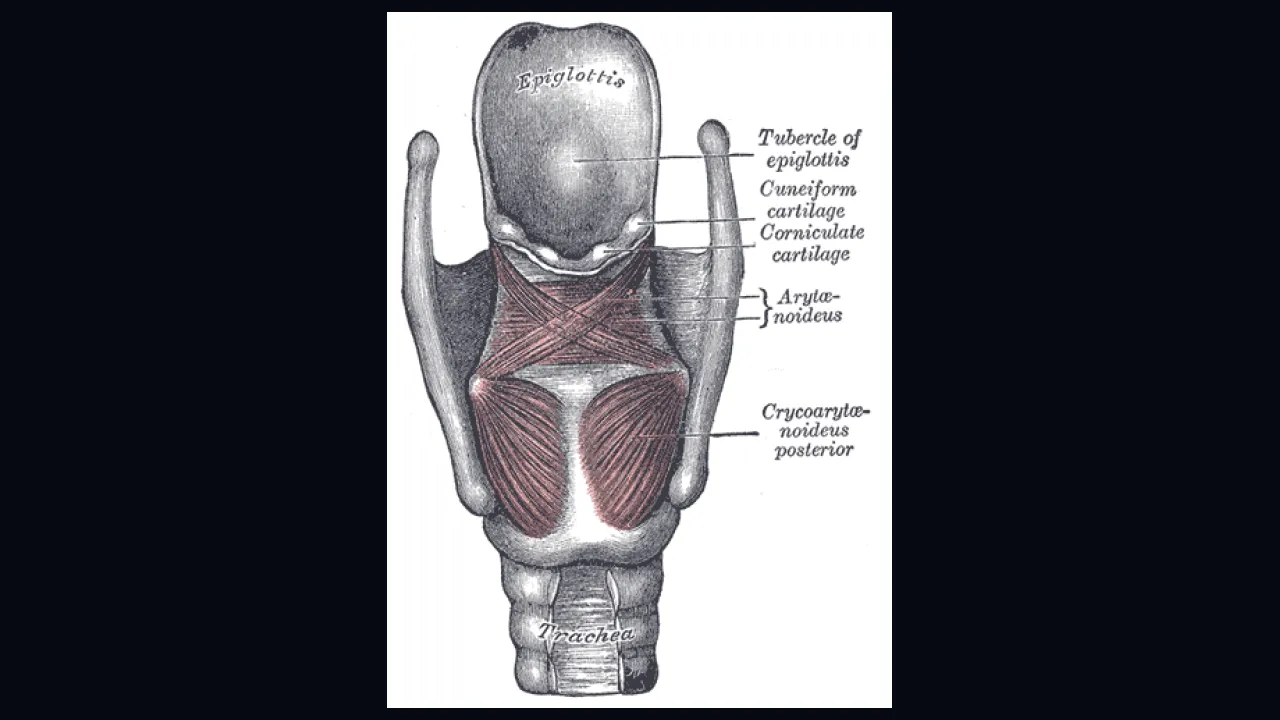
Epiglottis
Your Throat's Leaf-Shaped Trapdoor Traffic Cop
Grade 3 • Fluent • 143 words
🩺 Body System & LocationRespiratory & Digestive Crossroads • Root of the tongue right above the larynx
🔬 Size / Cell Count~1–1.5 inches (2.5–4 cm) leaf-shaped flap • Built from springy elastic cartilage
⚙️ Core JobFlips shut over the windpipe during every swallow so food and water enter the esophagus
⚡ Body SuperpowerRedirects snacks away from your lungs in less than half a second thousands of times a day
🤯 Mind-Blowing Fact • Grade 1
Your springy epiglottis flips shut and pops back open over 500 times a day every time you swallow snacks, drinks, or saliva!
✨ Word Sparks (Grade 1 Glossary)
Tap 🔊 to hear
Epiglottis
Leaf-shaped throat lid that guards your windpipe
Swallow
To send chewed food or drink down throat
Guard
To stand watch and keep something safe
🪝
Why did grown-ups tell you not to talk or giggle with a mouthful of food?
1
Two Tubes Side by Side
Gulp! Every sip of milk and every breath of air start out in the same throat. Down lower, the road splits into two tubes: one for air and one for food!
2
A Helpful Little Trapdoor
Guarding your air tube is a bendy, leaf-shaped flap called the ! When you breathe, it stands up open. The moment you , it flips down like a lid over your windpipe.
3
Wrong Pipe Cough
Laughing while swallowing can sneak a water drop past the lid—making you cough it right back out!
1. What happens to your epiglottis the instant you swallow a bite of apple?
2. Why can giggling with water in your mouth make you cough?
🤯 Mind-Blowing Fact • Grade 2
Unlike stiff bone, your epiglottis is built from special elastic cartilage that never stiffens up—staying just as springy at age 90 as at age 7!
✨ Word Sparks (Grade 2 Glossary)
Tap 🔊 to hear
Crossroads
A busy spot where two pathways meet
Elastic
Stretchy and springy so it bounces right back
Flap
A flat, movable piece hinged on one side
🪝
How does a tiny leaf-shaped switch inside your throat direct traffic without ever getting tired?
1
Busy Throat Crossroads
Picture a railroad switch that steers trains onto the right track at the very last second! Inside your neck, your windpipe sits in front and your food tube sits right behind it. Standing between them at the base of your tongue is a flexible called the epiglottis.
2
Open for Air, Closed for Lunch
All day and night while you breathe or chat, the epiglottis points upright so air zooms freely into your lungs. As soon as your tongue pushes chewed food backward, throat muscles lift your voice box and fold the epiglottis tightly over the airway!
3
Springing Right Back Up
Made of extra-stretchy cartilage, the epiglottis pops straight back open the instant your food slides safely into the food tube.
1. Where is your windpipe located compared with your food tube?
2. Why is elastic cartilage the perfect building material for the epiglottis?
🤯 Mind-Blowing Fact • Grade 3
Your epiglottis actually has microscopic taste buds on it—not for enjoying dessert, but to sense stray liquid droplets and protect your lungs!
✨ Word Sparks (Grade 3 Glossary)
Tap 🔊 to hear
Reflex
An automatic body action happening faster than thought
Brainstem
Lower brain control center running breathing and swallowing
Saliva
Watery mouth liquid that keeps food slippery
🪝
Did you know you automatically pause your breathing every single time you swallow?
1
Test Your Swallow Reflex
Try a quick, safe science test right now: swallow a tiny bit of and notice your breath! For about one second, your breathing pauses completely. Your runs an automatic safety program so you never inhale and swallow at the exact same moment.
2
A Two-Part Folding Trick
Anchored behind the root of your tongue like a shoehorn, the leaf-shaped epiglottis doesn't just flop down on its own. When you swallow, neck muscles pull your entire larynx upward and forward while the tongue presses backward—folding the epiglottis neatly over your vocal cords like a custom-fitted umbrella!
3
Sliding Down Side Chutes
Liquids and chewed food part smoothly around the sloped epiglottis, gliding down twin side channels straight into the waiting esophagus.
4
Surprise Taste Buds!
Believe it or not, scientists found real taste buds scattered right on the surface of the epiglottis—acting as extra chemical sensors to detect stray drops and guard your airway!
1. What helps fold the epiglottis neatly over your airway during a swallow?
2. Why are there taste buds on the surface of your epiglottis?
🤯 Mind-Blowing Fact • Grade 4
High-speed X-ray videos show your throat protects your lungs with THREE layers of defense on every swallow: true vocal folds, false vocal folds, and the folding epiglottis!
✨ Word Sparks (Grade 4 Glossary)
Tap 🔊 to hear
Pharynx
Shared muscular throat hallway behind nose and mouth
Bolus
A soft, rounded ball of chewed food
Elastin
Super-stretchy protein fiber letting tissues snap back
🪝
Why does water 'going down the wrong pipe' feel so dramatic even when it is only a tiny droplet?
1
Anatomy of the Pharyngeal Crossroads
Behind your mouth and nose lies a shared muscular hallway called the , where inhaled air and swallowed meals cross paths! Normally, air travels forward from the back of the nose into the larynx, while food travels backward from the mouth into the esophagus. Preventing a traffic collision at 600 to 1,000 swallows per day is the job of the epiglottis—a yellow-tinted leaf of elastic cartilage tethered by ligaments to both the thyroid cartilage and hyoid bone.
2
Triple-Lock Airway Security
High-speed X-ray movies reveal that your throat actually uses a triple-lock security system during the pharyngeal phase of swallowing! First, your true vocal folds snap tightly shut. Second, the false vocal folds squeeze closed right above them. Third, suprahyoid muscles haul the larynx upward beneath the tongue base, tipping the epiglottis backward over the laryngeal entrance so chewed food (a ) toboggans safely down twin side grooves called piriform recesses into the esophagus!
3
Swallowing Apnea and 'The Wrong Pipe'
Simultaneously, brainstem circuits trigger 'deglutition apnea'—silencing your diaphragm for half a second to one second. If you gasp in laughter mid-sip, air pries that triple lock open, letting a droplet touch ultra-sensitive laryngeal nerves that launch an instant cough to clear the airway!
4
Why Elastic Cartilage Matters
Unlike windpipe hyaline cartilage, which can slowly stiffen with calcium late in life, epiglottic elastic cartilage weaves dense fibers so this hinge stays flexible forever.
1. What are the three layers of protection that seal your airway during every normal swallow?
2. What happens during 'swallowing apnea' controlled by your brainstem?
🤯 Mind-Blowing Fact • Grade 5
In newborn babies, the epiglottis sits so high in the throat that it touches the soft palate, creating separate air and milk lanes before descending later for speech!
✨ Word Sparks (Grade 5 Glossary)
Tap 🔊 to hear
Deglutition
The scientific physiological word for the swallowing reflex
Ring-shaped muscle valve opening and closing a tube
🪝
How can a newborn human baby nurse and breathe almost continuously while adults have to pause every breath to swallow?
1
Dual Epithelial Surfaces and Elastic Histology
Taking its name from Greek roots meaning 'upon the glottis,' the epiglottis is anchored by its narrow stalk (petiolus) to the inner angle of the thyroid cartilage via the thyroepiglottic ligament. Remarkably, its two faces wear different microscopic linings matched to their mechanical wear! Its anterior (lingual) face, brushed constantly by rough food boluses, wears tough non-keratinized stratified epithelium, whereas its lower posterior (laryngeal) face transitions into ciliated respiratory epithelium to sweep stray mucus seamlessly away from the glottis.
2
Biomechanics of Deglutition
During the involuntary pharyngeal stage of —orchestrated in less than 700 milliseconds by the nucleus tractus solitarius and nucleus ambiguus in the medulla—cranial nerves IX and X coordinate over twenty muscle pairs. Contraction of suprahyoid and longitudinal pharyngeal muscles elevates and anteriorizes the hyoid-larynx complex, compressing the pre-epiglottic fat pad so the epiglottis inverts passively and actively via aryepiglottic muscle fibers, diverting boluses laterally through the piriform sinuses past the relaxing upper esophageal .
3
Infant Versus Adult Airway Geometry
In human infants (and most other mammals), the larynx sits high in the neck at vertebrae C1–C3, allowing the tip of the epiglottis to touch and interlock behind the soft palate! That elevated seal creates separated twin channels—letting milk stream around the sides into the esophagus while nasal air flows continuously down the center. As the larynx descends between ages one and three to unlock rich spoken vowel acoustics, humans trade away simultaneous breathing-and-drinking, placing lifelong reliance on millisecond epiglottic coordination.
4
Hib Vaccine: A Medical Triumph
Historically, bacterial infection by Haemophilus influenzae type b (Hib) could cause dangerous rapid swelling of a child's epiglottis; since the introduction of childhood Hib conjugate vaccines in the late 1980s, pediatric epiglottitis rates plummeted by more than 95 percent!
5
Vagal Chemoreceptor Sentinel
Innervated by the internal laryngeal branch of the vagus nerve, solitary chemosensory cells and taste buds on the laryngeal epiglottis detect water or bitter irritants instantly to safeguard pulmonary health.