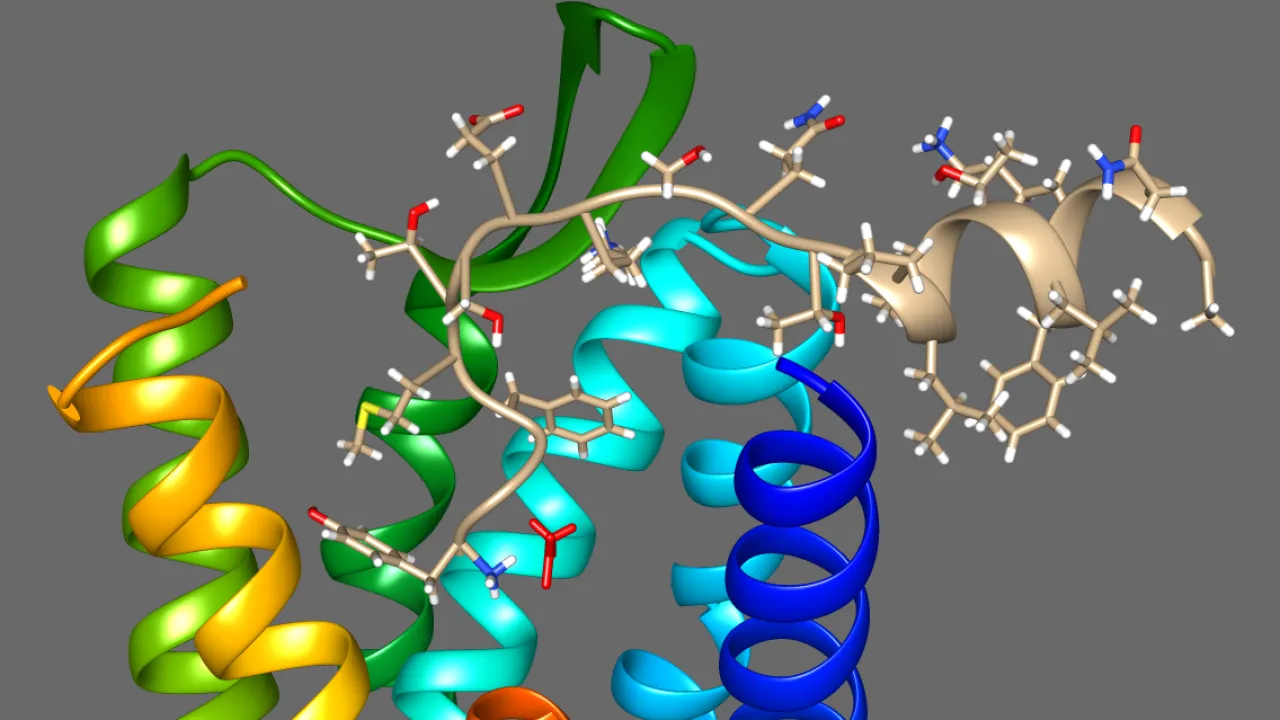
1. Which everyday activities help your brain release extra feel-good endorphins?
2. How do endorphins help right after a minor playground bump?
🤯 Mind-Blowing Fact • Grade 2
Even biting into a spicy chili pepper tricks heat sensors on your tongue into asking your brain for a cool wave of endorphins!
✨ Word Sparks (Grade 2 Glossary)
Tap 🔊 to hear
Nerve
Thin fiber carrying fast signals to brain
Spinal Cord
Main nerve cable protected inside your backbone
Workout
Active exercise building strength and heart health
🪝
Why do runners and soccer players often feel extra cheerful right after a tough workout?
1
Nature's Comfort Chemicals
Zoom inside your brain and pituitary gland to meet short protein chains called endorphins! Whenever your muscles work hard or you stub a toe, your nervous system releases these helpful messengers.
2
Muffling Soreness Signals
carry messages from your skin and muscles up your to your brain. Endorphins plug into special nerve docks along the way, turning down discomfort like dimming a bright lamp.
3
Sparking Joy Together
You don't even have to bump yourself to enjoy endorphins! Singing in a group, riding bikes, eating spicy peppers, and giggling with family all spark a warm, happy lift.
1. Why can eating spicy salsa trigger a tiny rush of endorphins?
2. How do endorphins travel and work along your nervous system?
🤯 Mind-Blowing Fact • Grade 3
Singing or drumming in rhythm with a group boosts endorphin levels noticeably higher than humming the exact same song all by yourself!
✨ Word Sparks (Grade 3 Glossary)
Tap 🔊 to hear
Endogenous
Produced naturally right inside your own body
Neuropeptide
Short amino-acid chain carrying nerve messages
Dopamine
Brain chemical linked to motivation and reward
🪝
Where did the word 'endorphin' come from, and why didn't scientists even know it existed until the 1970s?
1
Solving a Lock-Without-a-Key Mystery
In 1973, neuroscientists discovered tiny molecular locks—receptors—on brain cells that responded to soothing plant medicines. That raised a thrilling puzzle: why would human brains evolve locks for a poppy plant? Surely our bodies must manufacture their own natural keys!
2
Meet Your Homemade Keys
Sure enough, in 1975 researchers discovered those homemade keys—short chains of amino acids called ! Scientists blended '' (meaning made inside the body) with 'morphine' to coin the catchy name endorphin.
3
Gatekeepers in the Spinal Cord
Suppose an athlete twists an ankle slightly near the finish line yet barely notices until after the race. Endorphins released in the brainstem and spinal cord block relay chemicals like Substance P, keeping minor discomfort from crowding out focus.
4
Teamwork With Dopamine and Endocannabinoids
Inside the brain's reward centers, endorphins also team up with cheerful messengers like —explaining why swimming, choir singing, and kindness leave you glowing!
1. What clue in 1973 convinced scientists that the human brain must make its own endorphins?
2. What does the 'endo-' part of the word endorphin mean?
🤯 Mind-Blowing Fact • Grade 4
Deep belly laughter works abdominal muscles hard enough to trigger a measurable endorphin release that raises comfort thresholds within minutes!
✨ Word Sparks (Grade 4 Glossary)
Tap 🔊 to hear
Beta-Endorphin
Primary thirty-one-amino-acid soothing peptide in humans
Synapse
Microscopic signaling gap between two nerve cells
Substance P
Nerve chemical carrying discomfort signals to brain
🪝
How does a 31-amino-acid chain stop an 'ouch' message right at a microscopic gap between two nerve cells?
1
Snipped From a Master Protein
Inside your hypothalamus and anterior pituitary gland, cells first build a large parent protein called pro-opiomelanocortin, or POMC. Enzymes act like molecular scissors, snipping POMC into smaller active messengers—including , a thirty-one-amino-acid champion that works both as a fast brain neurotransmitter and a circulating bloodstream hormone.
2
Quieting the Synaptic Gap
When you scrape an elbow, sensory nerves release a neurotransmitter called across tiny gaps——in your spinal cord to alert your brain. Released endorphins bind mu-opioid receptors right on those nerve endings, slowing calcium entry so far less Substance P crosses the gap—turning a sharp shout into a calm whisper!
3
Reinterpreting the 'Runner's High'
For decades, textbooks credited blood alone for the cheerful 'runner's high' after sustained aerobic exercise. Modern brain imaging reveals a cool plot twist: large pituitary beta-endorphins in blood cannot easily cross the blood-brain barrier, so central brain endorphins share credit with lipid-soluble endocannabinoids that slip freely into mood circuits!
4
Social Bonding and Stress Resilience
Evolutionary biologists note that shared belly laughter, synchronized dancing, group singing, and warm family hugs all release central endorphins that quiet stress cortisol, brighten mood circuits, and weave strong cooperative friendships across human communities.
1. How do endorphins quiet discomfort at synapses inside the spinal cord?
2. Why do scientists now know blood-borne pituitary endorphins share credit with endocannabinoids for the 'runner's high'?
🤯 Mind-Blowing Fact • Grade 5
Brain-imaging studies prove that genuine optimism and reassurance—the placebo effect—trigger real, measurable waves of homemade beta-endorphins inside your prefrontal cortex and brainstem!
✨ Word Sparks (Grade 5 Glossary)
Tap 🔊 to hear
Analgesia
Natural relief from soreness while staying awake
Enkephalin
Five-amino-acid cousin of endorphin in spine
Disinhibition
Releasing a brake so another signal flows
🪝
How did neuroscientists Candace Pert, Solomon Snyder, John Hughes, and Hans Kosterlitz unlock the brain's endogenous comfort network?
1
Three Families of Endogenous Opioid Peptides
Neurobiologists group the human body's homemade comfort molecules into three related peptide families cleaved from distinct precursor proteins: endorphins (especially 31-residue beta-endorphin cleaved from pro-opiomelanocortin in the arcuate hypothalamus and pituitary), (five-residue pentapeptides widely distributed across the spinal cord), and dynorphins. All three share an identical four-amino-acid 'opioid motif'—Tyr-Gly-Gly-Phe—at their tip that slips neatly into G-protein-coupled opioid receptors.
2
Presynaptic and Postsynaptic Analgesia
When nociceptors detect tissue strain, signals ascend toward the brain's periaqueductal gray and rostral ventromedial medulla, activating descending analgesic pathways. Released beta-endorphin and bind mu-opioid receptors at spinal dorsal-horn synapses: presynaptically they close voltage-gated calcium channels to halt glutamate and Substance P exocytosis, while postsynaptically they open potassium channels to hyperpolarize relay neurons—creating natural without dulling alertness.
3
Disinhibition in Mesolimbic Reward Circuits
How do central endorphins spark serenity and joy? Inside the midbrain's ventral tegmental area, GABAergic interneurons normally keep a gentle brake on dopamine neurons. When beta-endorphin quiets those inhibitory GABA cells—a neat trick called —dopamine flows smoothly into the nucleus accumbens, pairing physical effort, music, or laughter with warm contentment and reduced hypothalamic-pituitary-adrenal stress output.
4
Placebo Expectation and Social Synchrony
Remarkably, positive expectation itself engages this chemistry! Functional PET scans demonstrate that encouraging reassurance—known clinically as the placebo effect—prompts the prefrontal cortex to recruit genuine beta-endorphin release across descending brain circuits. Similarly, Oxford evolutionary psychologist Robin Dunbar showed that synchronized rowing, singing, and shared laughter elevate endorphin tone to cement cooperative human bonds.
5
A Landmark 1970s Neurochemistry Race
In 1973, graduate student Candace Pert and Solomon Snyder at Johns Hopkins—alongside Lars Terenius and Eric Simon—mapped stereospecific opioid receptors in mammalian brain tissue. Two years later in Aberdeen, Scotland, John Hughes and Hans Kosterlitz isolated the first endogenous pentapeptide keys (), while Choh Hao Li characterized potent pituitary beta-endorphin from camel and human pituitaries—forever transforming neuroscience.