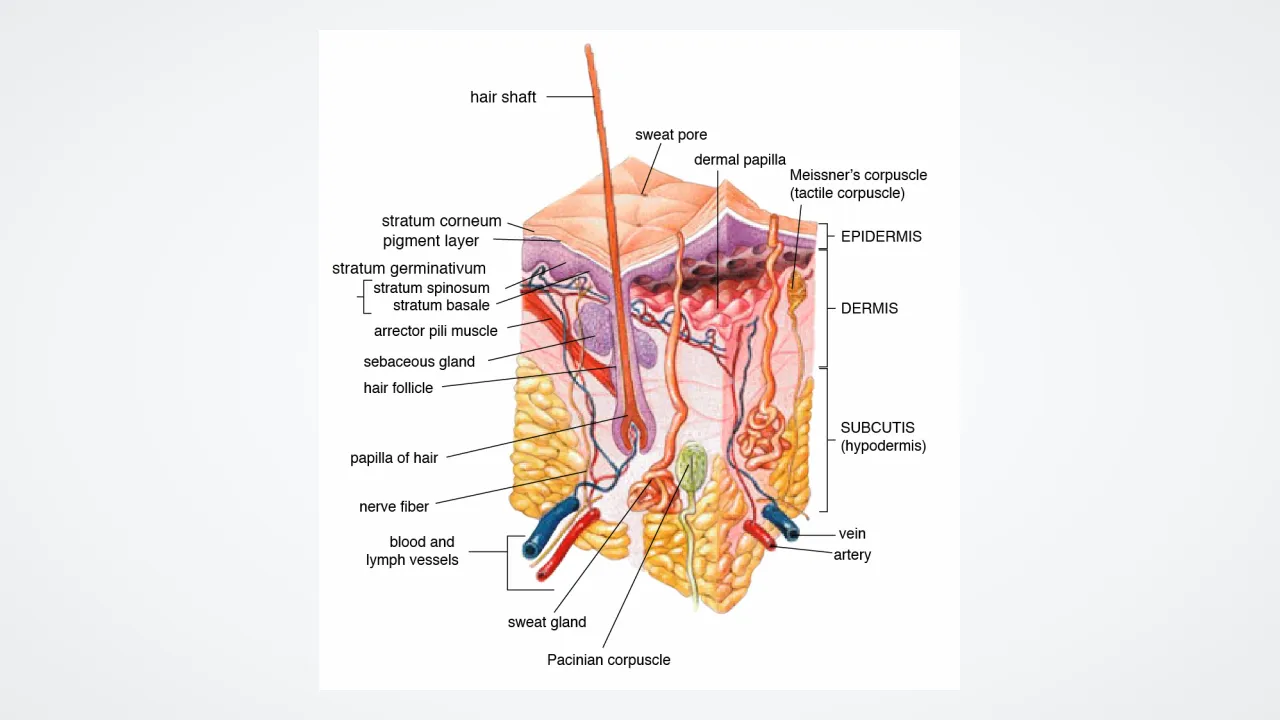
Every square inch of human dermis packs yards of tiny blood vessels and thousands of nerve endings!
✨ Word Sparks (Grade 2 Glossary)
Tap 🔊 to hear
collagen
tough rope-like protein giving skin strong support
elastin
springy protein helping skin snap back smoothly
pressure
a steady push or squeeze against something
🪝
How can your skin tell a fuzzy peach apart from a cold ice cube with your eyes shut?
1
The Busy Middle Layer
Bend your elbow, wiggle your toes, and smile wide! Your skin stretches smoothly without ripping because of its thick middle layer, the dermis. It sits right beneath the thin epidermis like a springy mattress.
2
Tough Ropes and Stretchy Springs
Two special proteins weave through your dermis. acts like tough rope so skin does not tear, while works like rubber bands so skin snaps back into place.
3
A Neighborhood of Helpers
Tiny blood vessels bring food and warmth through the dermis. Packed beside them sit sweat glands, oil glands, hair roots, and touch sensors that feel tickles, warmth, and !
1. What do collagen and elastin do inside your dermis?
2. How does your skin feel the difference between a warm mug and a fuzzy blanket?
🤯 Mind-Blowing Fact • Grade 3
As people grow into grandparents, cells in the dermis slowly make less collagen and elastin, which is why older skin forms gentle wrinkles!
✨ Word Sparks (Grade 3 Glossary)
Tap 🔊 to hear
papillary
upper dermis zone with tiny ridge bumps
reticular
deep net-like dermis layer of strong fibers
capillaries
microscopic blood vessels carrying oxygen and warmth
🪝
Why does your face flush rosy pink when you sprint across the playground?
1
Skin's Command Center
Sprint across a sunny field and feel warmth glow across your cheeks! While your thin outer epidermis acts as a shield, the thick dermis underneath runs almost all of your skin's busy machinery, reaching up to four millimeters thick on your back.
2
Two Interlocking Sub-Layers
Scientists divide the dermis into two zones. The upper layer forms tiny wave-like ridges that lock tightly into the epidermis above—creating your unique fingerprints! Beneath it, the thicker layer weaves dense collagen and elastin cables in every direction.
3
Built-In Radiator Tubes
Rich networks of blood wind through the dermis to feed upper skin cells and control body temperature. When you exercise, dermal blood vessels widen to let extra heat escape, turning fair skin rosy; in icy wind, they narrow to save warmth for vital organs.
4
Specialized Touch Capsules
Different dermal nerve capsules split up sensory jobs: high ones detect light flutters like a ladybug walking on your arm, while deeper ones feel firm squeezes and vibrations.
1. Why do blood vessels in your dermis widen when you get hot from running?
2. What famous feature on your fingertips starts in the wavy ridges of the upper papillary dermis?
🤯 Mind-Blowing Fact • Grade 4
Fingertips pack up to 150 Meissner's touch corpuscles per square centimeter of dermis, enabling blindfolded readers to feel Braille dots raised less than half a millimeter!
✨ Word Sparks (Grade 4 Glossary)
Tap 🔊 to hear
fibroblast
dermal builder cell weaving collagen and elastin
mechanoreceptor
sensory nerve ending detecting touch, stretch, or vibration
Meissner's corpuscle
upper dermal sensor detecting light touch and texture
🪝
How do microscopic builder cells and specialized nerve bulbs turn your dermis into a smart, self-healing fabric?
1
Fibroblasts Weaving Living Fabric
Pull gently on the skin over your elbow, then straighten your arm—watch it glide and tighten like custom-tailored athletic gear! That remarkable toughness comes from dermal builder cells called . Scattered throughout the dermis, fibroblasts spin triple-helix cables of collagen for tear resistance, springy elastin networks for recoil, and water-holding gel molecules called glycosaminoglycans that cushion bumps.
2
Papillary Pegs and Reticular Mesh
At the top of the dermis, the thin papillary layer projects finger-like dermal papillae upward into the epidermis, multiplying surface area so oxygen can diffuse efficiently and locking the two layers against sliding apart. Below lies the thick reticular dermis—roughly eighty percent of the layer—where thick collagen bundles interlace alongside sebaceous oil glands, coiled sweat glands, and anchored hair follicles.
3
A Toolkit of Mechanoreceptors
Your dermis houses an astonishing array of specialized touch sensors called . Oval perched high in fingertip papillae sense gentle texture and slip so a glass does not slide from your grip, while onion-layered Pacinian corpuscles deep in the dermis detect firm pressure and rapid vibrations like bass music humming through a floor.
4
Thermoregulation and Repair
Whenever a scrape reaches the vascular dermis, clotting platelets seal damaged capillaries and rush in to weave fresh collagen scar tissue, restoring your body's protective envelope.
1. Which cells inside the dermis manufacture collagen ropes and elastin springs?
2. How do Meissner's corpuscles and Pacinian corpuscles divide touch jobs in the dermis?
🤯 Mind-Blowing Fact • Grade 5
Type I collagen fibers woven inside your dermis are gram-for-gram stronger against pulling forces than steel wire, yet flexible enough to bend millions of times!
✨ Word Sparks (Grade 5 Glossary)
Tap 🔊 to hear
vasodilation
widening of blood vessels to release body heat
extracellular matrix
supportive web of proteins and gel surrounding cells
Pacinian corpuscle
onion-layered deep dermal sensor detecting rapid vibrations
🪝
How does a two-millimeter matrix of triple-helix proteins, capillary shunts, and encapsulated nerves outperform synthetic smart textiles?
1
Connective Tissue Powerhouse
Engineers designing robotic hands struggle to match what two millimeters of human dermis accomplishes effortlessly: resisting tens of pounds of pulling force, recoiling thousands of times a day without sagging, regulating core temperature, and resolving textures finer than a human hair. Accounting for roughly ninety percent of cutaneous thickness—from one millimeter on eyelids to four millimeters across the upper back—the dermis is a dense irregular connective tissue anchored between the avascular epidermis and fatty hypodermis.
2
Extracellular Matrix Architecture
Resident fibroblasts synthesize a sophisticated dominated by Type I and Type III collagen fibrils—whose braided triple helices rival steel wire in tensile strength by weight—interwoven with cross-linked elastin fibers and hydrophilic hyaluronic acid proteoglycans. Above, the loose areolar papillary dermis interlocks via dermal papillae with epidermal rete ridges; below, the dense reticular dermis arranges collagen along natural tension paths called Langer's lines, which surgeons follow to minimize scarring.
3
Precision Somatosensory Array
Four classic mechanoreceptors plus free nerve endings turn the dermis into a high-resolution sensory map. In the 1830s and 1850s, anatomists Filippo Pacini and Georg Meissner first described the encapsulated nerve bulbs named after them: rapidly adapting tuned to vibrations around 250 hertz and Meissner's corpuscles tuned to low-frequency flutter, complemented by Ruffini endings tracking skin stretch.
4
Vascular Plexuses and Thermal Shunts
Two horizontal vascular networks—the subpapillary and cutaneous plexuses—supply nutrients to hair follicles, eccrine sweat glands, and basal epidermal cells while operating arteriovenous shunts. Under hypothalamic command, diverts up to several liters of blood per minute toward dermal capillaries during intense heat, whereas vasoconstriction conserves core warmth in freezing weather.
5
Dynamic Wound Remodeling
When injury breaches the basement membrane, dermal macrophages clear debris while myofibroblasts pull wound edges together and deposit fresh collagen bundles, proving the dermis is a living, self-repairing textile.