1. Why did NASA crash the DART spacecraft into an asteroid on purpose?
2. Was the asteroid that DART bumped ever any danger to Earth?
🤯 Mind-Blowing Fact • Grade 2
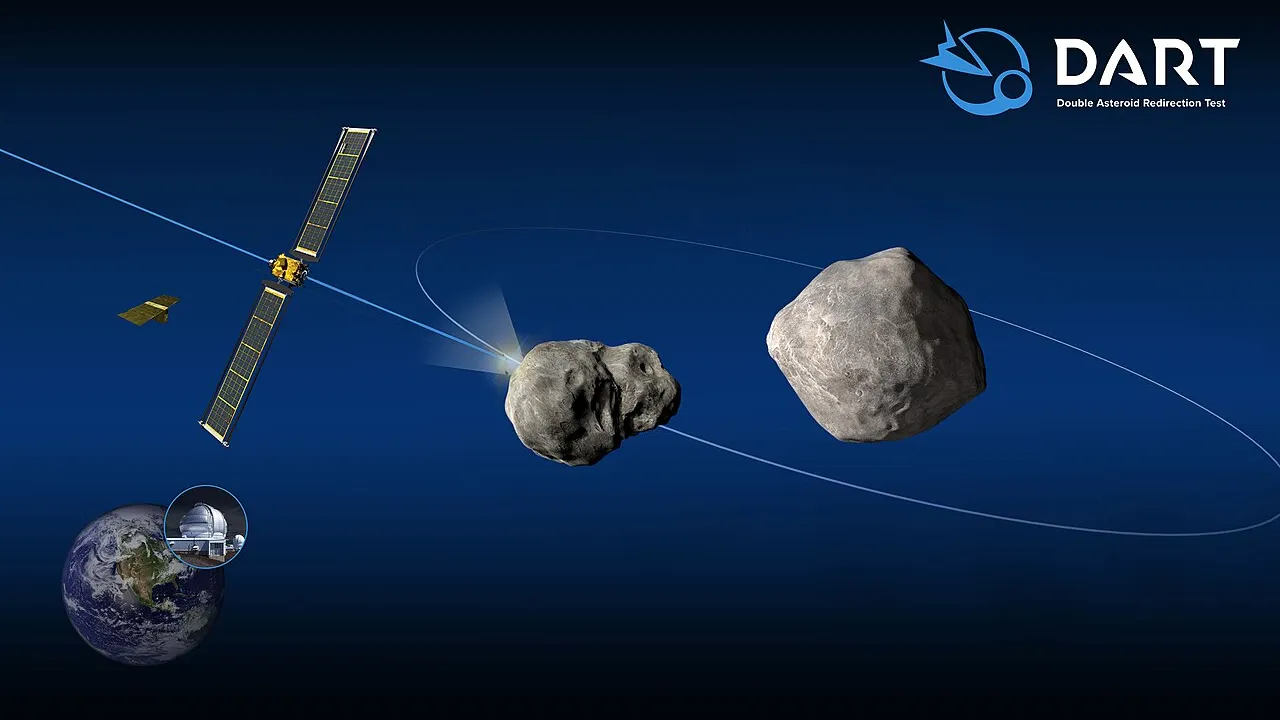
Fifteen days before the crash, DART released a toaster-sized Italian camera buddy named LICIACube to trail behind and photograph the giant dust plume!
✨ Word Sparks (Grade 2 Glossary)
Tap 🔊 to hear
moonlet
Tiny moon orbiting around a larger asteroid
autopilot
Computer system steering a craft by itself
plume
Tall cloud of dust and rock sprayed outward
🪝
How do you steer into a rock the size of a pyramid from seven million miles away?
1
Aiming at a Tiny Moonlet
Picture two space rocks dancing together: a half-mile asteroid named Didymos and its 525-foot little moon, Dimorphos. On September 26, 2022, NASA's Double Asteroid Redirection Test raced toward Dimorphos at 14,000 miles per hour!
2
Steering All by Itself
Until the final hour, Dimorphos was just a tiny speck in DART's single camera. Smart software locked onto that speck, snapping crisp boulder photos every second right until the screen went blank—bull's-eye!
3
Thirty-Three Minutes Faster
Before the bump, Dimorphos circled its partner in 11 hours and 55 minutes. Afterward, it circled 33 minutes faster—humanity's first planetary defense win!
1. Who snapped up-close photos of the dust cloud right after DART crashed?
2. By how much did DART shorten Dimorphos's orbit around its larger partner?
🤯 Mind-Blowing Fact • Grade 3
If a dangerous asteroid is spotted years early, nudging its speed by less than an inch per second is enough to make it miss Earth completely!
✨ Word Sparks (Grade 3 Glossary)
Tap 🔊 to hear
kinetic
Energy an object carries because of its motion
recoil
Backward push felt when material shoots forward
eclipse
When one space object passes across another's light
🪝
Why did flying boulders kicked backward give the asteroid an extra fourfold push?
1
Why Pick a Double Asteroid?
Measuring a tiny nudge on a lone asteroid circling the vast Sun would take years. Instead, astronomers chose Didymos and its moonlet Dimorphos! Because Dimorphos passes in front of and behind Didymos like clockwork, Earth telescopes could measure blink-like brightness dips to clock its new orbit with stopwatch accuracy.
2
Unrolling Solar Wings
To reach its target after launching atop a SpaceX Falcon 9 in 2021, DART unrolled two flexible twenty-eight-foot Roll-Out Solar Arrays like window shades and tested a next-generation xenon ion thruster.
3
Bonus Push From Recoil
Why did a 1,260-pound craft move a five-billion-pound rock so much? Over two million pounds of boulders blasted backward out of the impact spot acted like giant rocket exhaust, quadrupling the push!
4
Growing a Comet-Like Tail
Hubble and Webb telescopes even watched sunlight push that dust cloud into a sparkling 6,000-mile tail!
1. Why did scientists test DART on a moonlet orbiting a bigger asteroid instead of a lone asteroid?
2. What gave Dimorphos nearly four times more push than DART's weight alone?
🤯 Mind-Blowing Fact • Grade 4
DART hit loosely packed Dimorphos hard enough that instead of just carving a small crater, the impact likely squeezed and reshaped the entire 525-foot moonlet!
✨ Word Sparks (Grade 4 Glossary)
Tap 🔊 to hear
momentum
Mass multiplied by velocity in a given direction
kinetic impactor
High-speed spacecraft crashing without explosives to deflect asteroids
binary
Two cosmic bodies bound together by mutual gravity
🪝
Why don't planetary defenders want to blow an incoming asteroid into smithereens like in action movies?
1
Nudging Beats Shattering
Hollywood movies love blowing incoming space rocks to pieces at the last minute, yet real physicists know shattering an asteroid shortly before impact merely turns one cannonball into a shotgun blast of falling boulders! Planetary defense relies on early telescope detection plus gentle deflection years in advance: slowing or speeding an asteroid by just millimeters per second accumulates over millions of miles until it misses Earth entirely. DART proved the simplest method—the .
2
Missile-Defense Algorithms Repurposed for Peace
Closing on Dimorphos at 6.1 kilometers per second (14,000 mph) meant light took thirty-eight seconds to reach Earth—far too slow for human pilots. Engineers at the Johns Hopkins Applied Physics Laboratory adapted missile-guidance algorithms into SMART Nav. Using images from its sole instrument, the DRACO telescopic camera, DART distinguished tiny Dimorphos from blinding Didymos in the final hour and struck within fifty-five feet of dead center!
3
Momentum Enhancement Factor Beta
Physicists quantify kinetic deflection using a multiplier called beta. If DART had merely stuck into soft clay without splashing debris, beta would equal 1. Instead, ejecting at least a thousand metric tons of rubble from loosely bound Dimorphos produced a beta near 3.6, reshaping the egg-like rubble pile itself!
4
Europe's Hera Inspector Arrives Next
Launched in October 2024, ESA's Hera spacecraft is cruising to Dimorphos to weigh the moonlet and inspect DART's handiwork up close.
1. Why is gently changing an asteroid's speed years early safer than shattering it close to Earth?
2. What did physicists learn from measuring a momentum enhancement factor (beta) around 3.6?
🤯 Mind-Blowing Fact • Grade 5
DART's very last image before impact arrived on Earth missing its bottom half because the spacecraft literally smashed into boulders mid-transmission at four miles per second!
✨ Word Sparks (Grade 5 Glossary)
Tap 🔊 to hear
heliocentric
Centered upon and orbiting around the Sun
tidally locked
Always keeping the same face turned toward its partner
monolith
A single solid, unbroken block of stone
🪝
How did humanity conduct its first real-world planetary defense experiment without risking a single millimeter of danger to Earth?
1
Selecting a Fail-Safe Celestial Proving Ground
Designing humanity's first asteroid deflection trial required ironclad safety: even the wildest impact outcome could never nudge the target toward Earth. Astronomers selected near-Earth S-type stony binary 65803 Didymos (780 meters wide) and its satellite Dimorphos (160 meters wide), orbiting 1.2 kilometers apart. Because DART struck Dimorphos head-on against its orbital motion around Didymos—not Didymos's path—the moonlet simply dropped into a tighter, faster inner orbit around its parent while the binary's safe solar orbit remained secure.
2
Minimalist Hardware, Maximum Autonomy
Built by Johns Hopkins APL for NASA's Planetary Defense Coordination Office, the 570-kilogram impactor eschewed complex science payloads for lean, high-reliability tech demos: flexible Roll-Out Solar Arrays, a radial-line slot antenna, the NEXT-C gridded xenon ion thruster, and the twenty-centimeter DRACO aperture camera feeding SMART Nav optical guidance.
3
Final Seconds Revealed a Rubble Pile
During the nail-biting final four minutes on September 26, 2022, DRACO streamed a live frame every second from 11 million kilometers away, unveiling Dimorphos not as a , but a boulder-strewn oblate rubble pile before cutting off mid-frame upon 6.1-kilometer-per-second impact between two boulders named Atabaque and Bodhran!
4
Astrophysics of a 33-Minute Orbital Shift
Coordinated observations from LICIACube, Hubble, JWST, ALMA, and radar telescopes across four continents confirmed Dimorphos's 11-hour-55-minute period dropped by 33 minutes (±1 minute), corresponding to a 2.7-millimeter-per-second velocity change and over a million kilograms of ejected regolith.
5
Completing the Equation With ESA's Hera
When the European Space Agency's Hera orbiter and its twin CubeSats arrive at Dimorphos in late 2026 to measure the moonlet's exact mass and internal structure, humanity will hold a fully calibrated blueprint to defend life on Earth.