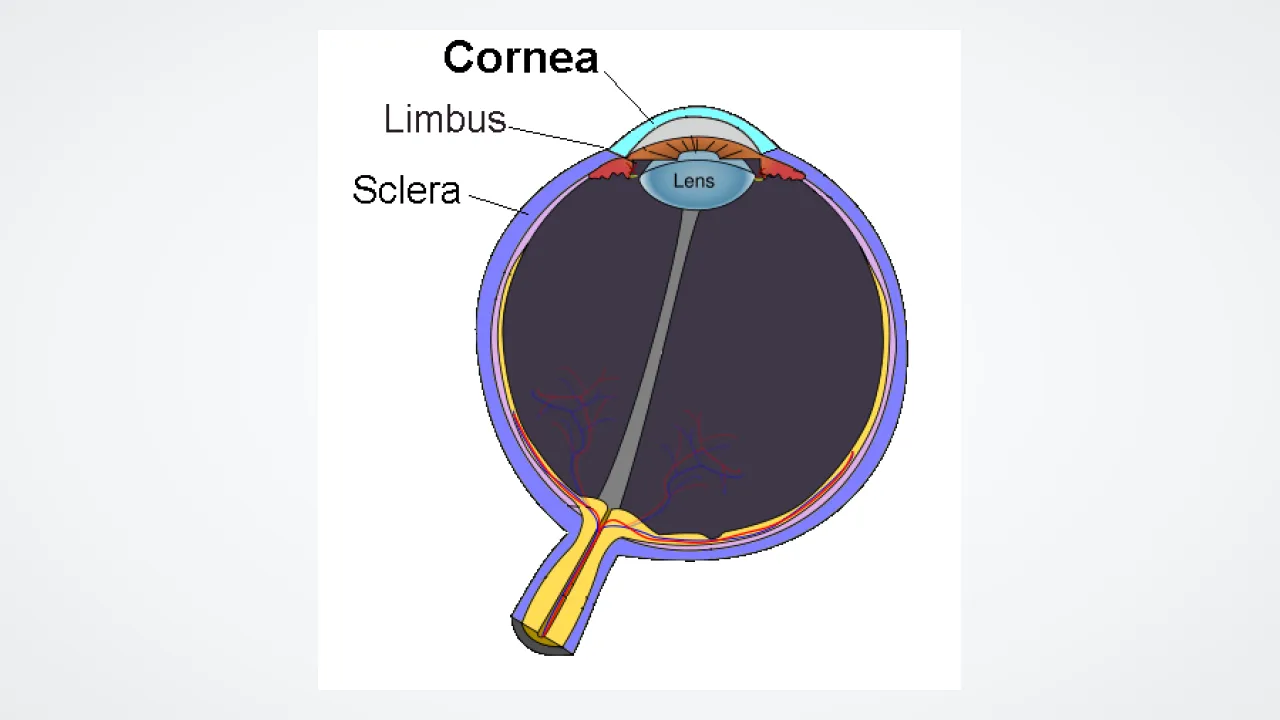
1. What does the cornea look like on the front of your eye?
2. How does your cornea get oxygen without having red blood vessels?
🤯 Mind-Blowing Fact • Grade 2
Minor surface scratches on a healthy cornea heal faster than almost anywhere else on your body—often in just twenty-four to forty-eight hours!
✨ Word Sparks (Grade 2 Glossary)
Tap 🔊 to hear
transparent
Crystal clear so all light passes through
focus
To gather light rays into sharp pictures
surface
The very outside layer of something
🪝
Why doesn't your eye's front window have any red blood vessels crisscrossing your view?
1
Like a Watch Crystal
Look sideways at a friend's eye while they gaze across the room, and you can spot a clear bubble curving out in front of their colored iris! That tough, see-through dome is the cornea, about the width of a dime.
2
Bending Light Into Focus
Sunlight bouncing off a soccer ball scatters in many directions. Because your cornea curves smoothly, it bends incoming light rays neatly inward so pictures land sharply inside your eye.
3
Super-Fast Dust Detector
Packed with tiny touch sensors, your cornea notices even one tiny eyelash! Instantly, it tells your eyelids to blink and wash the speck away with tears.
1. What happens the instant a tiny speck of dust touches your cornea?
2. Why is the curved shape of the cornea so helpful for vision?
🤯 Mind-Blowing Fact • Grade 3
Ounce for ounce, your cornea packs three hundred to six hundred times more touch-sensing nerve endings than your skin—making it the most sensitive spot on your body!
✨ Word Sparks (Grade 3 Glossary)
Tap 🔊 to hear
refraction
Bending of light passing into clear material
collagen
Strong protein fibers giving tissues firm shape
astigmatism
Uneven corneal curve fixed easily by glasses
🪝
Did you know your eye's front window bends MORE light than your eye's actual lens?
1
The Heavy Lifter of Focusing
Ask people what focuses light inside the eye, and almost everyone guesses 'the lens!' Surprise: while the inner lens fine-tunes close-up versus faraway views, your front cornea actually performs about two-thirds of your eye's total light-bending power!
2
Refraction at the Front Door
When light rays traveling through thin air enter the denser, curved dome of your tear-coated cornea, they slow down slightly and bend inward—a physics trick called . If a cornea curves slightly more like a football than a round basketball, doctors call that and fix it easily with glasses!
3
Five Microscopic Layers
Though thinner than a dime—just half a millimeter at its center—the cornea stacks five neat tissue layers! Tough fibers line up in precise grids so light passes straight through without scattering into a cloudy blur.
4
Fed by Tears and Fluid
Because red blood vessels would block your view, tears feed oxygen from the front while clear watery fluid feeds nutrients from behind!
1. Roughly how much of your eye's total light-focusing power comes from the cornea?
2. Why are collagen fibers inside the cornea arranged in neat, even grids?
🤯 Mind-Blowing Fact • Grade 4
Fish don't get focusing help from their corneas underwater—so instead of relying on curved corneas like humans, fish evolved super-round, marble-shaped inner lenses!
✨ Word Sparks (Grade 4 Glossary)
Tap 🔊 to hear
sclera
Tough white outer coat of the eyeball
stroma
Thick middle corneal layer of neat collagen
endothelial
Single inner cell sheet pumping excess fluid
🪝
Why are the white part of your eye and your crystal-clear cornea made of the exact same tough fibers?
1
Same Ingredients, Opposite Appearance
Look in a mirror at the tough white wall of your eyeball—the —and then at the transparent cornea curving smoothly out of its center. Believe it or not, both tissues are woven from the exact same protein: collagen! In the white sclera, collagen bundles criss-cross in messy, thick tangles that bounce every color of light back like white snow. At the border of the cornea, however, collagen fibrils suddenly shrink to uniform nanometer widths and line up in geometric lattices so precise that light waves glide straight through unobstructed!
2
Why Swimming Underwater Blurs Vision
Your cornea achieves about forty-three diopters of focusing power because light slows abruptly when moving from thin air into watery corneal tissue. Open your eyes underwater without swim goggles, however, and water touches water—canceling out most of your cornea's refraction and turning the pool floor blurry until flat goggles restore an air pocket in front!
3
Tireless Microscopic Water Pumps
Lining the very back of the cornea is a single sheet of hexagonal cells running nonstop ion pumps. If too much eye fluid leaked into the middle layer, collagen spacing would swell and cloud up—so those pumps keep corneal water balanced at exactly seventy-eight percent.
4
Trigeminal Blink Reflex
Wired to the trigeminal cranial nerve, corneal sensors trigger protective blinks in a tenth of a second while spreading a three-layer tear film smooth as optical glass.
1. Why does opening your eyes underwater without goggles make everything look super blurry?
2. What makes the cornea crystal clear while the neighboring sclera looks opaque white, even though both are made of collagen?
🤯 Mind-Blowing Fact • Grade 5
Sensory nerves entering your cornea shed their white myelin coats right at the outer edge so the nerve fibers crossing your view remain completely transparent!
✨ Word Sparks (Grade 5 Glossary)
Tap 🔊 to hear
avascular
Naturally containing zero blood vessels inside tissue
diopter
Unit measuring how strongly a lens bends light
limbus
Border ring where clear cornea meets sclera
🪝
How do destructive wave interference, avascular immune privilege, and five distinct tissue layers engineer a living lens clearer than laboratory glass?
1
Optical Physics of Living Transparency
Measuring roughly 11.5 millimeters horizontally and just 540 micrometers thick at its apex, the human cornea supplies approximately forty-three of the eye's sixty total of refractive power—principally because light slows from an index of refraction of 1.000 in air to 1.376 across the tear-cornea interface. In 1957, physicist David Maurice explained how solid collagen tissue achieves crystal clarity: within the corneal stroma, two hundred stacked lamellae hold collagen fibrils spaced closer than half a wavelength of visible light, causing side-scattered waves to cancel out by destructive interference while forward rays pass undiminished.
2
Five Specialized Architectural Layers
From front to back, five cooperative layers guard vision. The outer stratified squamous epithelium renews itself completely every seven days from stem cells ringing the corneal and blocks microbes. Beneath it lie tough acellular Bowman's layer and the structural stroma comprising ninety percent of corneal thickness. Deeper still, elastic Descemet's membrane anchors the innermost corneal endothelium—whose hexagonal cells never divide in adulthood yet pump ions nonstop to prevent stromal edema.
3
Avascularity and Immune Privilege
Deprived of blood vessels so hemoglobin never tints or scatters light, the cornea absorbs dissolved atmospheric oxygen through the precorneal tear film while drawing glucose from the anterior chamber's aqueous humor. This isolation also grants 'immune privilege': in 1905, Austrian ophthalmologist Eduard Zirm performed history's first successful human corneal transplant (keratoplasty), and today corneal grafts succeed at extraordinary rates without needing tissue-type matching!
4
Unmyelinated Nerve Fibers!
Even corneal nerves obey strict optical rules: trigeminal nerve branches shed their white myelin sheaths the exact millimeter they cross into the cornea so their naked axons stay completely invisible across your line of sight.
5
UV Filtering and Modern Laser Precision
Rich in antioxidant proteins called crystallins and vitamin C, the cornea absorbs harmful UVB rays to shield the inner retina, while modern femtosecond and excimer lasers can reshape stromal curvature by micrometers to restore crisp 20/20 focus.