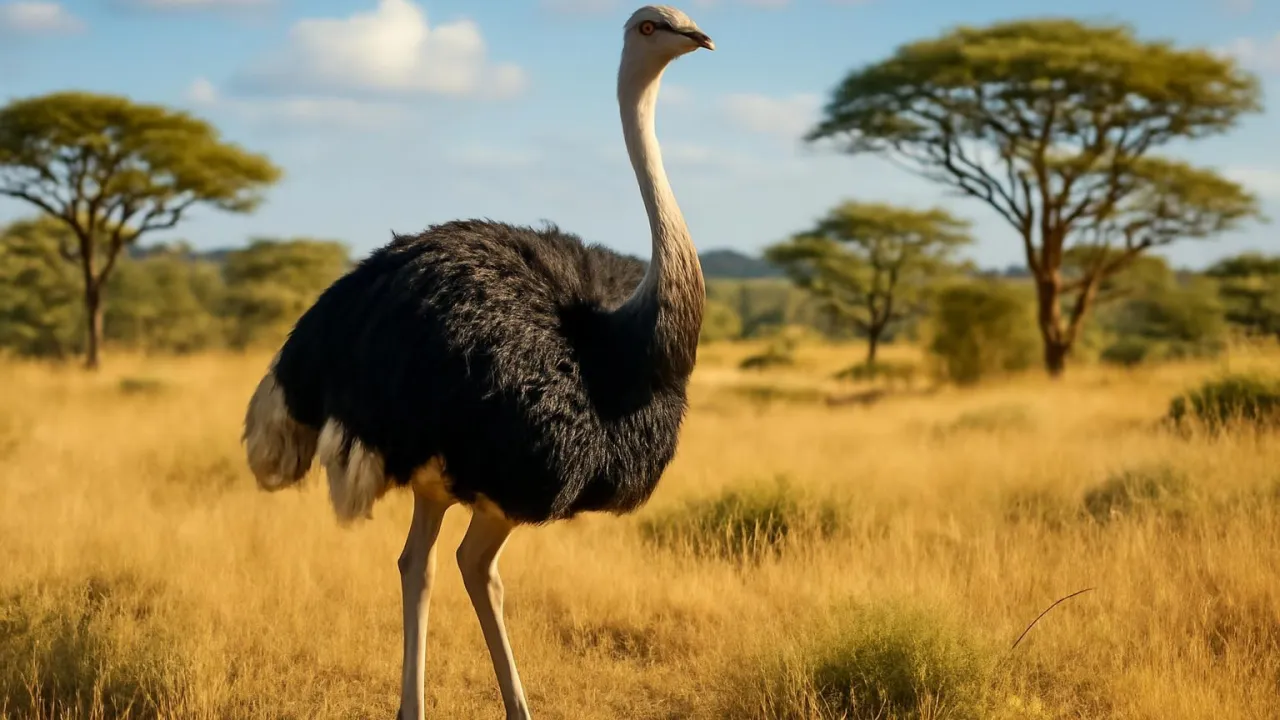
Ostriches have the largest eyes of any land animal, helping them spot danger far away!
✨ Word Sparks (Grade 2 Glossary)
Tap 🔊 to hear
savanna
A hot, grassy place with few trees
sprint
To run very fast for a short time
beak
The hard mouth part of a bird
🪝
Have you ever seen a bird that runs faster than a car?
1
Huge Bird with Long Legs
The common ostrich is the largest bird in the world and has very long legs. It stands tall and can reach up to nine feet in height. Its big eyes help it see far across the dry lands where it lives.
2
Fastest Runner on Land
Ostriches can run very fast to escape from danger. They can up to forty-five miles per hour. Their strong legs help them run for a long time without getting tired.
3
What Ostriches Eat and Where They Live
These birds live in African and deserts where it is hot and dry. They eat plants, seeds, insects, and small animals. Ostriches use their to peck food from the ground.
Ostriches have only two toes on each foot, unlike most birds that have three or four!
✨ Word Sparks (Grade 3 Glossary)
Tap 🔊 to hear
adaptation
A body change that helps survival
camouflage
Colors that help hide from danger
predator
An animal that hunts others
🪝
Did you know the ostrich is the fastest bird on land and the biggest bird alive?
1
Largest Bird on Earth
The common ostrich is the largest bird species, standing up to nine feet tall. Its long, powerful legs support its huge body weight and help it run swiftly. Ostriches cannot fly but are well adapted for running on land. Their strong legs have two toes, which help them balance while sprinting.
2
Amazing Speed and Adaptations
Ostriches can run at speeds up to 45 miles per hour, making them the fastest land birds. Their legs have tough muscles and tendons that store energy for quick strides. This helps them escape in their open habitats. Ostriches also use their wings for balance and to change direction while running.
3
Habitat and Diet
They live mostly in African savannas and deserts where water is scarce. Ostriches eat a varied diet including plants, seeds, insects, and small animals. They swallow small stones to help grind food in their stomachs since they do not have teeth. This helps them digest tough plant material.
4
Survival and Camouflage
Ostriches have feather colors that blend with dry grass and sand, providing from . When threatened, they either run fast or lie low to hide. Their excellent eyesight helps spot danger early. These survival traits help ostriches thrive in harsh environments.
1. Why do ostriches have strong legs with two toes?
2. What helps ostriches digest tough plants?
🤯 Mind-Blowing Fact • Grade 4
Ostriches can survive without water for several days by getting moisture from their food!
✨ Word Sparks (Grade 4 Glossary)
Tap 🔊 to hear
ecosystem
All living and nonliving things in a place
seed dispersal
Spreading seeds to help new plants grow
conservation
Protecting animals and their homes
🪝
How does the common ostrich’s speed and size help it survive in harsh African environments?
1
Physical Adaptations for Survival
The common ostrich’s large size and powerful legs allow it to run up to forty-five miles per hour, helping it escape predators effectively. Its two-toed feet provide better traction and balance on sandy and rocky terrain. Ostriches have long necks and large eyes that increase their field of vision, enabling early detection of threats. Their feathers help regulate body temperature by providing shade and insulation.
2
Role in the Ecosystem
Ostriches play an important role in African as both prey and seed dispersers. By eating various plants and insects, they help control insect populations and spread seeds through their droppings. This supports plant growth and maintains the balance of the savanna habitat. They also provide food for predators like lions and hyenas.
3
Habitat and Geographic Distribution
Common ostriches are native to the savannas and deserts of sub-Saharan Africa, where temperatures can be very high and water is limited. They are well adapted to survive in these dry, open landscapes by seeking shade during the hottest parts of the day and conserving water efficiently. Their ability to tolerate heat helps them thrive where many animals cannot.
4
Human Impact and Conservation
Humans have hunted ostriches for their feathers, meat, and skin, which has affected wild populations. However, ostrich farming has become popular, helping reduce pressure on wild birds. efforts focus on protecting natural habitats and educating people about the importance of ostriches in . These efforts aim to keep ostrich populations stable and healthy.
The common ostrich’s eyes are nearly two inches wide, the largest of any land vertebrate species!
✨ Word Sparks (Grade 5 Glossary)
Tap 🔊 to hear
ratite
A group of big flightless birds
gastrolith
Small stones birds swallow to help digestion
propulsion
Force that pushes something forward
🪝
What makes the common ostrich a unique giant bird adapted for speed and survival in Africa?
1
Taxonomy and Scientific Classification
The common ostrich, Struthio camelus, belongs to the group of flightless birds, which also includes emus and kiwis. It is the largest living bird species and the only member of its genus, Struthio. Its evolutionary adaptations have made it highly specialized for terrestrial life in open African habitats.
2
Physiological Mechanics of Speed
Ostriches achieve remarkable speeds up to 45 miles per hour due to their large, muscular legs and specialized tendons that store elastic energy. Their two-toed feet provide efficient and balance on uneven terrain. Additionally, their lightweight skeleton and reduced wing size minimize energy expenditure during running.
3
Diet, Digestion, and Survival Strategies
Their omnivorous diet includes seeds, shrubs, insects, and small vertebrates, which provides essential nutrients for survival. Ostriches swallow —small stones—to aid mechanical digestion in their gizzard, compensating for the lack of teeth. This adaptation allows them to process tough plant fibers effectively.
4
Conservation Status and Human Interaction
While wild ostrich populations have declined due to habitat loss and hunting, farming has increased globally, providing feathers, meat, and leather sustainably. Conservation programs focus on habitat preservation and reducing poaching to maintain wild populations. Ostriches also hold cultural significance in many African societies.
5
Quantitative Comparisons and Environmental Adaptations
Standing up to 9 feet tall and weighing as much as 320 pounds, ostriches are the tallest and heaviest birds alive. Their running speed exceeds that of most land animals, reaching 72 kilometers per hour. They tolerate extreme temperatures from hot deserts to cooler nights by regulating body temperature and seeking shade during peak heat. Their ability to survive in such environments makes them remarkable examples of evolutionary success.