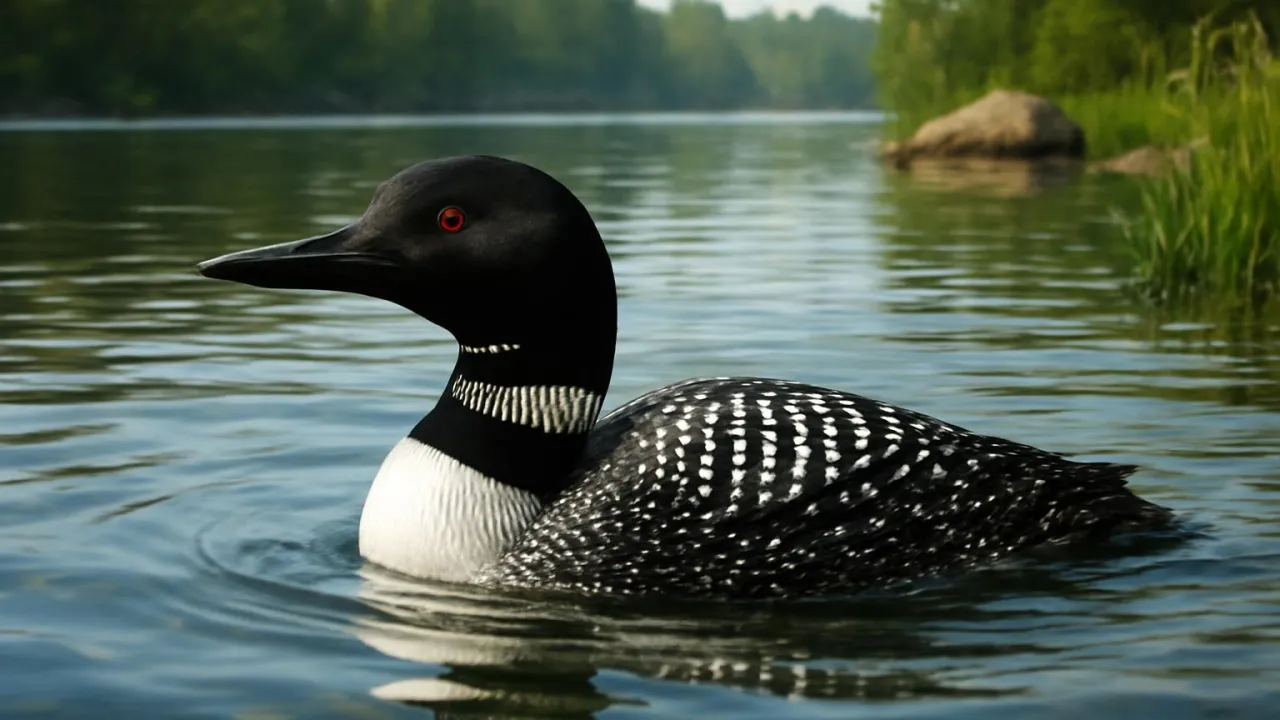
Did you know loons can dive deep underwater to catch fish?
1
What Loons Look Like
Common loons have black and white feathers that help them hide. Their red eyes help them see underwater clearly. They have strong legs placed far back on their bodies to swim fast.
2
Where Loons Live
Loons live on clean lakes and rivers in northern North America. They build close to the water’s edge where they lay eggs. The babies swim soon after they hatch to stay safe.
3
Loon Sounds and Skills
Loons make eerie calls that over the water to communicate. They deep to catch fish using their sharp beaks. Their feet help them swim underwater but make walking on land hard.
The common loon’s haunting calls can travel over a mile across quiet lakes.
✨ Word Sparks (Grade 3 Glossary)
Tap 🔊 to hear
camouflage
Colors that help animals hide in their homes
predator
An animal that hunts other animals for food
nutrients
Food parts that help animals grow and stay healthy
🪝
How does the common loon’s body help it survive underwater?
1
Loon’s Appearance and Adaptations
The common loon has sleek black and white plumage that provides in water. Its red eyes improve underwater vision to spot prey easily. The loon’s legs are set far back on its body, making it a powerful swimmer but awkward on land.
2
Habitat and Life Cycle
Loons inhabit freshwater lakes in northern North America where clean water is essential. They build nests close to shorelines to protect eggs from . After hatching, chicks quickly learn to swim and dive to avoid danger.
3
Loon’s Unique Calls
Loons produce eerie, echoing calls that travel long distances across lakes to communicate with mates or warn of . These vocalizations are important for territory defense and social bonding. Their calls can sound haunting to human listeners.
4
Survival Skills and Diet
Loons catch fish by diving deep underwater using sharp, pointed beaks to grasp prey. Their feet act like paddles, propelling them swiftly through water. This adaptation helps loons avoid and find enough to survive.
1. Why are a loon’s legs set far back on its body?
2. What do loons use their sharp beaks for?
🤯 Mind-Blowing Fact • Grade 4
Loons can dive underwater for up to a minute to catch fish, reaching depths over 200 feet.
✨ Word Sparks (Grade 4 Glossary)
Tap 🔊 to hear
ecosystem
A place where plants and animals live together
territory
An area animals protect as their own home
conservation
Protecting nature and animals from harm
🪝
What role does the common loon play in freshwater lake ecosystems?
1
Physical Adaptations for Survival
The common loon’s black-and-white plumage provides excellent camouflage against the water’s surface, helping it avoid predators. Its legs, located far back on its body, allow strong swimming but make walking on land difficult. This trade-off shows how loons are perfectly adapted for aquatic life. Their webbed feet act like paddles to propel them swiftly underwater.
2
Ecosystem Role and Food Web
Loons are top predators in many freshwater lakes, feeding mainly on fish and aquatic insects. Their hunting helps control fish populations, maintaining balance in the . In turn, loons must avoid predators like eagles and large mammals, showing their place in the food web. This balance supports healthy lake environments.
3
Communication and Behavior
Loons use haunting, echoing calls to communicate and defend territories during breeding season. These calls can travel for miles over calm water, helping mates find each other. Loons also display behaviors like diving and wing-flapping to warn rivals or attract partners. Such vocal and physical signals are vital for survival.
4
Geographic Range and Human Impact
Common loons live across northern North America, especially in Canada and the northern United States. Pollution and habitat loss from human activities threaten loon populations by reducing clean water and nesting areas. efforts focus on protecting lakes and minimizing disturbances. Public awareness helps protect loon habitats.
1. How do loons help keep lake ecosystems balanced?
2. What threatens loon populations the most?
🤯 Mind-Blowing Fact • Grade 5
Common loons can dive over 200 feet deep and stay underwater for nearly a minute to catch prey.
✨ Word Sparks (Grade 5 Glossary)
Tap 🔊 to hear
physiology
How a living thing’s body works and functions
bioindicator
An animal that shows how healthy an environment is
site fidelity
Returning to the same place every year
🪝
How do the common loon’s unique adaptations support its role as an aquatic predator in northern lakes?
1
Scientific Classification and Physical Traits
The common loon, scientifically named Gavia immer, belongs to the family Gaviidae, known for aquatic diving birds. It measures between 28 and 36 inches in length, with a wingspan up to 4.5 feet, and weighs about 7 to 12 pounds. Its striking black-and-white checkered plumage provides camouflage while hunting in water.
2
Physiological Adaptations for Diving
Loons have powerful leg muscles and webbed feet positioned far back on their bodies, enabling efficient underwater propulsion. Their dense bones reduce buoyancy, allowing them to dive as deep as 200 feet and stay submerged for up to one minute while pursuing fish. Their red eyes enhance underwater vision by filtering light wavelengths.
3
Conservation Status and Environmental Challenges
Common loons face threats from habitat degradation, water pollution, and human disturbance, especially during breeding seasons. Lead poisoning from fishing tackle and acid rain affecting lake chemistry also reduce survival rates. Conservation programs emphasize protecting nesting sites and promoting clean freshwater ecosystems.
4
Behavioral Ecology and Communication
Loons communicate using a repertoire of haunting vocalizations including wails, yodels, and tremolos, which serve to establish territories and strengthen pair bonds. These calls can travel several kilometers across calm water surfaces, playing a crucial role during the breeding season. Loons exhibit strong , returning to the same lakes annually.
5
Quantitative Comparisons and Ecological Impact
Compared to other diving birds, the common loon’s diving depth of up to 200 feet is remarkable, surpassing many species. It consumes several pounds of fish daily, influencing fish population dynamics in northern lakes. Loons also serve as , signaling ecosystem health through their presence and breeding success.